
What Is the Volume of a Cube?
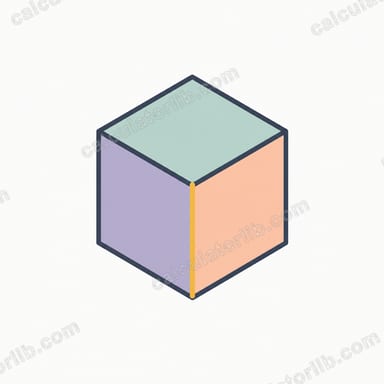
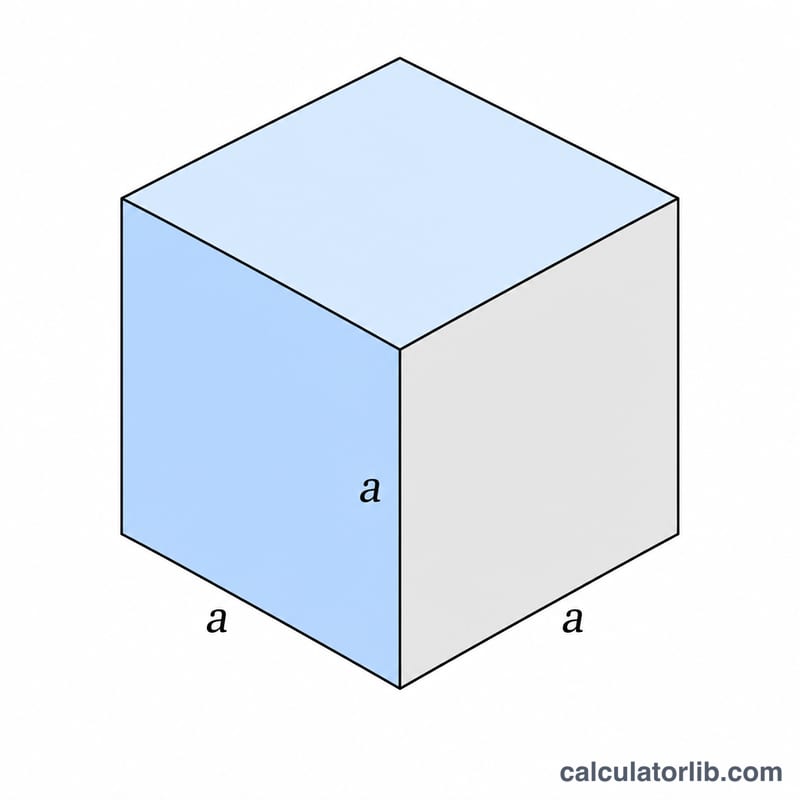
A cube is a three-dimensional solid with six equal square faces. Because every edge has the same length, its volume is found simply by cubing that edge length. This calculator takes a single value — the side length a — and instantly returns the cube's volume, surface area, and space diagonal. It works with any unit of measurement (cm, m, inches, feet) as long as you stay consistent; the output is expressed in the cubed version of whatever unit you entered.
How to Use It
Enter the length of one side of the cube into the input box and the calculator does the rest. There is only one measurement to provide because all edges of a cube are identical. The result panel shows the volume as the headline figure, plus two bonus geometry values: the total surface area and the space diagonal that runs from one corner to the opposite corner through the interior.
The Formula Explained
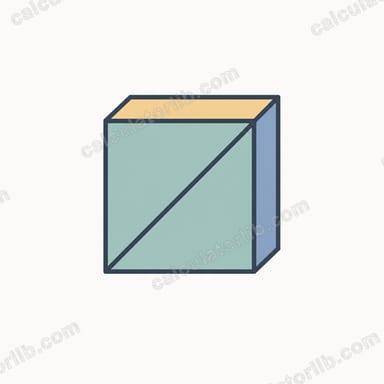
The volume formula is $$V = a^{3}$$ meaning you multiply the side length by itself three times \((a \times a \times a)\). Surface area uses $$A = 6a^{2}$$ because a cube has six identical square faces. The space diagonal is $$d = a\sqrt{3}$$ derived from the 3D Pythagorean theorem.
Worked Example
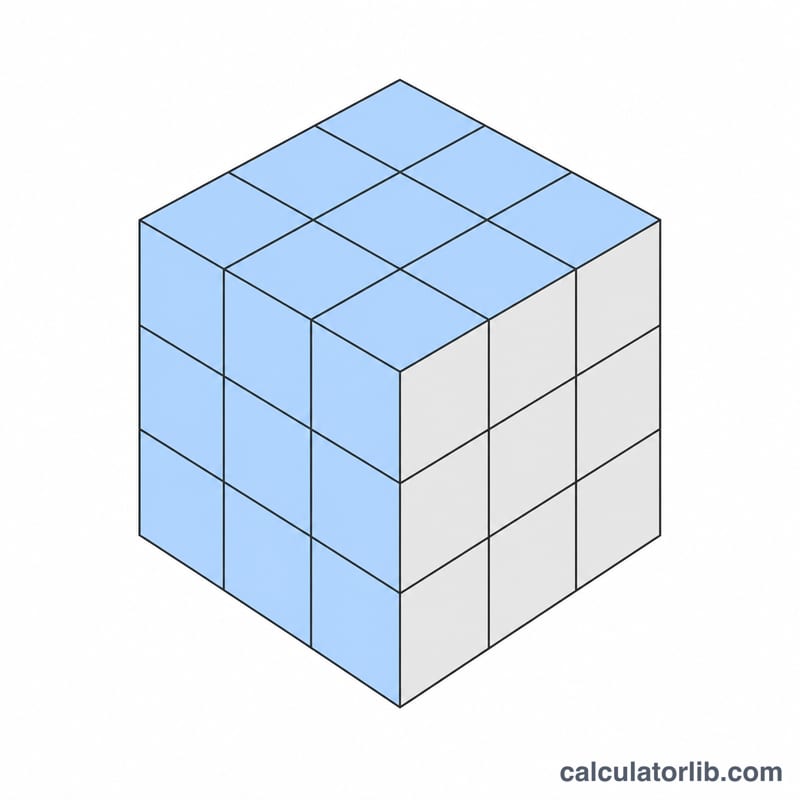
Suppose a cube has a side length of 5 cm. The volume is $$5 \times 5 \times 5 = 125 \text{ cm}^{3}$$ The surface area is $$6 \times 5^{2} = 6 \times 25 = 150 \text{ cm}^{2}$$ The space diagonal is $$5 \times \sqrt{3} \approx 8.66 \text{ cm}$$ A storage box that is 5 cm on every edge therefore holds 125 cubic centimeters.
FAQ
What units does the volume use? Whatever unit you enter for the side, cubed. A side in meters gives volume in cubic meters.
Can the side length be a decimal? Yes. You can enter fractional values like 2.5 and the calculator handles them precisely.
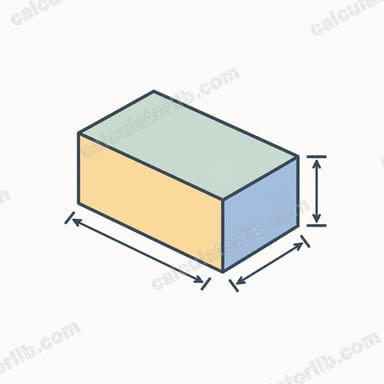
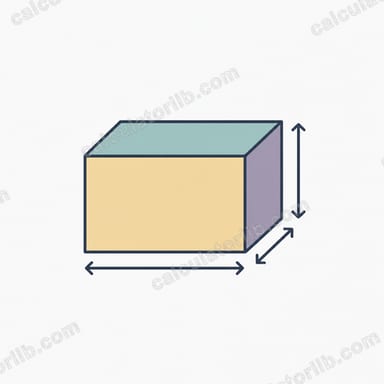
Does this work for a rectangular box? No — a cube requires all sides equal. For a box with different length, width, and height, use a rectangular prism (box) volume calculator instead.