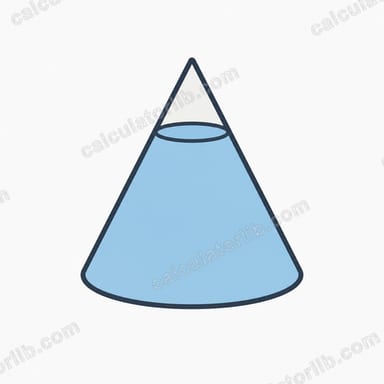

What Is the Volume of a Cone?
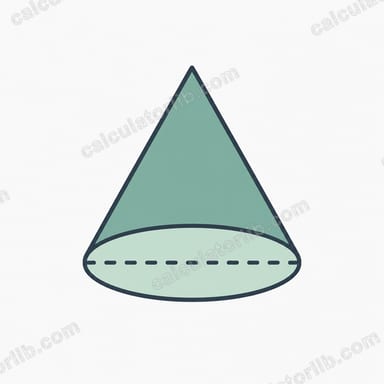
A cone is a three-dimensional shape with a circular base that tapers smoothly to a single point called the apex. Its volume is the amount of space enclosed inside it. This calculator finds that volume from just two measurements: the radius of the circular base and the perpendicular height from the base to the apex.
How to Use This Calculator
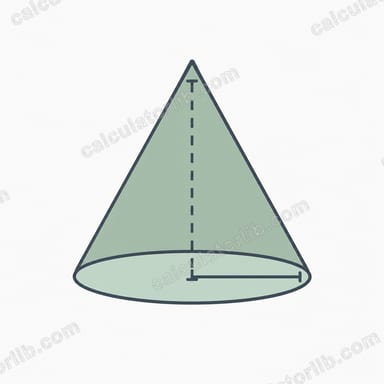
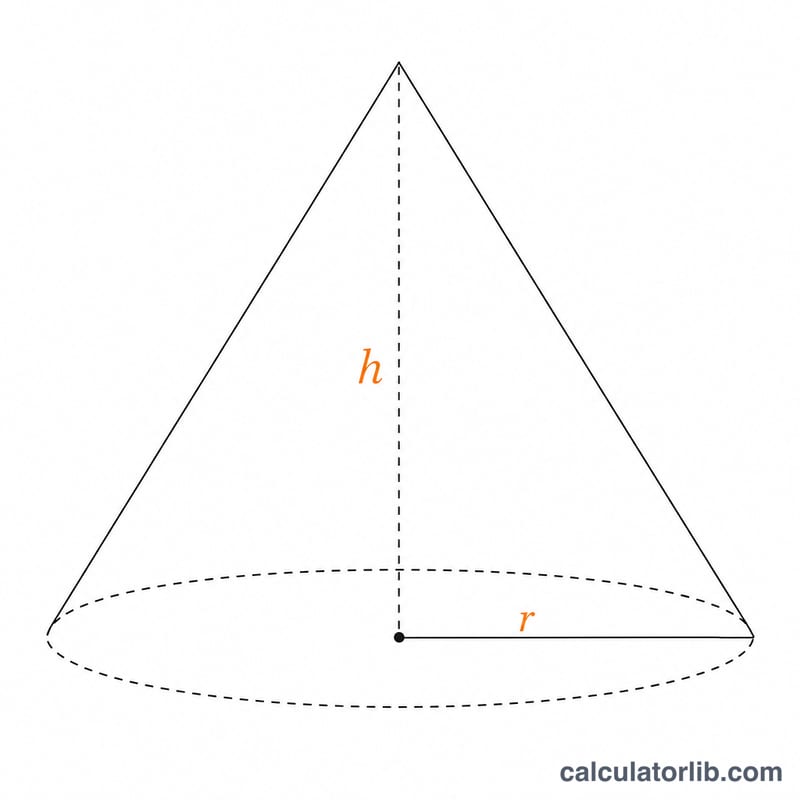
Enter the radius (\(r\)) of the cone's base and the height (\(h\)) measured straight up from the center of the base to the tip. Make sure both values use the same unit (e.g. centimeters). The calculator returns the volume in cubic units, along with the base area and the slant height as bonus values.
The Formula Explained
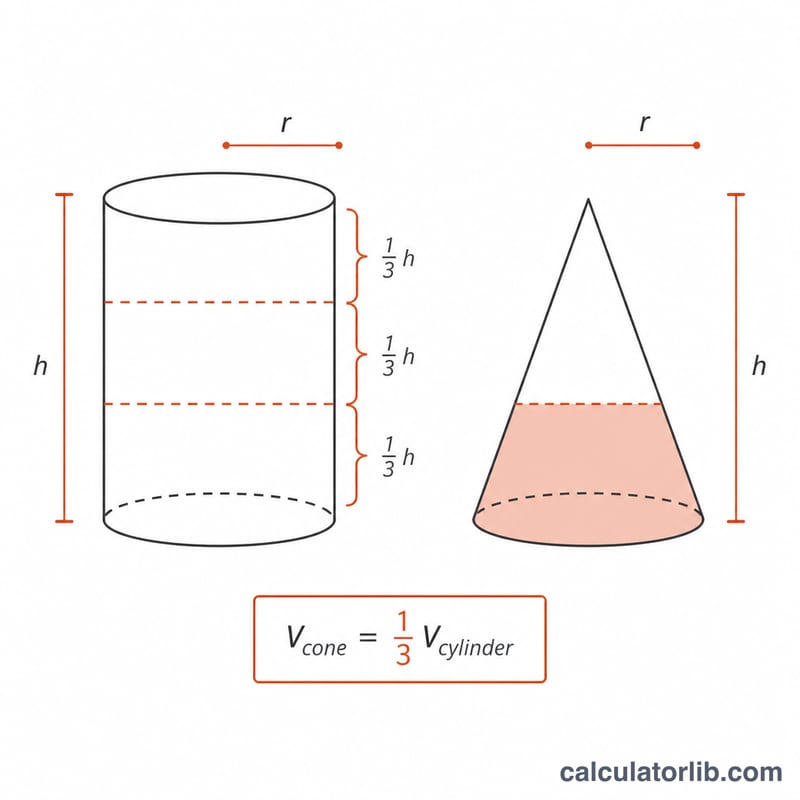
The volume of a cone is given by $$V = \frac{1}{3} \pi \, \text{Radius}^{2} \, \text{Height}$$ The term \(\pi r^{2}\) is the area of the circular base, and multiplying by the height \(h\) would give the volume of a cylinder. A cone holds exactly one-third of that cylinder, which is why we multiply by \(\frac{1}{3}\).
Worked Example
Suppose a cone has a radius of 5 and a height of 10. First find the base area: \(\pi \times 5^{2} = 25\pi \approx 78.54\). Then $$V = \frac{1}{3} \times 78.54 \times 10 \approx 261.8 \text{ cubic units.}$$ The slant height is \(\sqrt{5^{2} + 10^{2}} = \sqrt{125} \approx 11.18\) units.
FAQ
Do radius and height need the same units? Yes. Mixing units (e.g. radius in cm, height in m) gives a meaningless result. Convert both to one unit first.
What is slant height versus height? Height is the straight vertical distance from base to apex. Slant height runs along the cone's slanted surface from a base edge to the apex, and is always longer.
Can I use the diameter instead of the radius? Divide the diameter by 2 first — the formula needs the radius.