
What Is the Magnification Calculator?
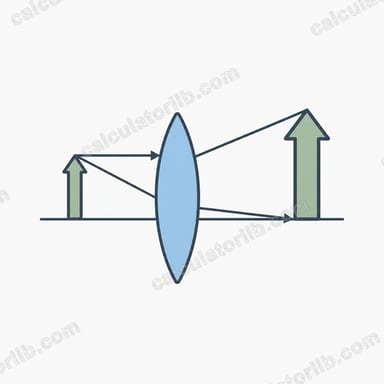
This calculator finds the linear magnification produced by a lens or curved mirror. Magnification (\(M\)) tells you how much larger or smaller an image is compared with the object, and whether the image is upright or inverted. It is a core concept in geometric optics, used in cameras, telescopes, microscopes, eyeglasses, and physics coursework.
How to Use It
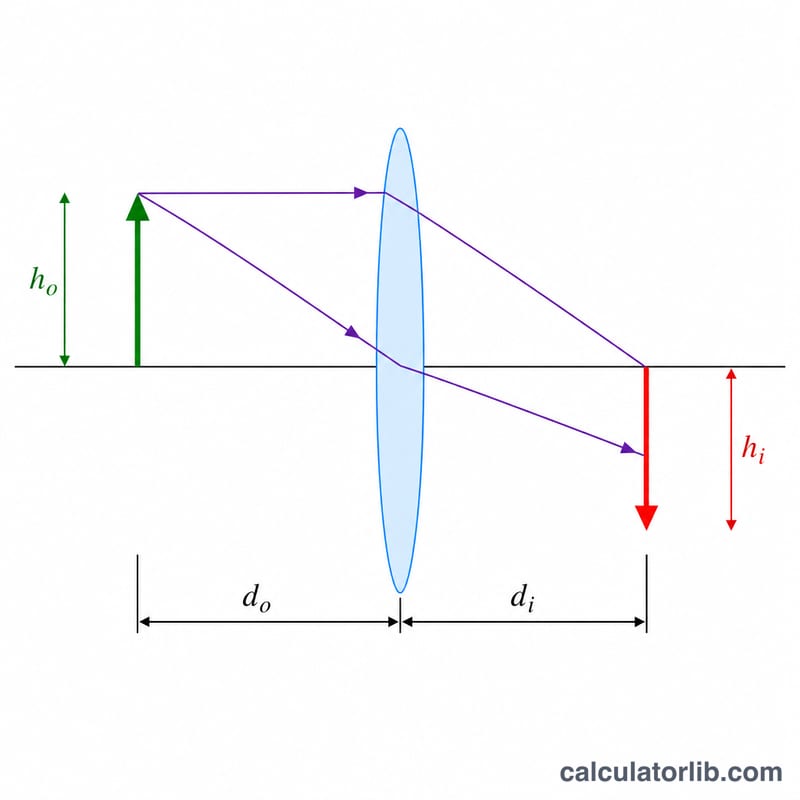
Enter the object distance (\(d_o\)) — the distance from the object to the lens or mirror — and the image distance (\(d_i\)) — the distance from the image to the lens or mirror. Use a consistent sign convention: in the standard convention a real image has a positive \(d_i\) and a virtual image has a negative \(d_i\). The calculator returns \(M\), its magnitude, the image orientation, and whether the image is enlarged or reduced.
The Formula Explained
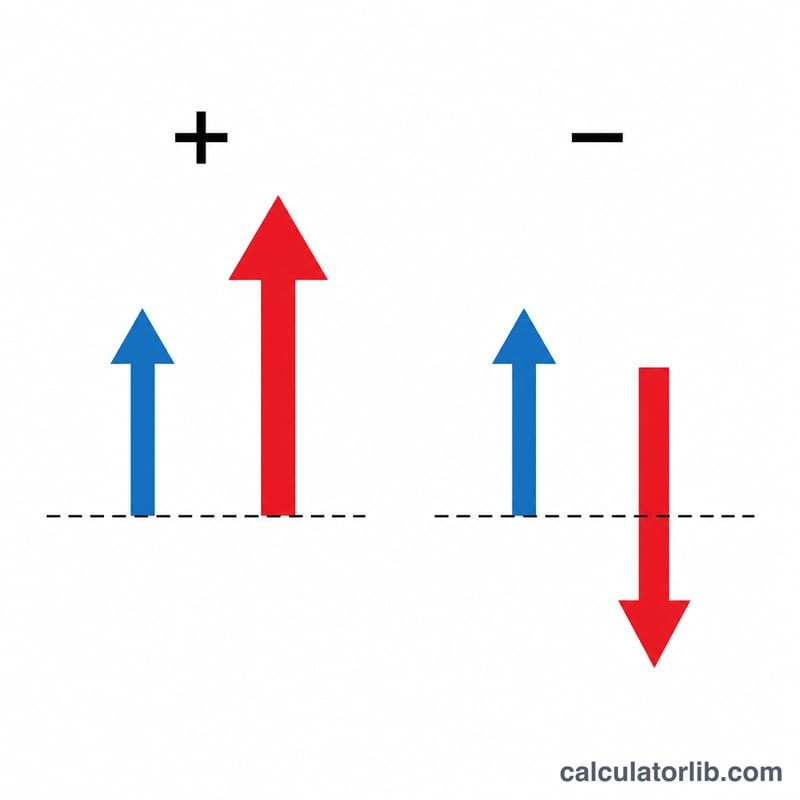
The governing equation is $$M = -\frac{d_i}{d_o} = \frac{h_i}{h_o}$$ The negative sign encodes orientation: a negative \(M\) means the image is inverted (typical of a real image), while a positive \(M\) means the image is upright (typical of a virtual image). The absolute value \(|M|\) gives the size factor — \(|M| > 1\) means the image is enlarged, \(|M| < 1\) means it is reduced, and \(|M| = 1\) means it is the same size as the object.
Worked Example
Suppose an object sits 20 cm in front of a converging lens and the resulting real image forms 60 cm away. Then $$M = -\frac{d_i}{d_o} = -\frac{60}{20} = -3$$ The magnitude is 3, so the image is three times larger than the object, and the negative sign tells us the image is inverted — a real, enlarged, inverted image.
FAQ
What does a negative magnification mean? A negative value means the image is inverted (upside-down) relative to the object, which is characteristic of real images.
What if magnification is between 0 and 1? The image is upright but smaller than the object — a reduced, virtual image, as seen in a convex (diverging) mirror.
Can I use it for mirrors and lenses? Yes. The relation \(M = -\frac{d_i}{d_o}\) applies to both thin lenses and spherical mirrors as long as you follow a consistent sign convention.