
What Is Sound Intensity Level?
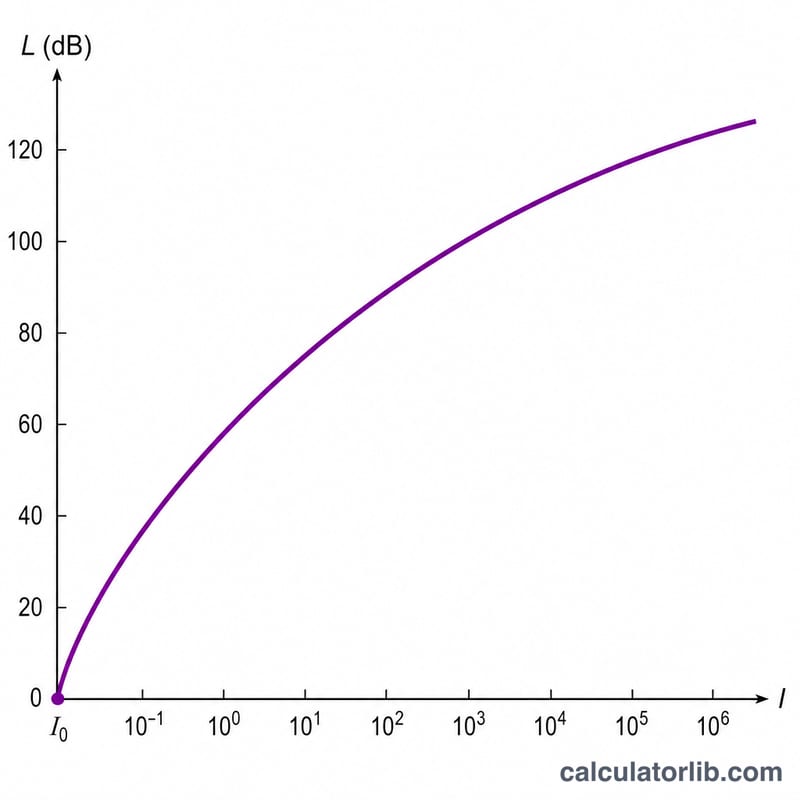
Sound intensity level (SIL) expresses how strong a sound is on a logarithmic decibel (dB) scale relative to a fixed reference. The human ear responds to an enormous range of intensities, so a logarithmic scale compresses that range into manageable numbers. The reference intensity \(I_0 = 1 \times 10^{-12}\ \text{W/m}^2\) corresponds to the quietest sound a healthy young person can detect, which is defined as 0 dB.
How to Use This Calculator
Enter the measured sound intensity \(I\) in watts per square meter (W/m²) and the reference intensity \(I_0\). Leave \(I_0\) at the default 1e-12 W/m² unless you have a specific reference. The calculator returns the sound intensity level in decibels. You can type values in scientific notation such as 1e-6.
The Formula Explained
The sound intensity level is given by $$L = 10 \cdot \log_{10}\!\left(\frac{\text{Intensity } I}{\text{Reference } I_0}\right)$$ The ratio \(I/I_0\) is dimensionless, and taking its base-10 logarithm and multiplying by 10 converts the ratio into decibels. Every tenfold increase in intensity adds 10 dB, so a sound that is 100× more intense is 20 dB higher.
Worked Example
Suppose normal conversation has an intensity of \(I = 1 \times 10^{-6}\ \text{W/m}^2\). With \(I_0 = 1 \times 10^{-12}\ \text{W/m}^2\), the ratio is \(10^6\), so $$L = 10 \cdot \log_{10}(10^6) = 10 \times 6 = 60\ \text{dB}$$ — a typical conversational level.
FAQ
Why is 0 dB not silence? 0 dB is the threshold of hearing, not zero sound energy. Sounds below this exist but are inaudible to most people.
What is a safe sound level? Prolonged exposure above 85 dB can cause hearing damage; levels around 120 dB are painful.
Can the level be negative? Yes. If the intensity is below the reference (\(I < I_0\)), the logarithm is negative, giving a negative dB value.