
What the Viscosity Index Calculator Does
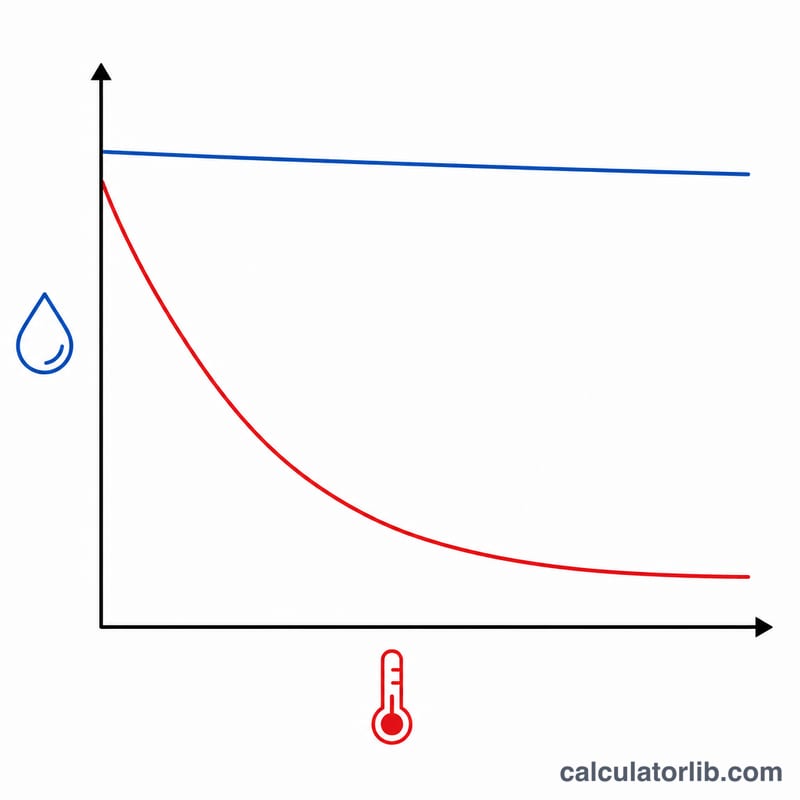
The Viscosity Index (VI) is a dimensionless number that describes how much a lubricant's viscosity changes with temperature. A high VI means the oil stays relatively stable as temperature rises and falls, while a low VI means it thins dramatically when heated. This calculator works out the VI from just two laboratory measurements: the kinematic viscosity of your oil at 40°C and at 100°C. It is widely used in engineering, automotive maintenance, and lubricant manufacturing to compare oils and confirm they meet specification.
The Two Inputs You Need
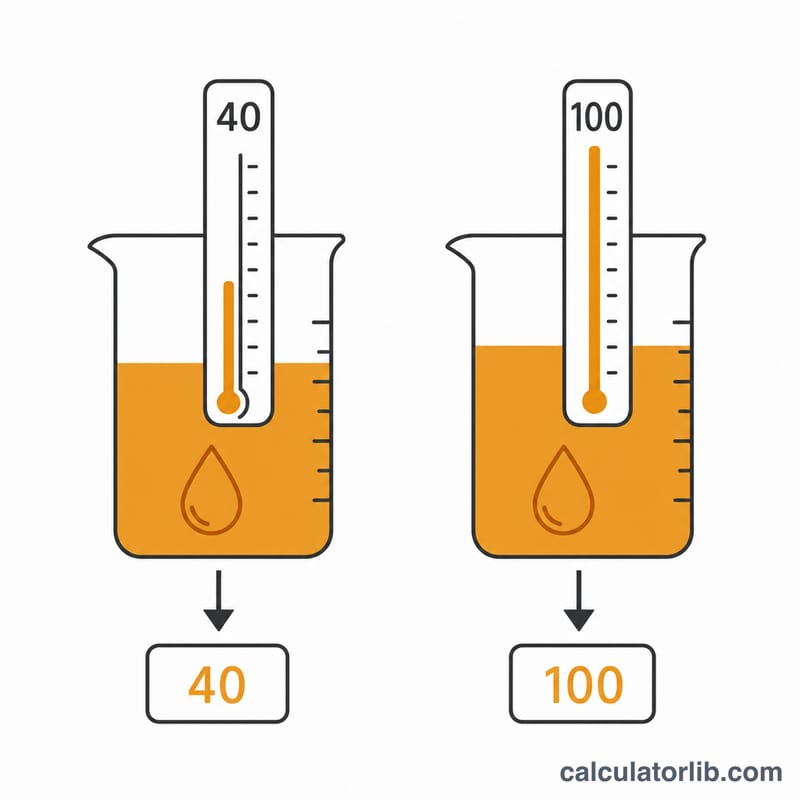
- Kinematic Viscosity at 40°C (cSt) — the oil's flow resistance at the lower reference temperature, in centistokes.
- Kinematic Viscosity at 100°C (cSt) — the same measurement at the higher reference temperature.
Both values are normally obtained from a standard test (such as ASTM D445) and are printed on most oil data sheets.
The Formula Explained
The calculator follows the established ASTM D2270 method for oils with a VI under 100. Using your 40°C value (v40) and 100°C value (v100):
- L = \(0.8353 \times v_{40}^{2} - 14.67 \times v_{40} - 216\) (viscosity at 40°C of a reference oil with VI = 0)
- H = \(0.1684 \times v_{40}^{2} - 11.85 \times v_{40} - 97\) (viscosity at 40°C of a reference oil with VI = 100)
- U = \(10^{\left(\frac{v_{100} - 0.7}{0.2}\right)} - 1\)
- VI = \((\log H - \log U) \div (\log H - \log L) \times 100\)
In plain terms, the formula compares your oil against two reference oils that bracket its behaviour, then expresses where it falls between them.
$$\text{VI} = \frac{\log_{10} H - \log_{10} U}{\log_{10} H - \log_{10} L} \times 100$$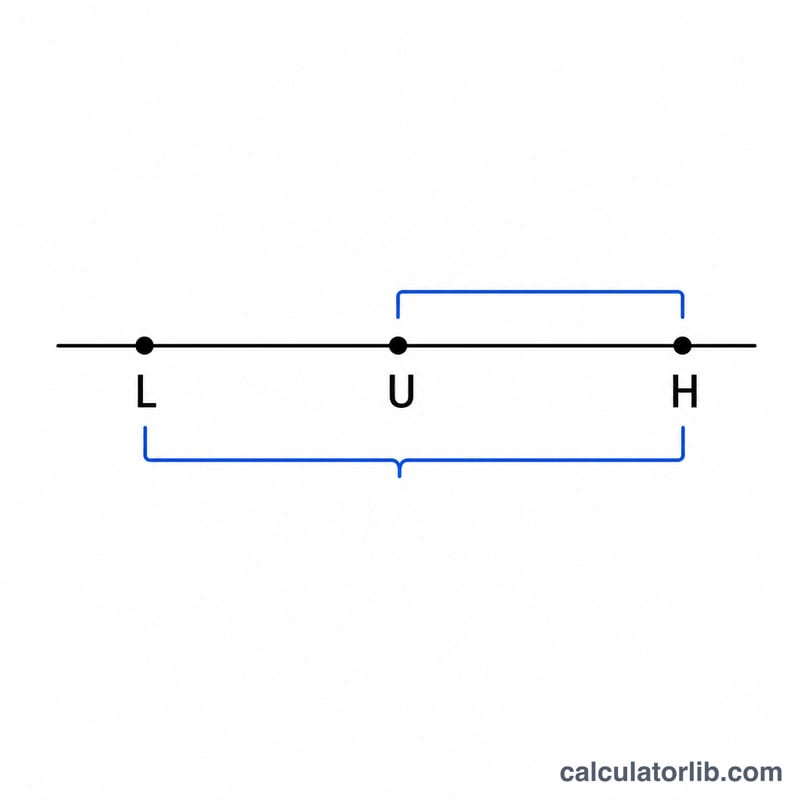
Worked Example
Suppose an oil measures v40 = 73 cSt and v100 = 8.6 cSt. Then \(L = 0.8353 \times 5329 - 14.67 \times 73 - 216 \approx 3163\), \(H = 0.1684 \times 5329 - 11.85 \times 73 - 97 \approx 36.3\), and \(U = 10^{\left(\frac{8.6 - 0.7}{0.2}\right)} - 1\), which is a very large number. Plugging into the VI equation gives an index in the low-to-mid range, telling you the oil's viscosity is fairly sensitive to temperature.
Frequently Asked Questions
What is a good Viscosity Index? Premium multigrade engine oils often exceed 120, while basic mineral oils may sit around 90–100. Higher is generally better for varying temperatures.
What units should I enter? Use centistokes (cSt) for both inputs, measured at exactly 40°C and 100°C, so the result matches industry references.
Does this work for oils with VI over 100? This tool uses the standard interpolation formula. For very high-VI oils, an extended ASTM D2270 calculation is technically required, so treat high results as approximate.