
What Is a Bolt Circle Calculator?
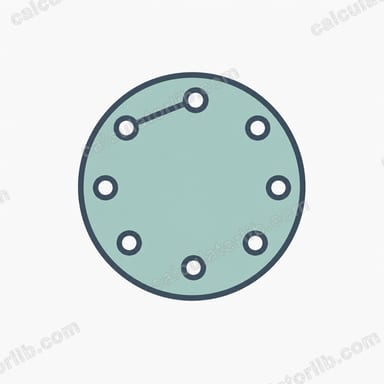
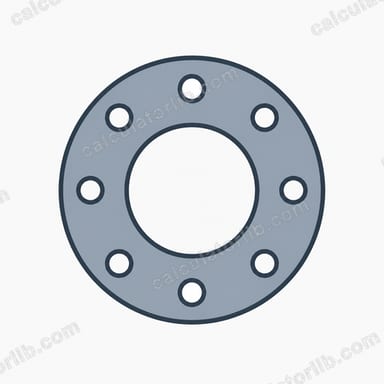
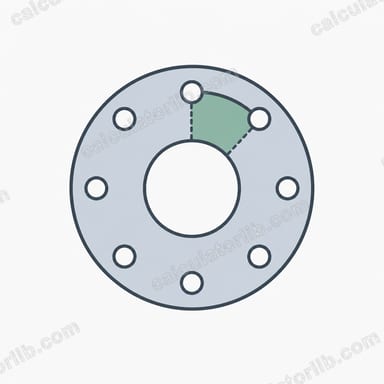
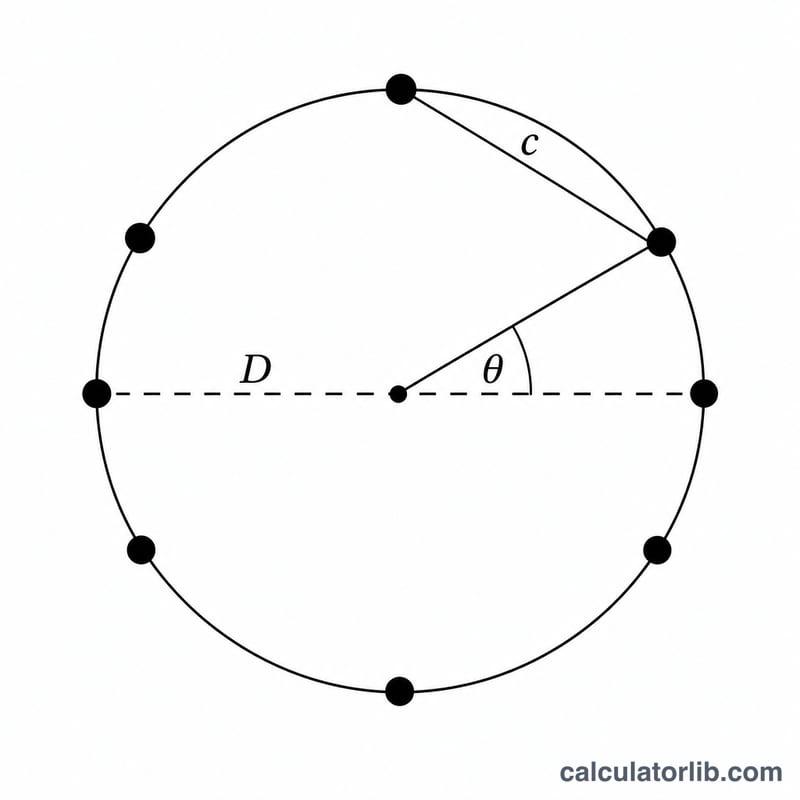
A bolt circle calculator helps you lay out evenly spaced holes around a circle. Given the bolt circle diameter (BCD) — the diameter of the imaginary circle that passes through the center of each bolt hole — and the number of bolts, it instantly returns two key values: the angle between adjacent bolts and the chord length, which is the straight-line distance between the centers of two neighboring holes. These figures are essential in machining, fabrication, flange design, wheel manufacturing, and any task requiring a precise circular hole pattern.
How to Use It
- Enter the bolt circle diameter (the through-center diameter of your hole pattern).
- Enter the number of bolts (holes) you want equally spaced.
- Read off the angle between bolts and the chord length.
- Use the angle to mark positions and the chord length to verify spacing with calipers or a tape measure.
The Formulas Explained
The bolts are spread evenly around 360 degrees, so the angle between any two adjacent bolts is simply:
- Angle = \(\dfrac{360}{N}\), where \(N\) is the number of bolts.
The chord length — the spacing between neighboring bolt centers — uses basic trigonometry. With diameter \(D\) and number of bolts \(N\):
- Chord = \(D \times \sin\!\left(\dfrac{180}{N}\right)\), where the angle inside sin is in degrees.
The chord is shorter than the arc length along the circle and is the value you actually measure across a straight line between two holes.
Worked Example
Suppose you have a flange with a 100 mm bolt circle diameter and 6 bolts.
- Angle = $$360 \div 6 = 60$$ degrees between each bolt.
- Chord = $$100 \times \sin\!\left(\frac{180}{6}\right) = 100 \times \sin(30^{\circ}) = 100 \times 0.5 = 50 \text{ mm}.$$
So each hole sits 60 degrees apart, and the center-to-center distance between adjacent holes is 50 mm.
Common Bolt Circle Patterns Reference
The angle between adjacent bolts depends only on the number of bolts: \(\theta = 360^{\circ}/N\). The chord (straight-line distance between two adjacent bolt centers) is found by multiplying the bolt circle diameter (BCD) by a chord factor equal to \(\sin(180^{\circ}/N)\). So once you know the factor, the spacing is simply:
$$C = \text{BCD}\times\sin\!\left(\frac{180^{\circ}}{N}\right)$$
The table below lists the angle and chord factor for the most common evenly spaced patterns. Multiply the factor by your actual BCD to get the chord length.
| Bolts (N) | Angle between bolts | Chord factor \(\sin(180^{\circ}/N)\) |
|---|---|---|
| 3 | 120° | 0.8660 |
| 4 | 90° | 0.7071 |
| 5 | 72° | 0.5878 |
| 6 | 60° | 0.5000 |
| 8 | 45° | 0.3827 |
| 10 | 36° | 0.3090 |
| 12 | 30° | 0.2588 |
For example, a 6-bolt pattern gives an angle of 60° between adjacent holes, and the chord factor of 0.5000 means the spacing equals exactly half the diameter — a handy mental check.
FAQ
Does the calculator work in inches and millimeters? Yes. The chord length comes out in the same unit you enter for the diameter, so use either consistently.
What is the difference between chord length and arc length? The chord is the straight distance between two adjacent hole centers, while the arc is the curved distance along the circle. For layout and measuring with a ruler, you want the chord length.
Can I find the diameter if I know the chord? Yes — rearrange the formula: \(D = \text{Chord} \div \sin\!\left(\frac{180}{N}\right)\). This is handy when reverse-engineering an existing pattern.