
What Is a Crosswind Calculator?
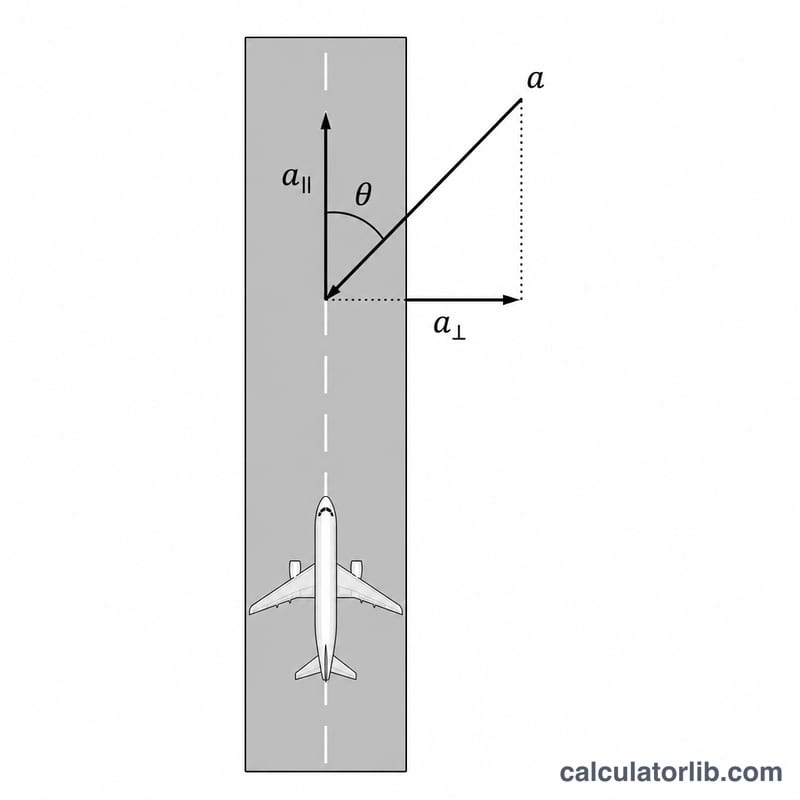
A crosswind calculator breaks the reported wind into two parts relative to the runway: the crosswind component (blowing across the runway) and the headwind or tailwind component (blowing along the runway). Pilots use these numbers to decide whether a takeoff or landing is within the aircraft's demonstrated crosswind limit and to anticipate ground speed and control inputs. This tool is used worldwide and follows standard aviation conventions — wind speed in knots and all directions in degrees magnetic or true (be consistent with your reporting source).
How to Use It
- Wind speed – enter the reported wind velocity in knots.
- Wind direction – the direction the wind is coming from, in degrees (000–360).
- Runway heading – the runway's magnetic heading in degrees (for example, Runway 09 = 090°).
The calculator returns the crosswind component, the headwind component (positive) or tailwind (negative), and the wind angle off the runway. Compare these against your aircraft's published maximum demonstrated crosswind and any tailwind limit.
The Formula Explained
First find the angle between the wind and the runway:
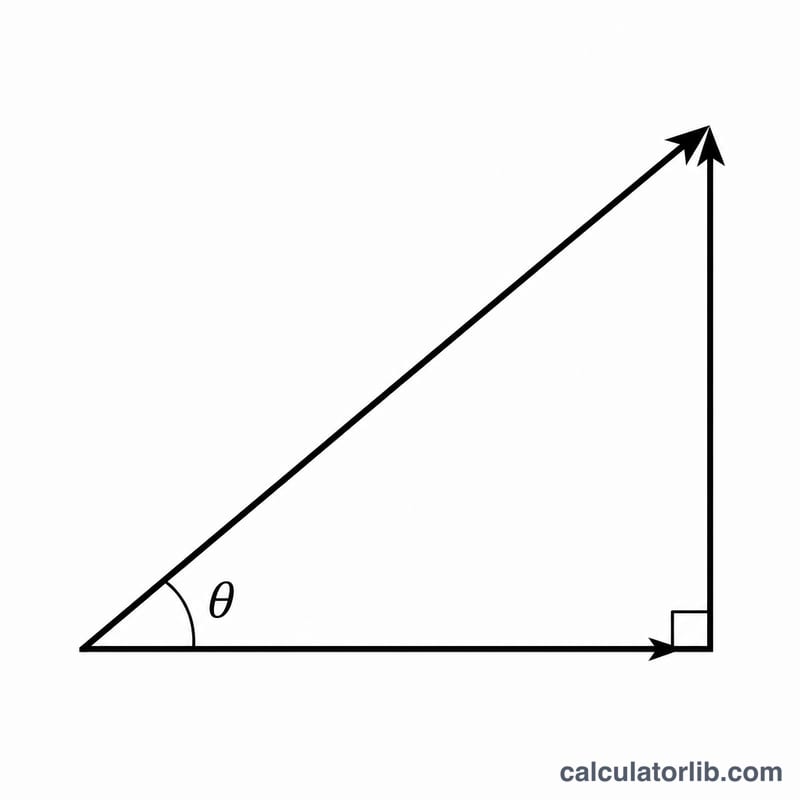
$$\text{Crosswind} = V \cdot \sin(\theta) \qquad \text{Headwind} = V \cdot \cos(\theta)$$
$$\text{where}\quad \left\{ \begin{aligned} V &= \text{Wind Speed (kt)} \\ \theta &= \text{Wind Direction} - \text{Runway Heading} \end{aligned} \right.$$
- Angle = Wind direction − Runway heading (normalised to 0–180°)
- Crosswind = Wind speed × sin(angle)
- Headwind = Wind speed × cos(angle)
A positive cosine result means a headwind; a negative result means a tailwind. The sine term is always treated as a positive crosswind magnitude, with the direction (left or right) determined by which side the wind is on.
Worked Example
Suppose the wind is 20 knots from 120°, and you are landing on Runway 09 (heading 090°). The angle off the runway is 120 − 90 = 30°.
- Crosswind = \(20 \times \sin(30°) = 20 \times 0.5 = \textbf{10 knots}\)
- Headwind = \(20 \times \cos(30°) = 20 \times 0.866 = \textbf{17.3 knots}\)
So you have a 10-knot crosswind and a 17.3-knot headwind — well within most light-aircraft limits.
FAQ
What is a typical crosswind limit? Many light aircraft list a maximum demonstrated crosswind of 12–17 knots, but always check your specific aircraft's flight manual.
Is the result a hard limit? The "maximum demonstrated" crosswind is a tested value, not a regulatory limit, but exceeding it requires skill and good judgement.
Should I use true or magnetic direction? Match both wind and runway in the same reference. ATIS and tower winds are typically magnetic, matching runway numbers.