
What Is a Wind Component Calculator?
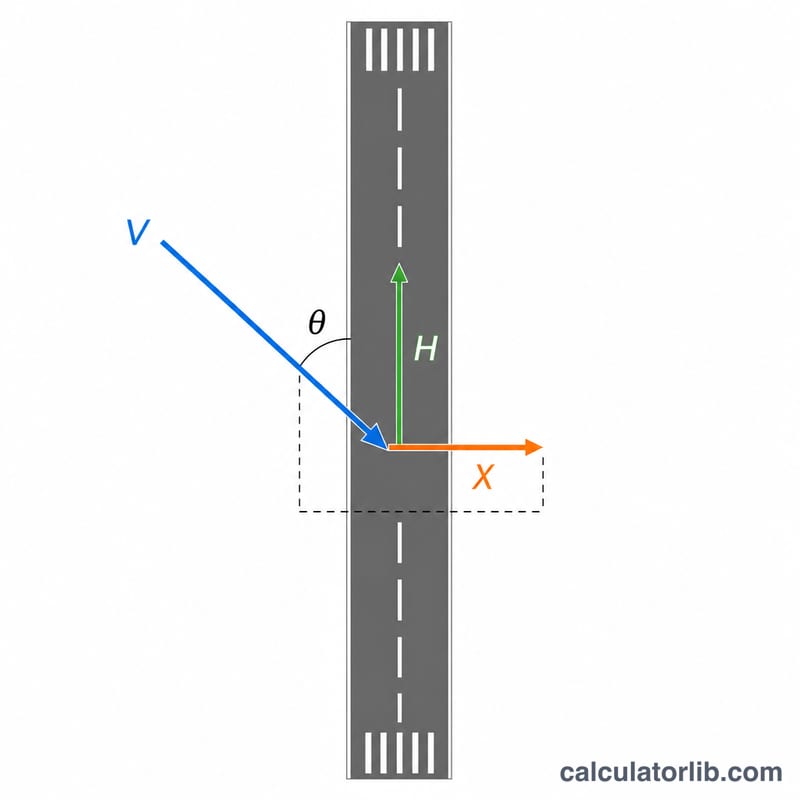
When flying, the wind rarely blows straight down the runway. Instead it strikes at an angle, splitting into two parts: a headwind/tailwind component aligned with the runway, and a crosswind component perpendicular to it. This calculator resolves a reported wind into those two components so pilots can verify the takeoff or landing is within aircraft and personal limits.
How to Use It
Enter the wind speed in knots, the direction the wind is coming from (in degrees, 0–360), and the runway heading (the magnetic direction the runway points, e.g. runway 09 = 090°). The calculator computes the headwind component (positive = headwind, negative = tailwind) and the crosswind magnitude, plus which side the crosswind comes from.
The Formula Explained
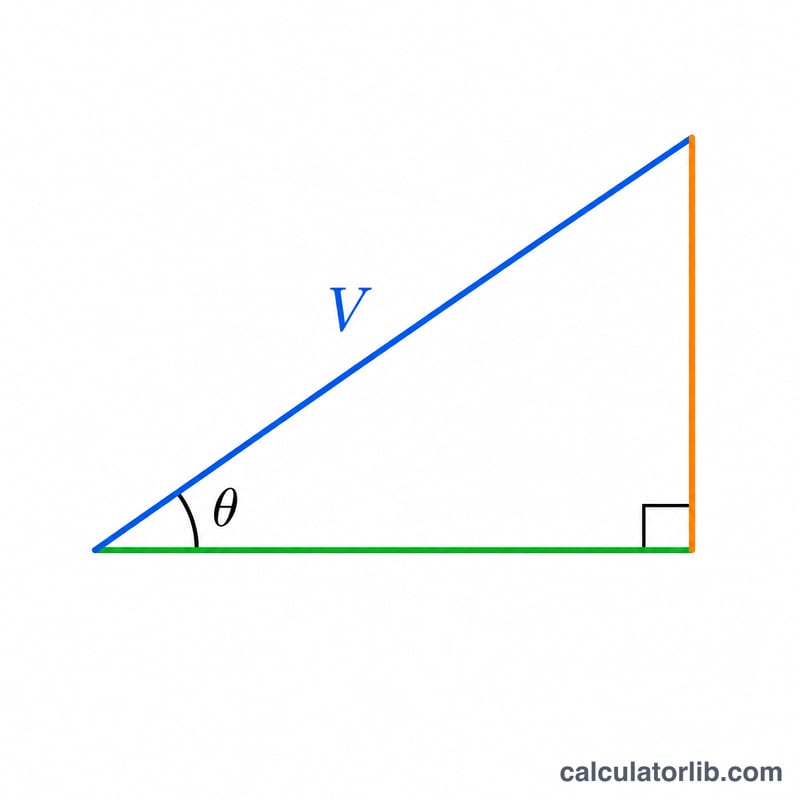
Let \(\theta\) be the angle between the wind direction and the runway heading (\(\theta = \text{wind direction} - \text{runway heading}\)). Then:
$$\text{Headwind} = V \cos\theta, \qquad \text{Crosswind} = V \sin\theta$$where \(V\) is wind speed. When \(\theta = 0^\circ\) the wind is straight down the runway (pure headwind). When \(\theta = 90^\circ\) it is a pure crosswind. A negative cosine means a tailwind.
Worked Example
Suppose the wind is 20 knots from 120°, and the runway heading is 090°. The angle \(\theta = 120 - 90 = 30^\circ\). \(\text{Headwind} = 20 \times \cos(30^\circ) = 20 \times 0.8660 = 17.32\) knots. \(\text{Crosswind} = 20 \times \sin(30^\circ) = 20 \times 0.5 = 10\) knots from the right. So you face a 17.3-knot headwind and a 10-knot right crosswind.
FAQ
What does a negative headwind mean? A negative headwind component is a tailwind, which lengthens takeoff and landing distances.
Which side is the crosswind from? If the wind direction is clockwise of the runway heading (\(\theta\) positive), the crosswind is from the right; if counter-clockwise, from the left.
What units should I use? Wind speed can be any consistent unit (knots is standard in aviation); the components come out in the same unit. Angles are in degrees.