
What Is Gross Margin Percentage?
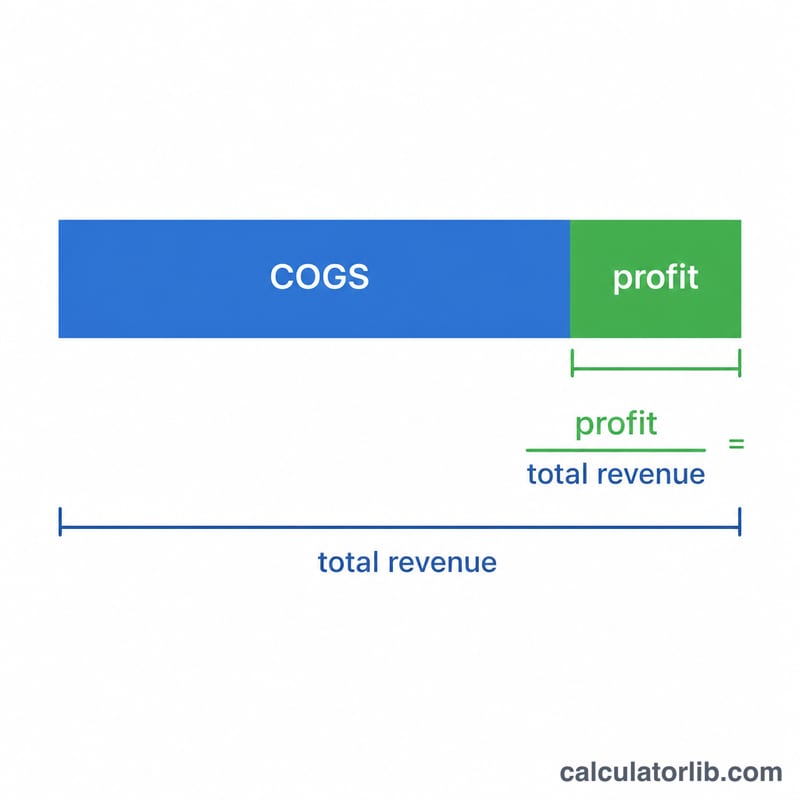
Gross margin percentage measures how much of every dollar of revenue a business keeps after paying the direct costs of producing its goods or services (the cost of goods sold, or COGS). It is one of the most important profitability ratios because it shows how efficiently a company turns sales into gross profit before operating expenses, taxes, and interest. A higher gross margin means more money is available to cover overhead and generate net profit.
How to Use This Calculator
Enter your total Revenue (net sales for the period) and your Cost of Goods Sold (direct materials, direct labor, and other production costs). The calculator instantly returns your gross margin percentage along with the gross profit in dollars. Use it to track trends over time, compare product lines, or benchmark against competitors.
The Formula Explained
The formula is $$\text{Gross Margin \%} = \frac{\text{Revenue} - \text{COGS}}{\text{Revenue}} \times 100$$ First subtract COGS from revenue to get gross profit, then divide by revenue and multiply by 100 to express it as a percentage. Note that margin is always calculated on revenue (not cost) — that is what distinguishes it from markup.
Worked Example
Suppose a shop has revenue of $10,000 and COGS of $6,000. Gross profit is \($10{,}000 - $6{,}000 = $4{,}000\). Gross margin is $$\frac{\$4{,}000}{\$10{,}000} \times 100 = \textbf{40\%}$$ The business keeps 40 cents of gross profit for every dollar of sales.
FAQ
What is the difference between margin and markup? Margin is profit as a percentage of selling price (revenue), while markup is profit as a percentage of cost. A 40% margin equals a higher markup percentage.
What is a good gross margin? It varies widely by industry — software firms often exceed 70%, while grocery stores may run below 25%. Compare within your sector.
Can gross margin be negative? Yes. If COGS exceeds revenue, gross profit and the margin percentage are negative, signaling you are selling below the direct cost of production.