
What is the TAM SAM SOM Calculator?
Market sizing is one of the first things investors and founders look at when evaluating an opportunity. This calculator breaks a market into three nested layers: TAM (Total Addressable Market) — total demand if you captured 100% of the market; SAM (Serviceable Available Market) — the segment you can realistically reach with your current product, geography and business model; and SOM (Serviceable Obtainable Market) — the slice of SAM you can win in the short to medium term given competition and capacity.
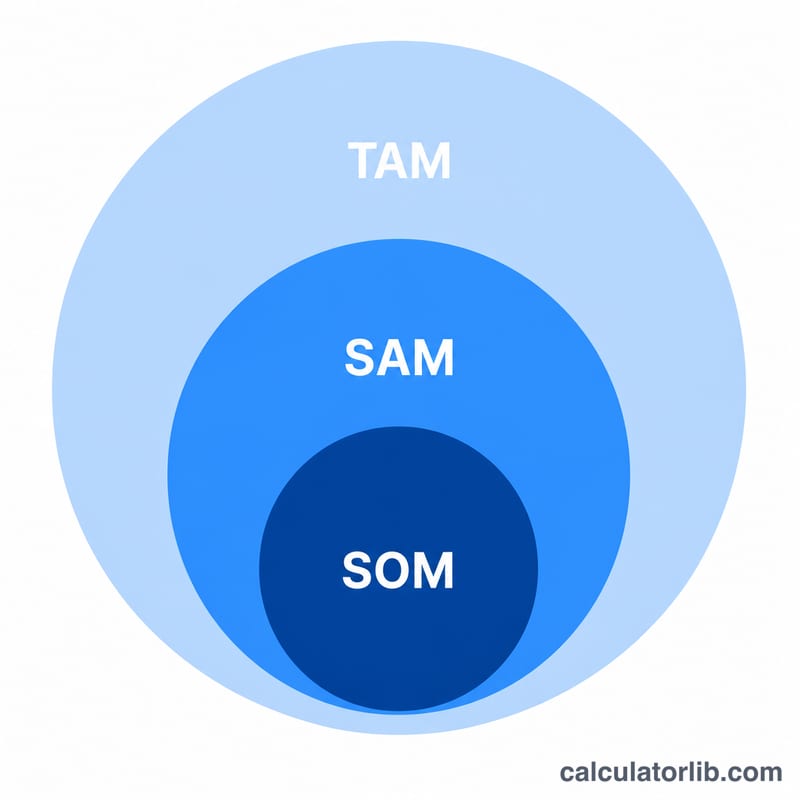
How to use it
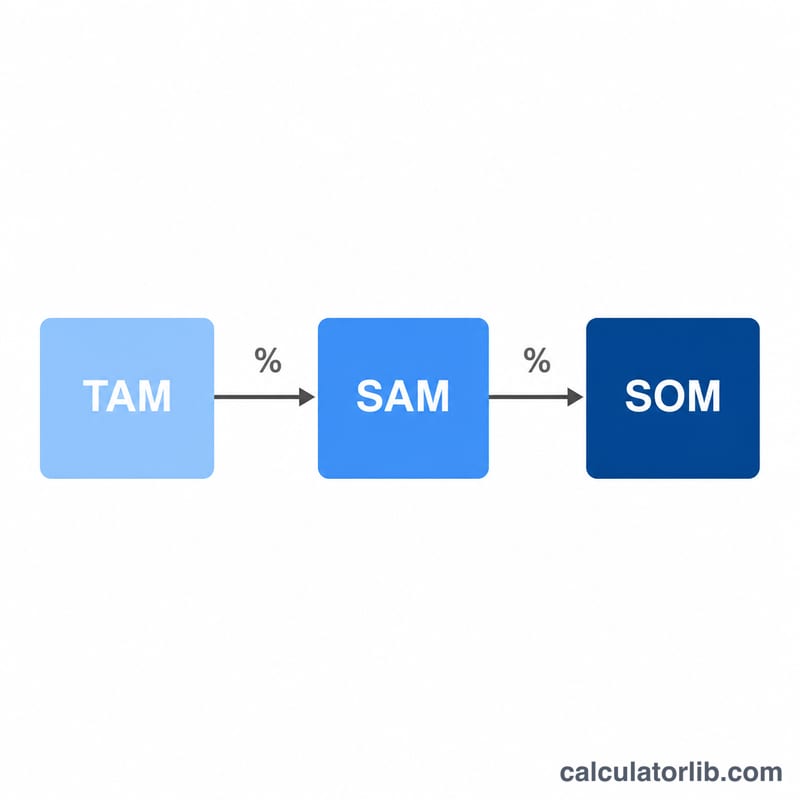
Enter your Total Addressable Market as a revenue or unit figure (any currency works — keep it consistent). Set the percentage of that market that is serviceable for your offering, and then the percentage of that serviceable market you expect to obtain. The calculator returns SAM, SOM, and SOM expressed as a percentage of TAM so you can sanity-check your assumptions.
The formula explained
SAM is simply TAM multiplied by the serviceable percentage divided by 100. SOM is SAM multiplied by the obtainable share percentage divided by 100. Because each layer is a fraction of the one above it, SOM is always the smallest number — a reality check against over-optimistic projections.
$$\text{SAM} = \text{TAM} \times \frac{\text{Serviceable \%}}{100}$$
$$\text{SOM} = \text{SAM} \times \frac{\text{Obtainable \%}}{100}$$
Worked example
Suppose your TAM is $1,000,000,000. You judge that 40% of that market is serviceable, giving a SAM of $400,000,000. If you can realistically capture 10% of that serviceable market, your SOM is $40,000,000 — which is 4% of the original TAM.
$$\text{SAM} = 1{,}000{,}000{,}000 \times \frac{40}{100} = 400{,}000{,}000$$
$$\text{SOM} = 400{,}000{,}000 \times \frac{10}{100} = 40{,}000{,}000$$
FAQ
Should TAM be in revenue or units? Either works, as long as you keep all three layers in the same unit. Revenue (annual) is most common for pitch decks.
What is a realistic obtainable share? For early-stage startups, SOM is often 1–10% of SAM in the first few years. Use conservative numbers you can defend.
Is this method top-down or bottom-up? TAM-SAM-SOM is a top-down approach. Validate it against a bottom-up estimate (customers × price) for credibility.