
What Is Return on Investment (ROI)?
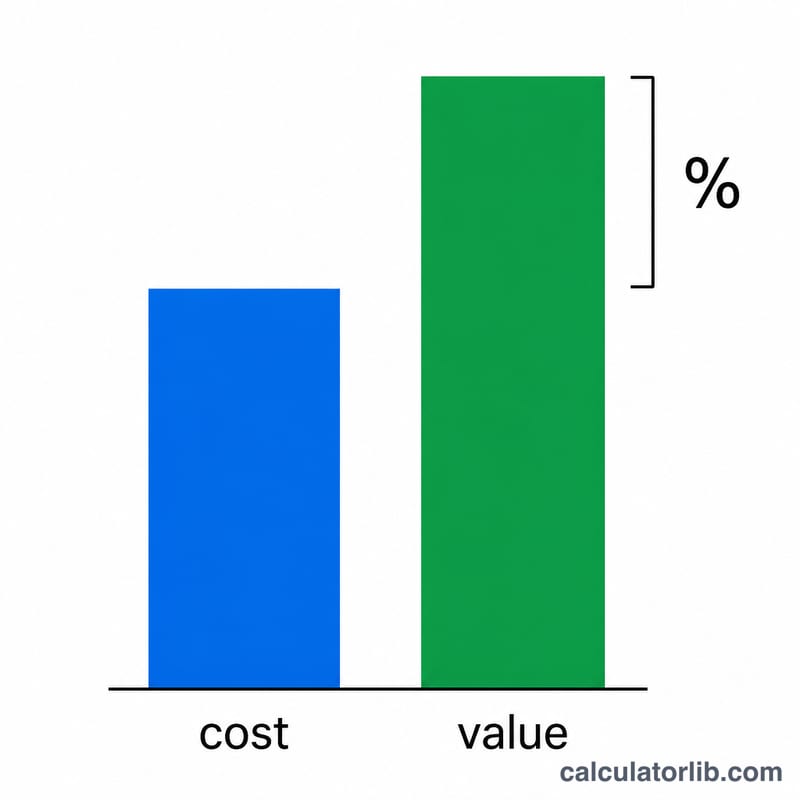
Return on investment (ROI) is a simple, widely used metric that measures how profitable an investment is relative to its cost. Expressed as a percentage, it lets you compare very different opportunities — stocks, real estate, marketing campaigns, or a small business — on a level playing field. A positive ROI means you made money; a negative ROI means you lost money.
How to Use This Calculator
Enter two numbers: the initial investment (cost) you put in, and the final value (gain) you received back. The calculator instantly returns your ROI percentage along with the net profit in money terms. Use the same currency for both fields. The "final value" should be the total amount you ended up with, not just the profit.
The Formula Explained
ROI is calculated as:
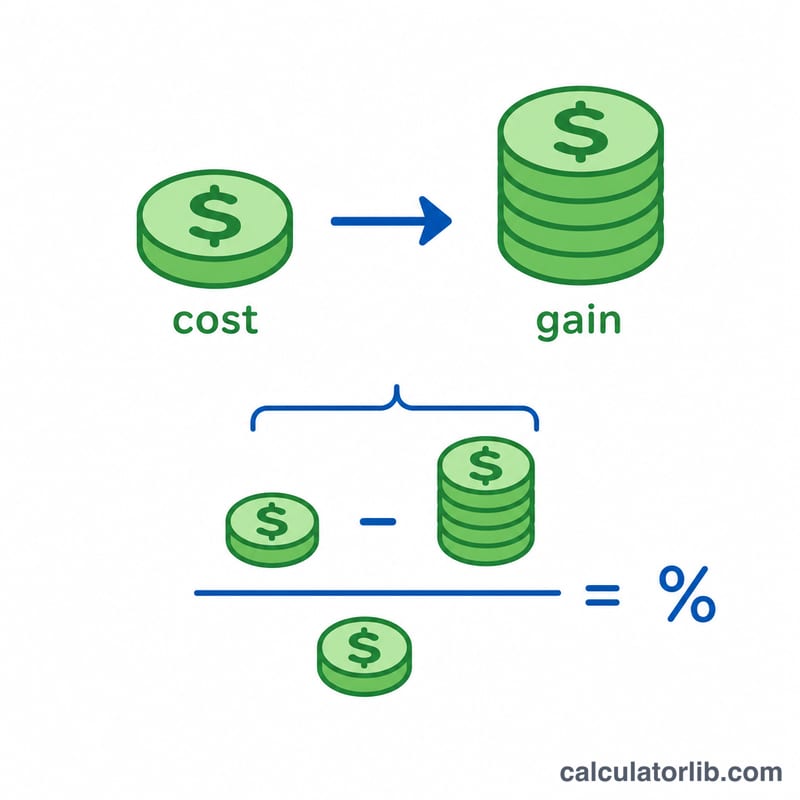
$$\text{ROI}\% = \frac{\text{Gain} - \text{Cost}}{\text{Cost}} \times 100$$
First subtract the cost from the final value to get net profit. Then divide that profit by the original cost and multiply by 100 to convert it into a percentage. Because it is normalized by cost, a $50 profit on a $100 investment (50%) is clearly better than a $50 profit on a $1,000 investment (5%).
Worked Example
Suppose you buy shares for $1,000 and later sell them for $1,200. Your net profit is $$\$1{,}200 - \$1{,}000 = \$200.$$ Your ROI is $$\$200 \div \$1{,}000 \times 100 = 20\%.$$ That means you earned 20 cents for every dollar invested.
FAQ
Does ROI account for time? No. Basic ROI ignores how long you held the investment. To compare investments over different periods, look at annualized ROI or CAGR.
Can ROI be negative? Yes. If the final value is less than the cost, ROI is negative, indicating a loss.
What's a good ROI? It depends on the asset and risk. Historically, broad stock market returns average roughly 7–10% per year, but riskier ventures may target higher returns.