
What Is the Investment Calculator?
The Investment Calculator projects how much an investment could be worth in the future. It combines an initial lump-sum deposit with regular periodic contributions and applies compound interest at a frequency you choose. The result shows your projected future value along with how much came from contributions versus interest growth.
How to Use It
Enter your initial investment, the amount you plan to add each period, the expected annual interest rate as a percentage, the number of years you will invest, and how often interest compounds (monthly is common). The calculator instantly returns the future value, total amount contributed, and total interest earned.
The Formula Explained
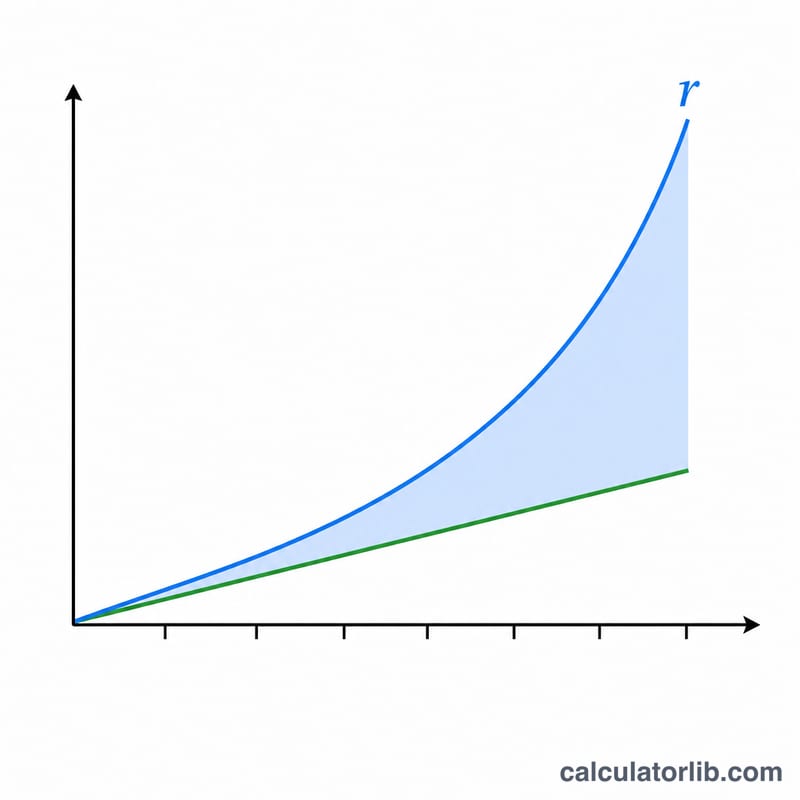
The future value combines two parts. The first, \(P(1+r)^n\), grows your initial principal at the periodic rate \(r\) over \(n\) periods. The second term applies the future-value-of-an-annuity formula to your recurring contributions:
$$FV = P(1+r)^n + PMT \cdot \dfrac{(1+r)^n - 1}{r}$$Here \(r\) equals the annual rate divided by the number of compounding periods per year, and \(n\) equals the periods per year multiplied by the number of years.
$$r = \dfrac{\text{annualRate}}{\text{periods}}$$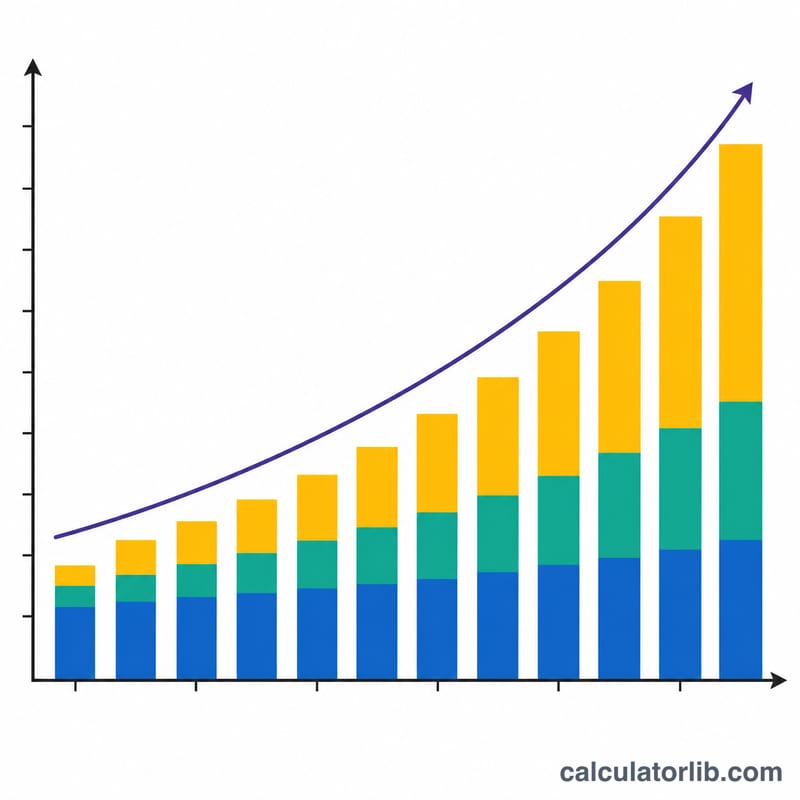
Worked Example
Suppose you start with $10,000, add $100 every month, expect a 6% annual return compounded monthly, for 10 years. Then \(r = 0.06/12 = 0.005\) and \(n = 120\). The principal grows to
$$\$10{,}000 \times 1.005^{120} \approx \$18{,}193.97$$and the contributions grow to
$$\$100 \times \dfrac{1.005^{120} - 1}{0.005} \approx \$16{,}387.93,$$for a future value of about $34,581.90.
FAQ
Does this account for taxes or inflation? No. It shows nominal growth before taxes and inflation. Subtract your expected inflation rate from the return for a real-value estimate.
What does compounding frequency change? More frequent compounding slightly increases growth because interest is calculated and reinvested more often.
Are contributions added at the start or end of each period? This calculator assumes contributions are made at the end of each period (an ordinary annuity).