
What Is an RMD?
A Required Minimum Distribution (RMD) is the minimum amount the IRS requires you to withdraw each year from most tax-deferred retirement accounts — traditional IRAs, 401(k)s, 403(b)s, and similar plans — once you reach a certain age. The SECURE 2.0 Act set the starting age at 73 for most people. Failing to take your full RMD can trigger a steep excise tax penalty, so calculating it accurately matters.
How to Use This Calculator
Enter your account balance as of December 31 of the previous year and your current age. The calculator looks up the corresponding distribution period (life expectancy) factor from the IRS Uniform Lifetime Table and divides your balance by that factor to produce your RMD for the year.
The Formula Explained
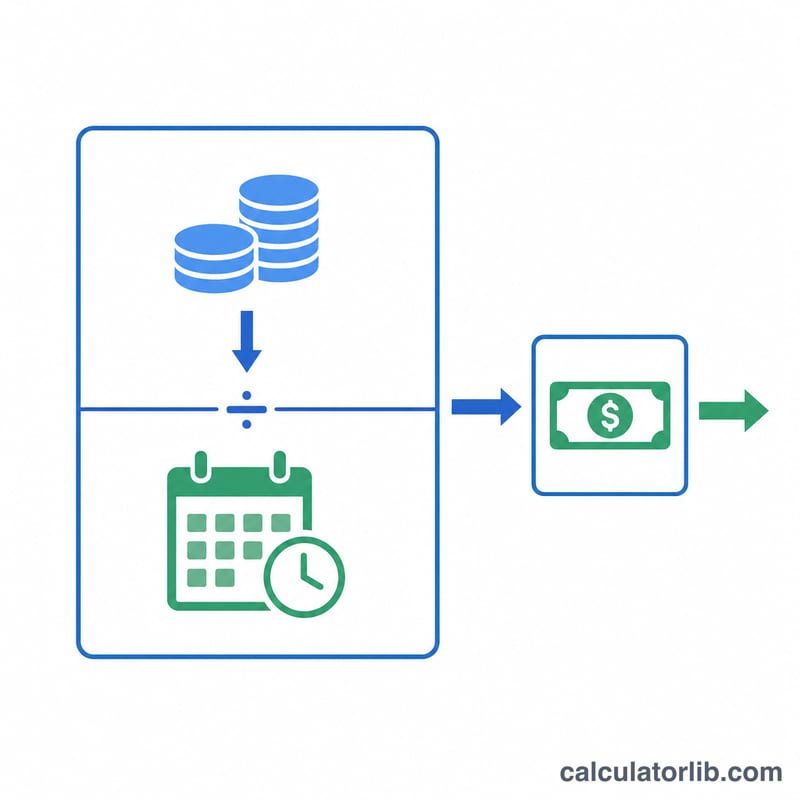
The core formula is simple: $$\text{RMD} = \dfrac{\text{Account Balance}}{\text{Distribution Period Factor}}$$. The factor comes from the IRS Uniform Lifetime Table, which assigns a longer payout period (larger factor, smaller RMD) at younger ages and a shorter period as you age. For example, age 73 uses a factor of \(26.5\), while age 80 uses \(20.2\).
Worked Example
Suppose you are 73 years old with a prior year-end IRA balance of $500,000. The factor for age 73 is \(26.5\). Your RMD: $$\text{RMD} = \frac{\$500{,}000}{26.5} = \$18{,}867.92$$ roughly \(3.77\%\) of your balance. You would need to withdraw at least this amount during the year.
FAQ
When must I take my first RMD? Generally by April 1 of the year after you turn 73, then by December 31 each year thereafter.
Does this apply to Roth IRAs? No. Roth IRAs are not subject to RMDs during the original owner's lifetime.
Which balance do I use? Always the fair market value of the account as of December 31 of the prior year.