
What Is an RMD?
Applies to the United States. A Required Minimum Distribution (RMD) is the minimum amount the IRS requires you to withdraw each year from tax-deferred retirement accounts such as Traditional IRAs, 401(k)s, 403(b)s, and most other employer plans once you reach the RMD age (73 under the SECURE 2.0 Act for those reaching 72 after 2022). Because these withdrawals are taxed as ordinary income, this calculator estimates both the RMD and the tax you may owe. Roth IRAs are not subject to RMDs during the owner's lifetime.
How to Use This Calculator
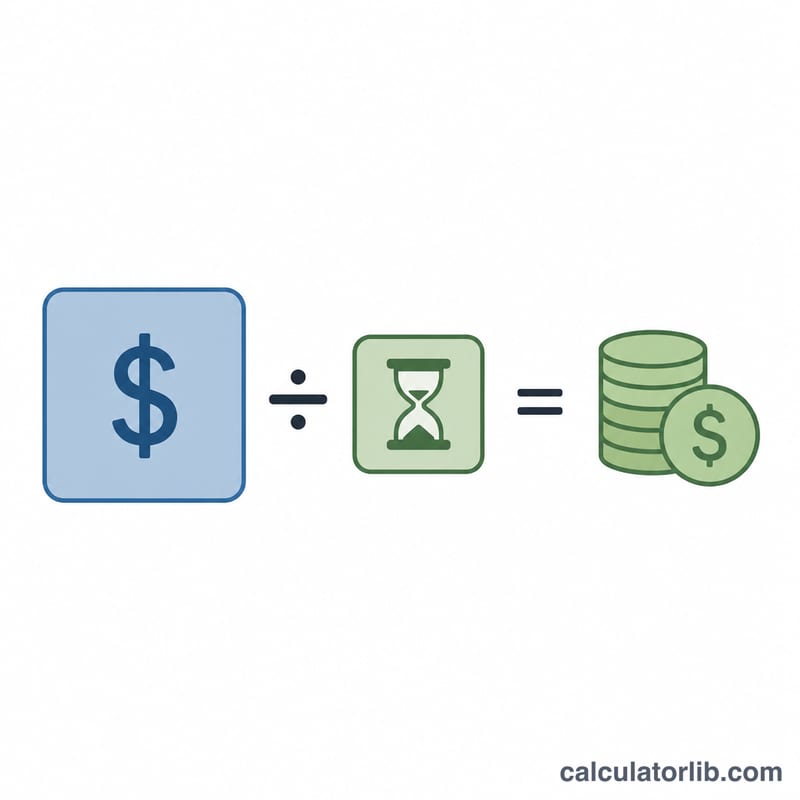
Enter your retirement account balance as of December 31 of the prior year, the IRS life expectancy factor for your age (from the Uniform Lifetime Table in IRS Publication 590-B), and your marginal income tax rate. The tool divides the balance by the factor to get your RMD, then multiplies by your tax rate to estimate the income tax and your net amount after tax.
The Formula Explained
$$\text{RMD} = \dfrac{\text{Account Balance}}{\text{Life Expectancy Factor}}$$ The factor decreases each year as you age, so the percentage you must withdraw rises over time. $$\text{Tax} = \text{RMD} \times \dfrac{\text{Marginal Rate}}{100}$$ $$\text{Net} = \text{RMD} - \text{Tax}$$
Worked Example
Suppose your IRA was worth $500,000 on December 31 and you are 73 (Uniform Lifetime factor 26.5), in the 24% bracket. $$\text{RMD} = \frac{500{,}000}{26.5} = \$18{,}867.92$$ $$\text{Tax} = 18{,}867.92 \times 0.24 = \$4{,}528.30$$ $$\text{Net} = \$14{,}339.62$$
FAQ
Where do I find my life expectancy factor? Use the IRS Uniform Lifetime Table in Publication 590-B; most account holders use this table unless a spouse more than 10 years younger is the sole beneficiary.
What happens if I miss an RMD? Under SECURE 2.0 the excise tax on a missed RMD is 25%, which may drop to 10% if corrected promptly.
Is this an exact tax figure? No. It is an estimate using a flat marginal rate. Your actual tax depends on total income, brackets, deductions, and state taxes. Consult a tax professional.