
What This Calculator Does
The Biweekly Take-Home Pay Calculator turns your gross annual salary into the net amount you actually receive every two weeks, after taxes are removed. Most employers paying biweekly issue 26 paychecks per year (every other week), so this tool divides your after-tax annual pay by 26. It is useful for budgeting, comparing job offers, or checking that your paycheck matches expectations.
How to Use It
Enter your gross annual salary (before any deductions) and your effective tax rate as a percentage. The effective rate is the share of your income that goes to taxes overall — combining federal, state, and payroll taxes if you wish. The calculator shows your net biweekly paycheck along with gross biweekly pay, tax withheld per period, and your full after-tax annual income.
The Formula Explained
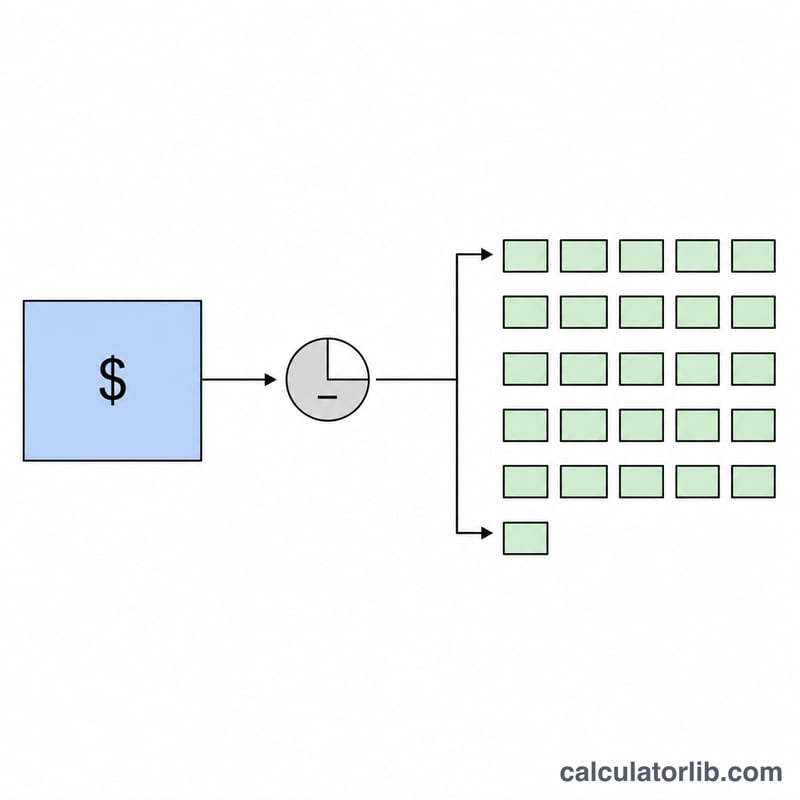
The math is straightforward. First, the tax rate is converted to a decimal: \(r = \text{tax\%} / 100\). Your after-tax annual pay is \(\text{Gross} \times (1 - r)\). Dividing by 26 spreads that across each biweekly pay period:
$$\text{Net Biweekly} = \frac{\text{Gross} \times (1 - r)}{26}$$
Worked Example
Suppose you earn $60,000 per year and have a 22% effective tax rate. After-tax annual pay is $$60{,}000 \times (1 - 0.22) = 46{,}800.$$ Divided by 26 pay periods, your biweekly take-home pay is $$46{,}800 \div 26 = 1{,}800.$$ Your gross biweekly pay would be \(60{,}000 \div 26 \approx 2{,}307.69\), with about $507.69 withheld each period.
FAQ
Why 26 pay periods? A biweekly schedule pays every two weeks, which is \(52 \div 2 = 26\) paychecks per year. (Semi-monthly is different — that's 24.)
What tax rate should I enter? Use your effective rate (total tax ÷ total income), not your top marginal bracket, for the most accurate take-home figure.
Does this include retirement or insurance deductions? No. This estimate covers taxes only. Subtract 401(k), health premiums, and other pre-/post-tax deductions separately for a fully precise paycheck.