
What this calculator does
The Annual Salary to Monthly Paycheck Calculator converts a yearly salary into the amount you would receive each month before taxes and deductions. It also breaks the same salary down into weekly and bi-weekly equivalents so you can match it to your employer's pay schedule. The result is your gross pay — the figure before income tax, social contributions, retirement, or insurance are withheld.
How to use it
Enter your total annual salary and the calculator instantly divides it across standard pay periods. Use the monthly figure for budgeting, the bi-weekly figure if you are paid every two weeks (26 checks a year), or the weekly figure for hourly-equivalent comparisons.
The formula explained
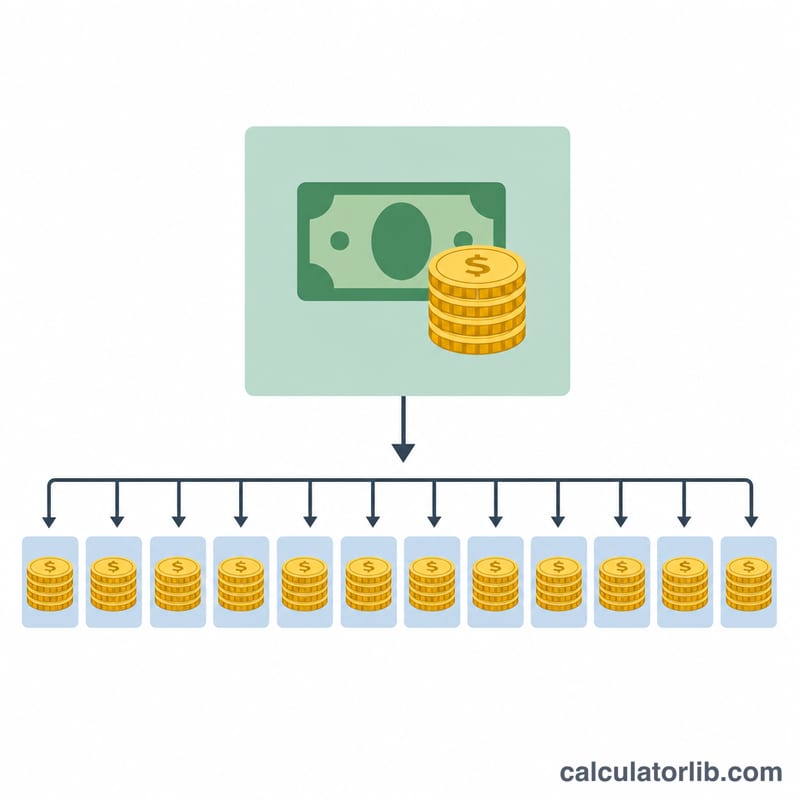
The core calculation is simple division. There are 12 months in a year, so your monthly paycheck is the annual salary divided by 12. For other schedules we use 52 weeks per year (weekly) and 26 fortnights per year (bi-weekly):
$$\text{Monthly} = \frac{\text{Annual}}{12}$$
$$\text{Weekly} = \frac{\text{Annual}}{52}$$
$$\text{Bi-weekly} = \frac{\text{Annual}}{26}$$
Worked example
Suppose your annual salary is $60,000. Your gross monthly paycheck is $$60{,}000 \div 12 = \$5{,}000$$ Weekly pay is \(60{,}000 \div 52 \approx \$1{,}153.85\), and bi-weekly pay is \(60{,}000 \div 26 \approx \$2{,}307.69\).
FAQ
Is this my take-home pay? No — this shows gross pay. Your net (take-home) paycheck will be lower after taxes, retirement contributions, and other deductions.
Why is a bi-weekly check less than half of a monthly check? Because there are 26 bi-weekly periods in a year but only 12 months, the per-period bi-weekly amount is smaller, though it works out to the same annual total.
Does this work in any currency? Yes. The math is pure division, so enter your salary in any currency and the results stay in that same currency.