
What This Calculator Does
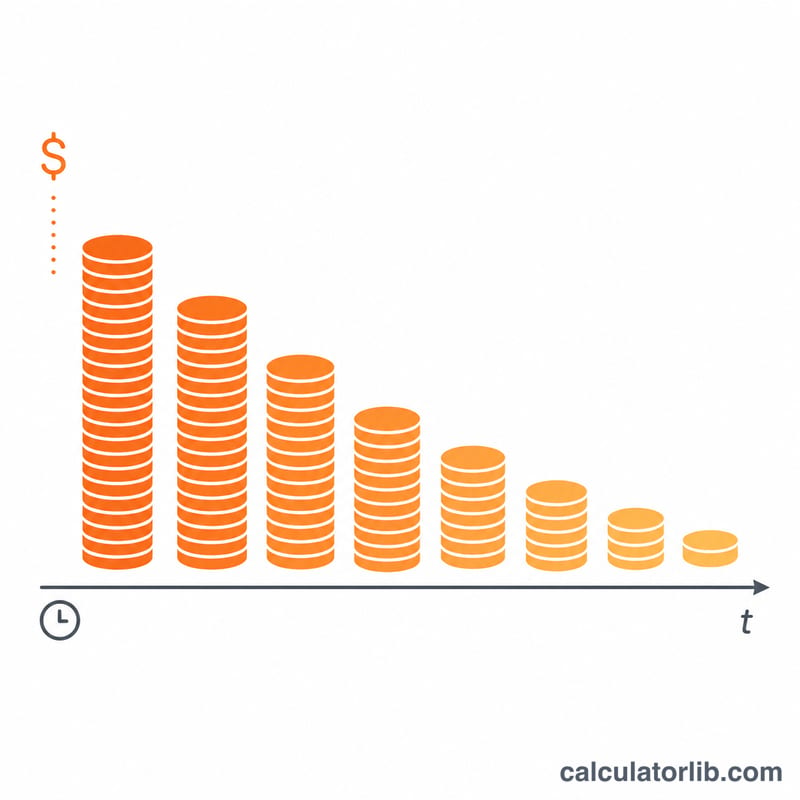
The Today's Dollar Value Calculator tells you what a sum of money in the future is really worth in today's terms. Because inflation erodes purchasing power over time, $10,000 received in 10 years buys far less than $10,000 today. This tool discounts a future amount back to the present using an assumed annual inflation rate, so you can compare future money to money you hold now.
How to Use It
Enter three values: the future dollar amount you expect to receive or spend, the average annual inflation rate as a percentage, and the number of years from now. The calculator instantly shows the equivalent value in today's dollars, how much purchasing power is lost to inflation, and the percentage of value retained.
The Formula Explained
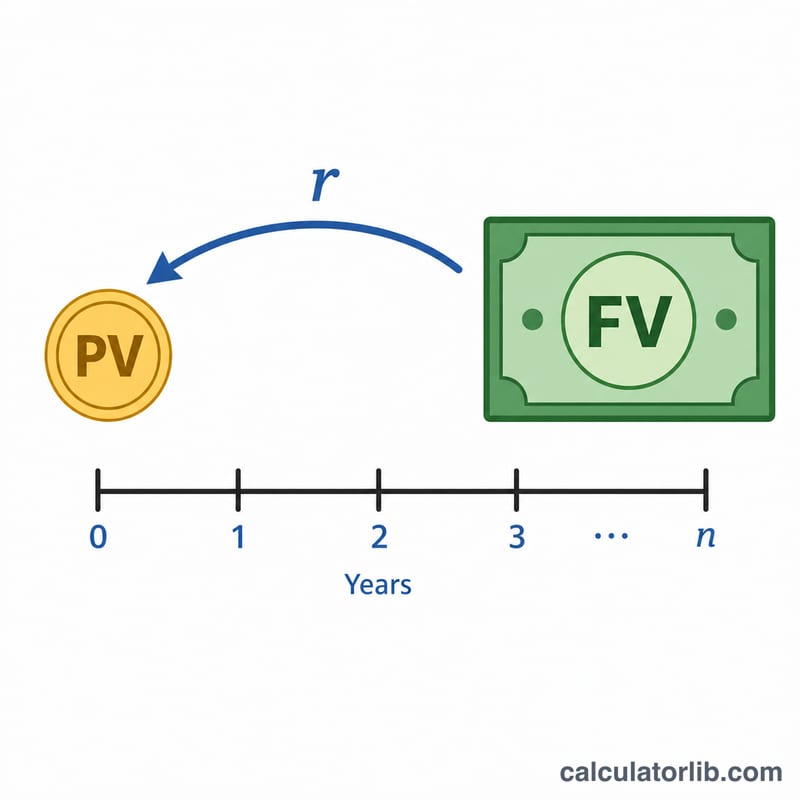
The core equation is $$\text{PV} = \frac{\text{FV}}{(1 + r)^{n}}$$ where PV is present value, FV is the future amount, r is the annual inflation rate as a decimal, and n is the number of years. Raising \((1 + r)\) to the power of \(n\) compounds inflation across every year, and dividing the future amount by that factor strips out the inflated portion to reveal real value.
Worked Example
Suppose you expect to receive $10,000 in 10 years and inflation averages 3% per year. The discount factor is \((1.03)^{10} \approx 1.343916\). Dividing $10,000 by 1.343916 gives about $7,440.94. That means $10,000 a decade from now will have the purchasing power of roughly $7,441 today — about $2,559 is lost to inflation.
FAQ
What inflation rate should I use? Long-run averages are often around 2–3% in many developed economies, but you can use any rate that reflects your expectations or historical data.
Is this the same as net present value? It is a simplified present-value calculation that uses inflation as the discount rate. Full NPV typically uses a discount rate based on opportunity cost or required return.
Does this account for taxes or interest earned? No. It only adjusts for inflation's effect on purchasing power and does not model investment growth or taxation.