

What this calculator does
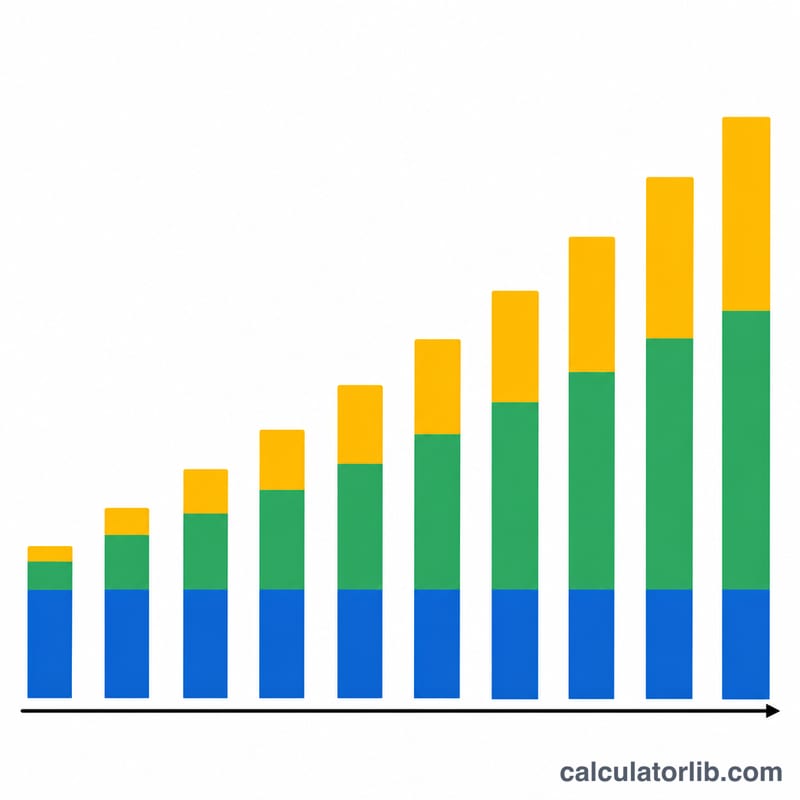
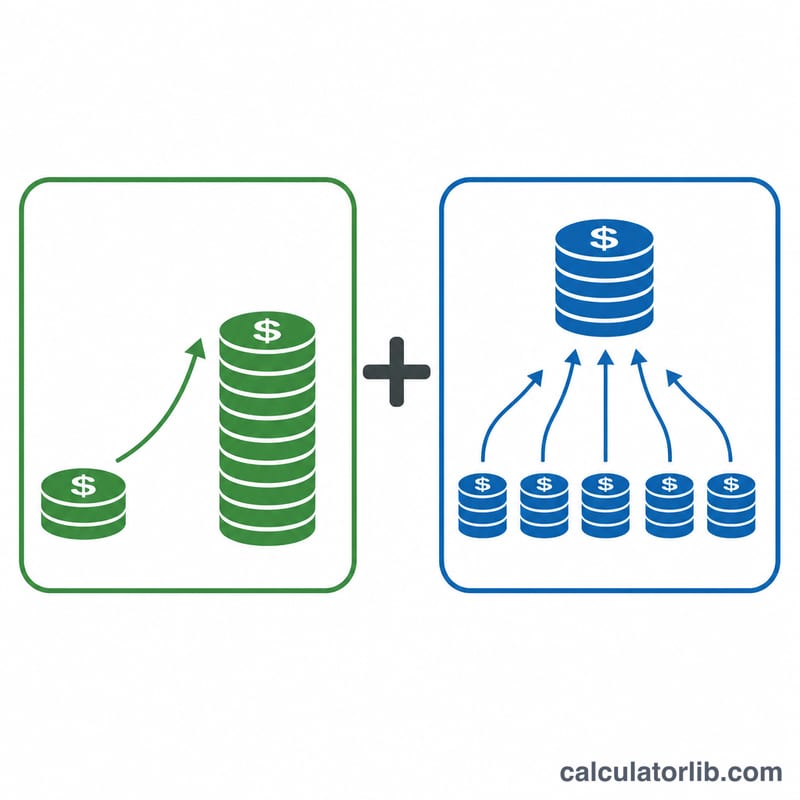
This Future Value (FV) calculator tells you how much an investment will be worth in the future. It combines two sources of growth in one model: a present lump sum you invest today (PV) and a stream of equal periodic deposits you add over time (PMT). Both are compounded at a periodic interest rate derived from your annual rate and chosen compounding frequency. It works for any currency and uses standard time-value-of-money math, so it applies universally with no country-specific rules.
How to use it
Enter your starting amount (Present Value), the nominal annual interest rate as a percent, the number of years, and how often interest compounds. Add a Periodic Deposit if you contribute regularly — deposits are assumed to occur once per compounding period. Choose whether deposits land at the end of each period (an ordinary annuity, the usual case) or the beginning (an annuity due). The result shows the future value, the total you actually put in, and the interest you earned.
The formula explained
Let \(i = r/m\) be the periodic rate (annual rate \(r\) divided by \(m\) compounding periods per year) and \(n = m \times t\) total periods. The lump sum grows as $$FV_{lump} = PV(1+i)^n.$$ The deposits grow as $$FV_{annuity} = PMT \cdot \frac{(1+i)^n - 1}{i} \cdot (1+i)^{due},$$ multiplied by an extra \((1+i)\) if deposits are made at the beginning of each period. When the rate is zero, the annuity term simplifies to \(PMT \times n\). Continuous compounding uses \(PV \times e^{rt}\) for the lump sum.
Worked example
Invest $1,000 today, add $100 monthly for 10 years at 6% compounded monthly, deposits at end of period. Here \(i = 0.06/12 = 0.005\) and \(n = 120\). The lump sum becomes $$1000 \times 1.005^{120} = \$1{,}819.40.$$ The deposits become $$100 \times \frac{1.005^{120} - 1}{0.005} = \$16{,}387.93.$$ Future value ≈ $18,207.33, total principal $13,000, total interest $5,207.33.
FAQ
Should deposits be at the beginning or end of the period? End of period (ordinary annuity) is standard for most savings plans. Beginning of period (annuity due) earns slightly more because each deposit compounds one extra period.
What is total principal vs. total interest? Total principal is the money you contributed (PV plus all deposits). Total interest is the future value minus that principal — the growth earned.
Can I model only a lump sum or only deposits? Yes. Set the deposit to 0 for a pure lump-sum calculation, or set the present value to 0 for a pure annuity (regular savings) calculation.