
What is the Future Value (FV) Calculator?
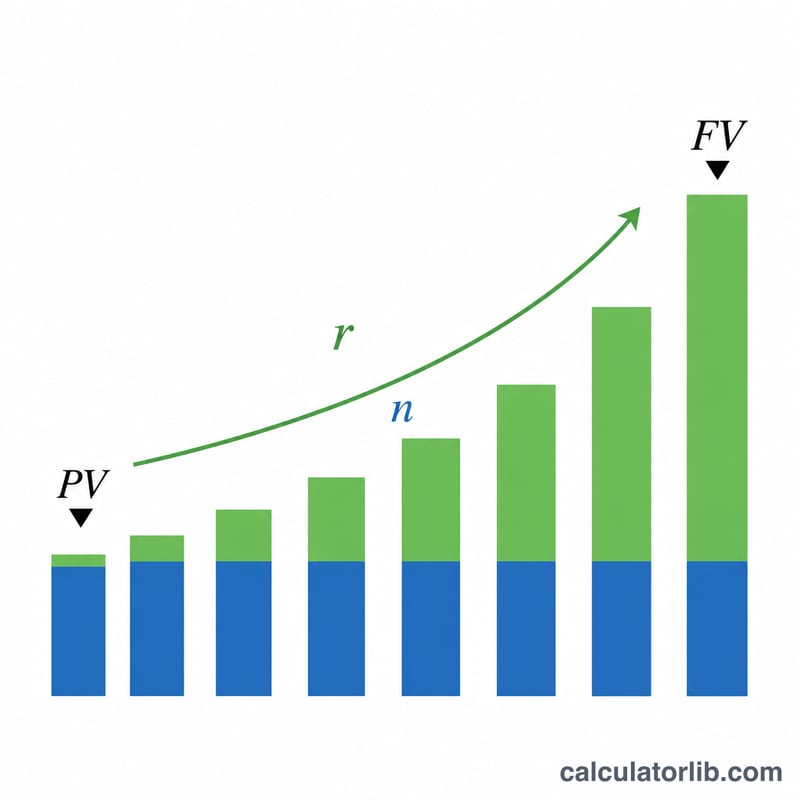
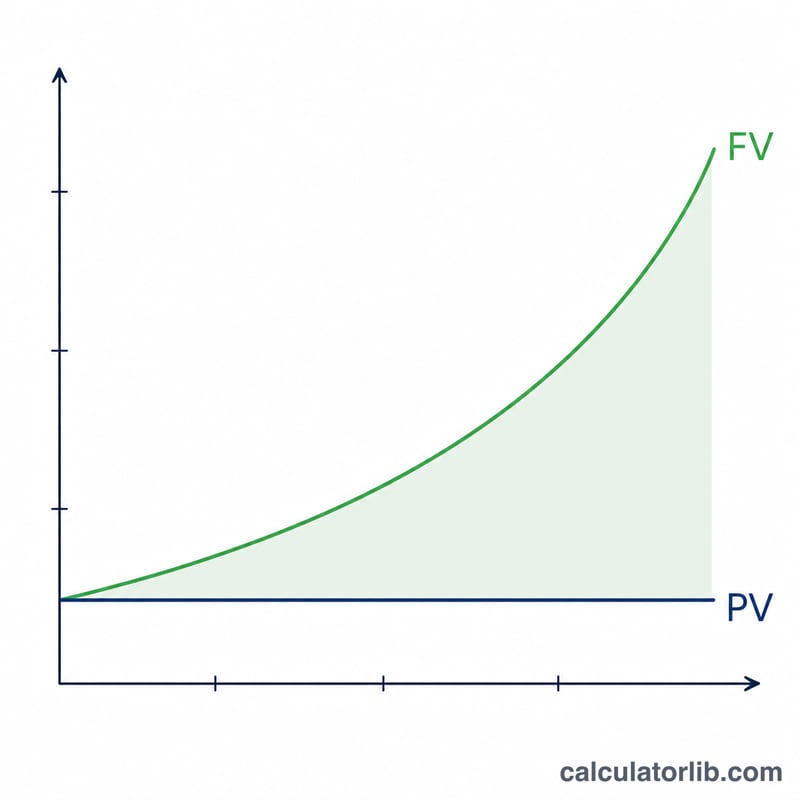
The Future Value calculator tells you how much a single lump sum of money will be worth after a given number of years, assuming it grows at a fixed annual rate of return. It uses the standard compound interest formula and applies to any currency — just enter a plain money amount. This is a universal finance tool with no country-specific rules.
How to use it
Enter three values: the Present Value (the amount you have or invest today), the Rate of Return as an annual percentage, and the Number of Years the money will grow. The calculator divides the rate by 100, raises \((1 + r)\) to the power of the years, and multiplies by the present value. Fractional years (such as 2.5) are allowed, and a negative rate models depreciation.
The formula explained
The core equation is $$\text{FV} = \text{PV} \times \left(1 + \frac{R}{100}\right)^{n}$$ Here \(R/100\) converts the percent rate into a decimal fraction \(r\), so a 5% rate becomes 0.05. The term \((1 + r)\) is the yearly growth factor, and raising it to the power \(n\) compounds the growth over each year. This version uses annual compounding (one period per year) and a single lump sum — there are no periodic contributions.
Worked example
Suppose you invest 1,000,000 at a 5% annual return for 5 years. First, \(r = 5/100 = 0.05\), so the growth factor is 1.05. Raising it to the 5th power gives $$1.05^{5} = 1.2762815625$$ Multiplying by the present value: $$1{,}000{,}000 \times 1.2762815625 = 1{,}276{,}281.56$$ So the lump sum grows to about 1,276,282.
FAQ
What if the rate is 0%? The growth factor becomes 1, so the future value equals the present value — no growth.
Can the rate be negative? Yes. A negative rate models loss or depreciation (for example -10% uses a 0.9 factor per year). Rates below -100% are not valid because the growth base would turn negative.
How does this relate to present value? The inverse formula, $$\text{PV} = \frac{\text{FV}}{\left(1 + \frac{R}{100}\right)^{n}}$$ discounts a future amount back to today. Note that final rounding to the nearest currency unit can differ between financial institutions; this tool shows the unrounded mathematical result.