
What is the Watts to Heating Time Calculator?
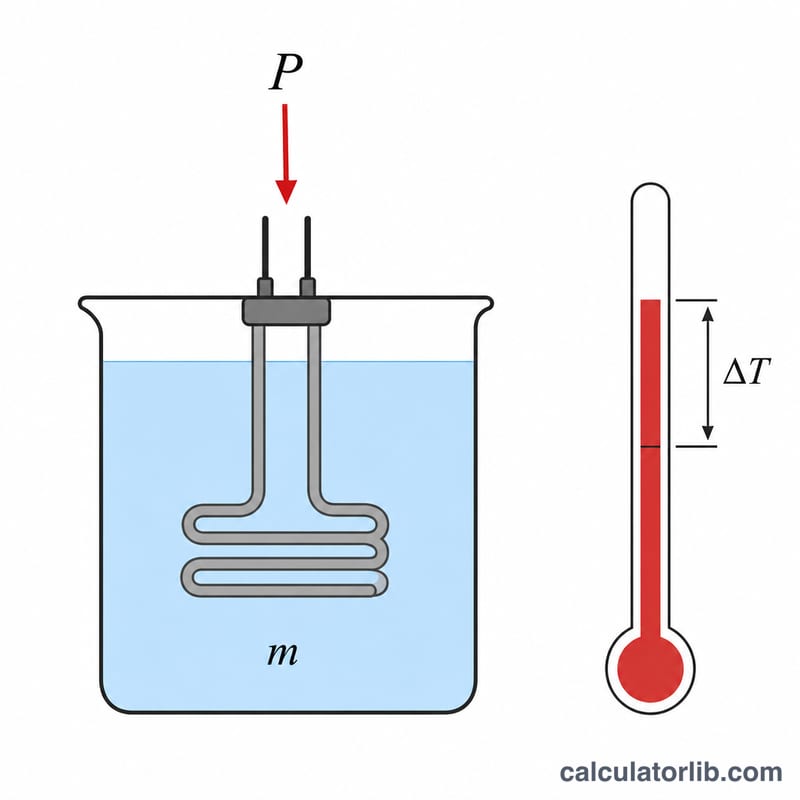
This calculator estimates how long an electric heating element of a known wattage takes to raise the temperature of water. It is handy for sizing kettles, immersion heaters, water heaters, sous-vide setups, and aquarium or pool heaters. By combining the physics of specific heat with the heater's electrical power, it converts watts into a real-world heating time.
How to use it
Enter the mass of water in kilograms (1 liter of water ≈ 1 kg), the heater power in watts, the starting and target temperatures in degrees Celsius, and a heating efficiency percentage. Real systems lose heat to the surroundings and the container, so 80–95% is a realistic efficiency; use 100% for an ideal best-case estimate. The result shows the heating time in minutes, seconds and hours, plus the total energy required.
The formula explained
The heat energy required is \(Q = m \cdot c \cdot \Delta T\), where \(m\) is mass, \(c\) is the specific heat capacity of water (4186 J per kg per °C) and \(\Delta T\) is the temperature rise. Power is energy per unit time, so dividing the energy by the effective power (\(P \times \eta\)) gives the time in seconds:
$$t = \frac{m \cdot c \cdot \Delta T}{P \cdot \eta}$$
Worked example
Heating 1 kg of water from 20 °C to 100 °C with a 1000 W heater at 100% efficiency: \(\Delta T = 80\ °C\), so
$$Q = 1 \times 4186 \times 80 = 334{,}880\ \text{J}$$
$$t = \frac{334{,}880}{1000} = 334.88\ \text{seconds} \approx 5.58\ \text{minutes}$$
That matches the familiar "a few minutes to boil a cup" intuition.
FAQ
What specific heat does it use? It assumes liquid water, \(c = 4186\ \text{J/(kg}\cdot\text{°C)}\). For other liquids the time will differ.
Why include efficiency? Heaters lose energy to the container and surroundings, so the real time is longer than the ideal calculation. Lowering efficiency increases the predicted time.
1 liter equals how many kg? Roughly 1 kg for water near room temperature, so you can enter liters directly.