
What Is the Curie Constant?
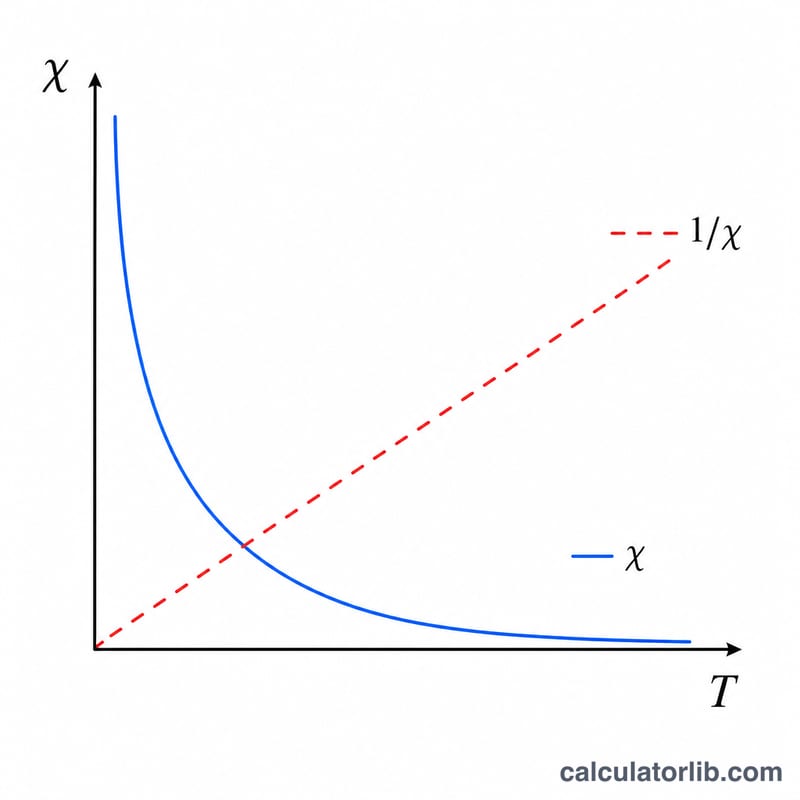
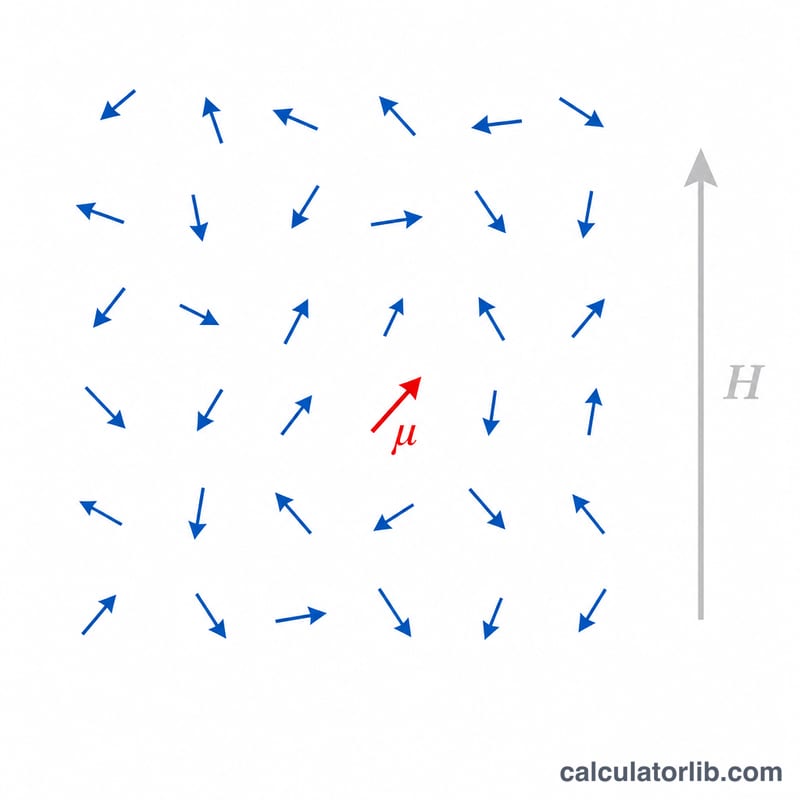
The Curie constant (\(C\)) is a material-specific quantity in Curie's law of paramagnetism, which states that the magnetic susceptibility of a paramagnet is inversely proportional to temperature: \(\chi = C / T\). The constant depends on the density of magnetic moments and the size of each moment. This calculator is a universal physics tool — it applies anywhere and uses SI units throughout.
How to Use the Calculator
Enter three values: the number density of magnetic moments \(N\) (number of moments per cubic metre), the effective magnetic moment \(\mu\) of each entity (in joules per tesla, J/T), and the Boltzmann constant \(k_B\) (pre-filled with the exact SI value \(1.380649\times10^{-23}\) J/K). Press calculate to obtain the Curie constant in K·m³, which feeds directly into \(\chi = C/T\).
The Formula Explained
The Curie constant is given by $$C = \frac{N \cdot \mu^{2}}{3 \, k_B}$$ Here \(N \cdot \mu^2\) captures the total magnetic response per unit volume, the factor 3 comes from averaging the moment orientation over all directions in three-dimensional space, and dividing by the thermal energy scale \(k_B\) links the alignment of moments to temperature. A larger moment or denser packing raises \(C\); thermal agitation (\(k_B\)) lowers it.
Worked Example
Suppose \(N = 1\times10^{28}\) moments/m³ and \(\mu = 9.274\times10^{-24}\) J/T (about one Bohr magneton). Then $$\mu^{2} = 8.6007\times10^{-47}, \quad N \cdot \mu^{2} = 8.6007\times10^{-19},$$ and dividing by \(3 \cdot k_B = 4.141947\times10^{-23}\) gives $$C \approx 2.0765\times10^{4} \ \text{K}\cdot\text{m}^3.$$ You can then predict susceptibility at any temperature as \(\chi = C/T\).
FAQ
What units does this use? Strict SI: \(N\) in m⁻³, \(\mu\) in J/T, \(k_B\) in J/K, giving \(C\) in K·m³.
What is the effective magnetic moment? For an ion it is \(\mu = g \cdot \sqrt{J(J+1)} \cdot \mu_B\), where \(\mu_B = 9.274\times10^{-24}\) J/T is the Bohr magneton.
Why divide by 3? The factor of 3 arises from the orientational (thermal) average of the projection of the moment along the applied field in three dimensions.