
What Is the Frequency of Light Calculator?
This calculator converts the wavelength of an electromagnetic wave into its frequency. Light, like all electromagnetic radiation, travels through a vacuum at a constant speed \(c \approx 299{,}792{,}458\) meters per second. Because speed equals frequency times wavelength, knowing the wavelength lets you find exactly how many wave cycles pass a point each second.
How to Use It
Enter the wavelength of your light and choose the unit (nanometers, micrometers, millimeters, or meters). Visible light typically ranges from about 380 nm (violet) to 750 nm (red). The calculator returns the frequency in hertz (Hz) and, for convenience, in terahertz (THz), the scale most often used for optical light.
The Formula Explained
The relationship is \(f = c / \lambda\), where f is frequency in hertz, c is the speed of light in meters per second, and \(\lambda\) is the wavelength in meters. The calculator first converts your wavelength to meters, then divides the speed of light by it. Shorter wavelengths produce higher frequencies, while longer wavelengths produce lower frequencies.
$$f = \frac{c}{\lambda}$$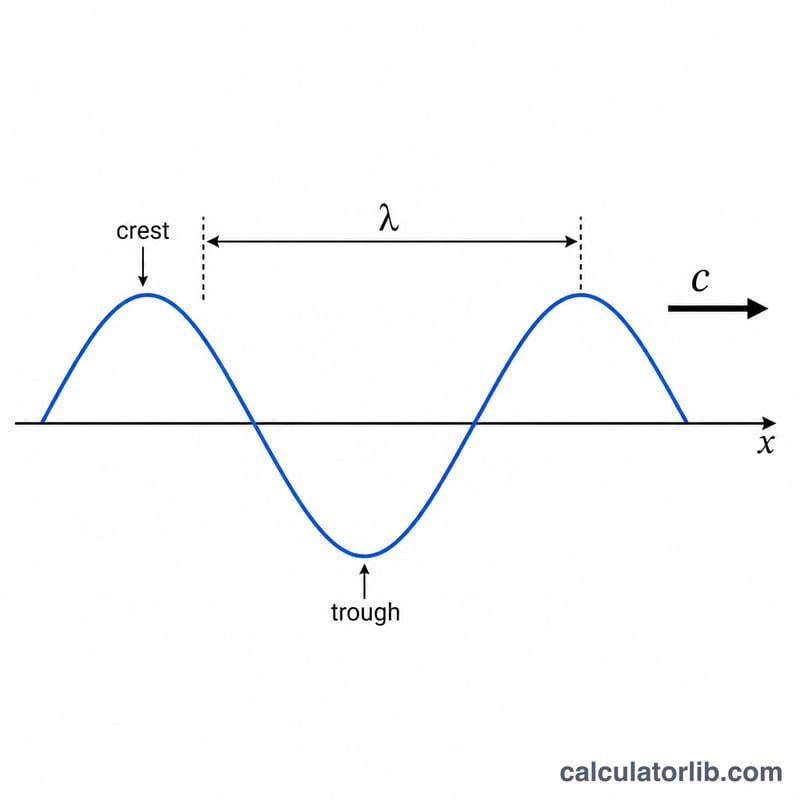
Worked Example
Consider green light with a wavelength of 500 nm. First convert: \(500 \text{ nm} = 500 \times 10^{-9} \text{ m} = 5 \times 10^{-7} \text{ m}\). Then $$f = \frac{299{,}792{,}458}{5 \times 10^{-7}} \approx 5.996 \times 10^{14} \text{ Hz},$$ or about 599.6 THz. This falls squarely in the visible spectrum, matching the perception of green light.
FAQ
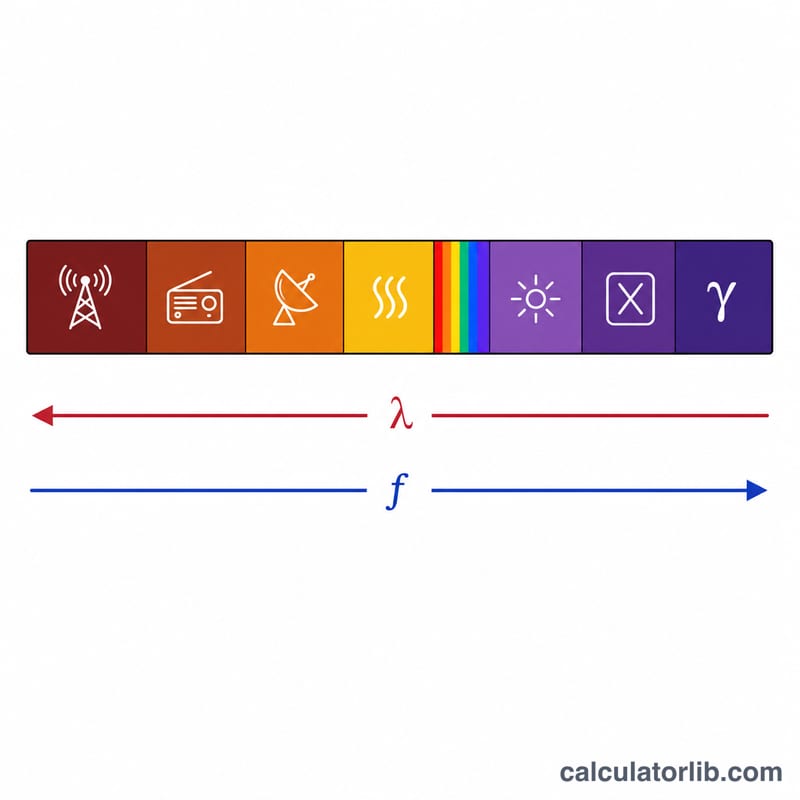
Does this work for any electromagnetic wave? Yes — radio, microwave, infrared, visible, ultraviolet, X-ray, and gamma rays all obey \(f = c / \lambda\) in a vacuum.
What about light in glass or water? In a medium light slows down, so use the medium's speed (c divided by its refractive index) instead of the vacuum value for more precise results.
Why use THz for visible light? Optical frequencies are enormous (hundreds of trillions of Hz), so expressing them in terahertz keeps the numbers manageable.