
What this calculator does
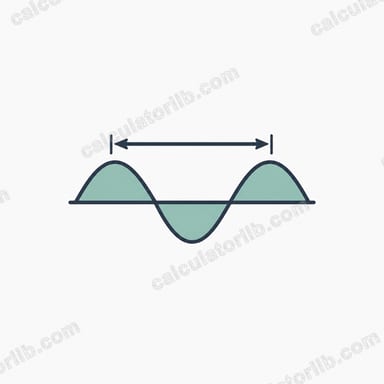
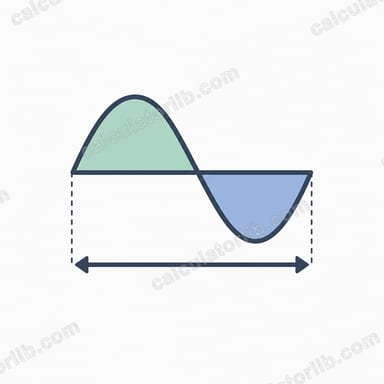
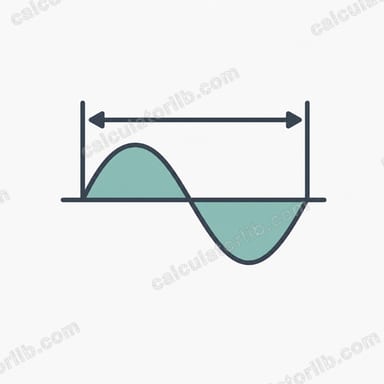
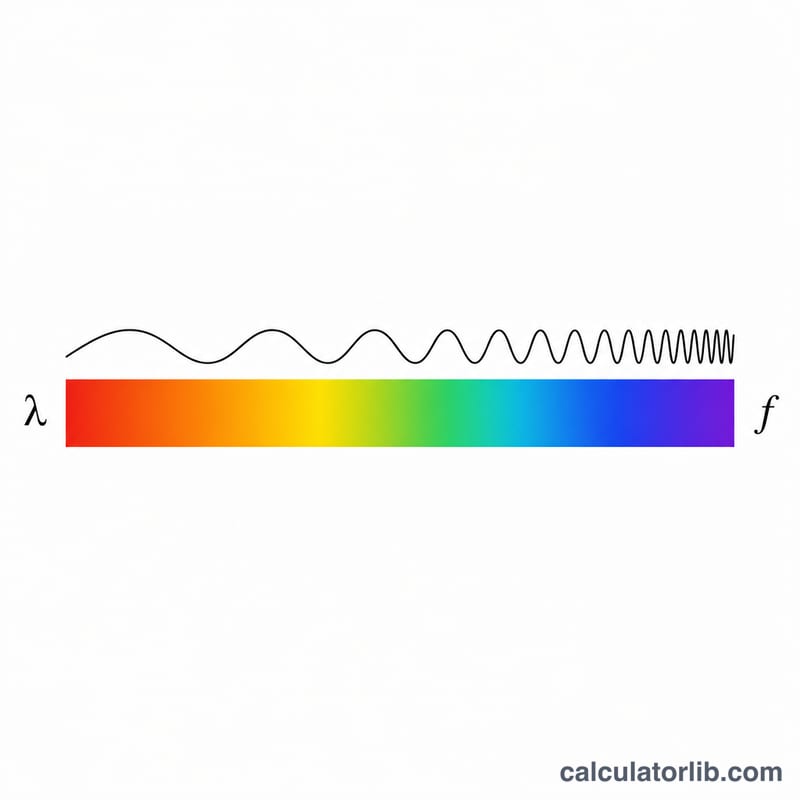
This tool converts between the wavelength and frequency of an electromagnetic wave traveling in a vacuum (or, to a very good approximation, air). Electromagnetic radiation — radio waves, microwaves, infrared, visible light, ultraviolet, X-rays and gamma rays — all propagate at the speed of light, so wavelength and frequency are linked by a single equation. Enter a value in any common unit and the calculator returns the matching quantity instantly.
How to use it
Pick whether you want to solve for frequency or wavelength, type your known value, and choose its unit. Wavelength units (nm, µm, mm, m) and frequency units (Hz, kHz, MHz, GHz, THz) are both supported. The result panel shows the converted value plus handy secondary forms so you don't have to juggle scientific notation yourself.
The formula explained
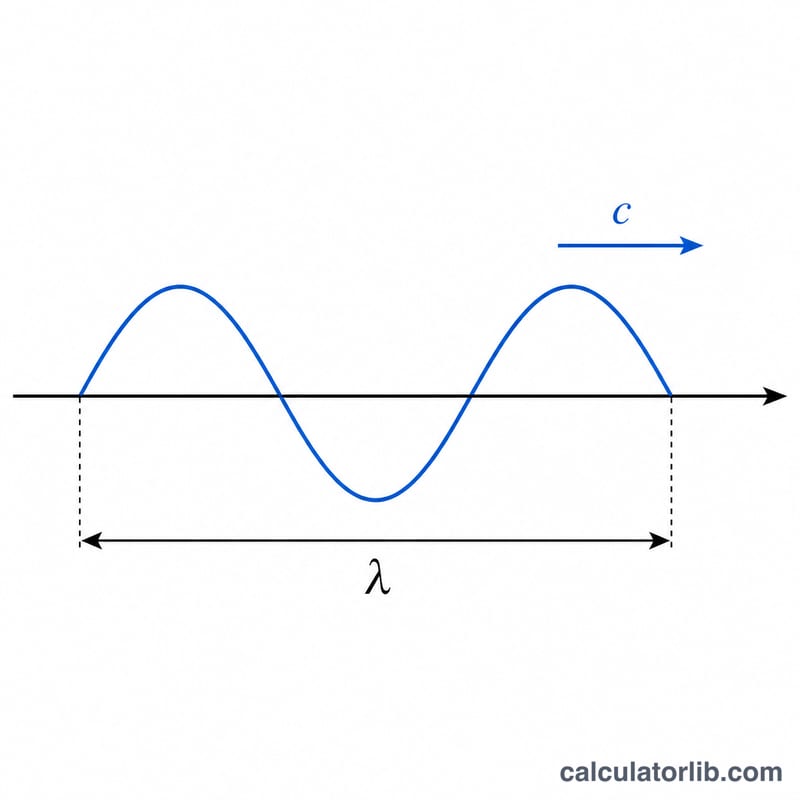
The governing relation is $$\lambda = \frac{c}{f}$$ where \(\lambda\) is wavelength in meters, \(f\) is frequency in hertz, and \(c\) is the speed of light, \(299{,}792{,}458 \ \text{m/s}\). Because the product \(\lambda \cdot f\) always equals \(c\), increasing frequency shortens wavelength and vice versa. Rearranging gives \(f = \frac{c}{\lambda}\) for the reverse direction.
Worked example
Green light has a wavelength of about \(500 \ \text{nm} = 500 \times 10^{-9} \ \text{m}\). Its frequency is $$f = \frac{c}{\lambda} = \frac{299{,}792{,}458}{5 \times 10^{-7}} \approx 5.996 \times 10^{14} \ \text{Hz}$$ or roughly \(599.6 \ \text{THz}\) — squarely in the visible band.
FAQ
Does this account for a medium? No — it assumes propagation in vacuum/air. In glass or water the effective speed is \(c/n\), so multiply wavelength by \(1/n\) if you need the in-medium value.
Why is the speed of light exact? Since 1983 the meter is defined from a fixed value of \(c\), so \(299{,}792{,}458 \ \text{m/s}\) is exact by definition.
Can I use it for sound waves? No. Sound is not electromagnetic; use the local speed of sound instead of \(c\).