
What Is the Parallel Axis Theorem?
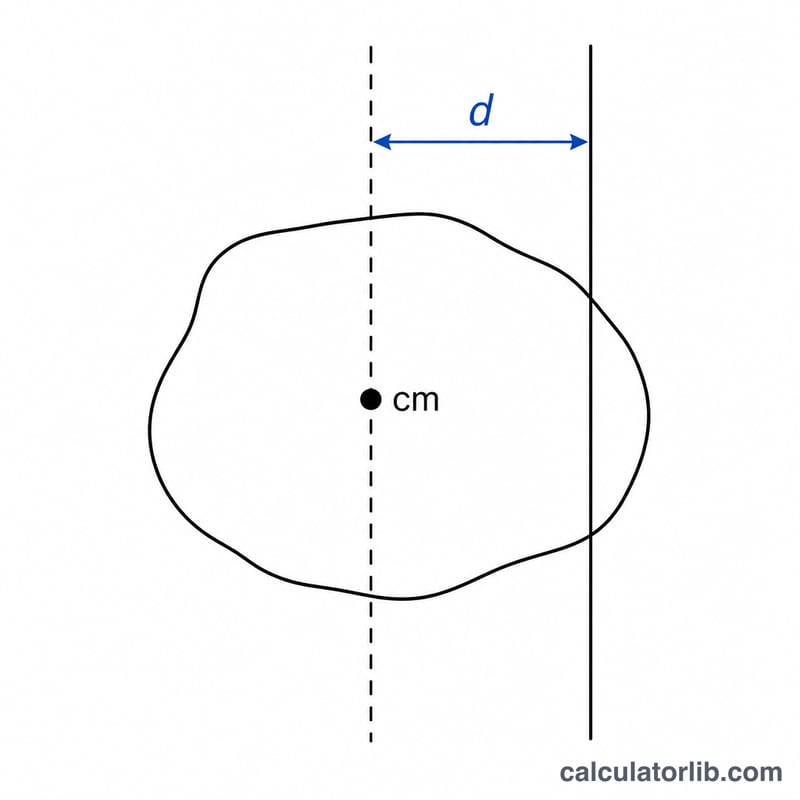
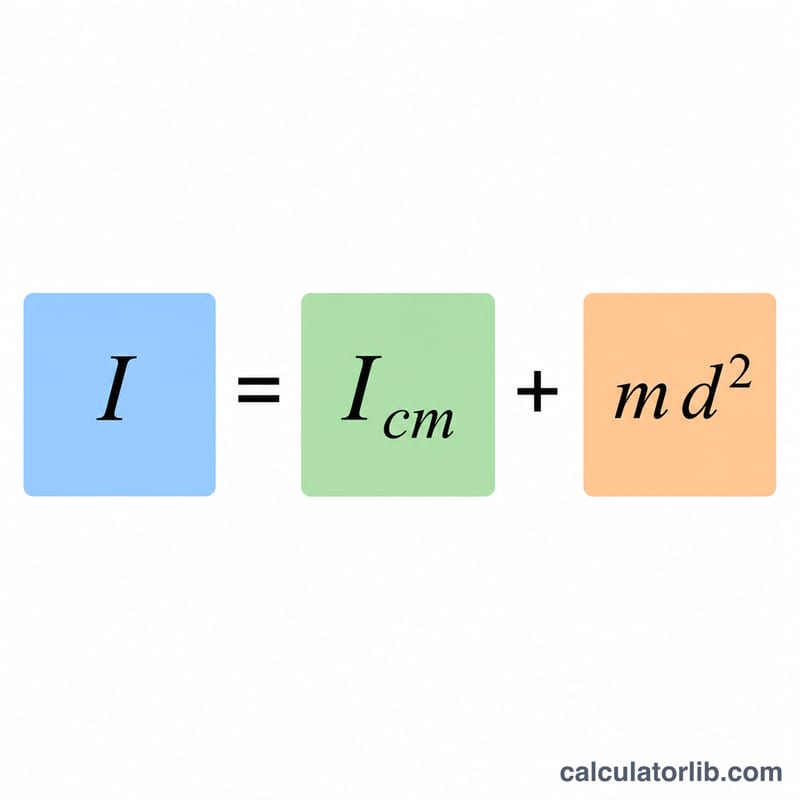
The parallel axis theorem (also called the Huygens–Steiner theorem) lets you find the moment of inertia of a rigid body about any axis, as long as you know the moment of inertia about a parallel axis passing through the body's center of mass. It states that $$I = I_{cm} + m \cdot d^{2}$$ where \(I_{cm}\) is the inertia about the center-of-mass axis, \(m\) is the total mass, and \(d\) is the perpendicular distance between the two parallel axes.
How to Use This Calculator
Enter three values: the moment of inertia about the center of mass (\(I_{cm}\)) in kg\(\cdot\)m², the object's mass (\(m\)) in kilograms, and the distance (\(d\)) in meters between the center-of-mass axis and your new axis of rotation. The calculator multiplies \(m\) by \(d^{2}\) to get the shift term, then adds \(I_{cm}\) to give the total moment of inertia about the new axis.
The Formula Explained
Because moving the rotation axis away from the center of mass always increases the moment of inertia, the \(m \cdot d^{2}\) term is always positive (or zero when the axes coincide). The center of mass is the unique axis location that minimizes the moment of inertia, which is why \(I_{cm}\) is the baseline. The theorem works for any rigid body and any pair of parallel axes.
Worked Example
A uniform rod of mass 10 kg has a moment of inertia of 0.5 kg\(\cdot\)m² about its center of mass. To find its inertia about an axis 2 m away: $$\text{shift} = m \cdot d^{2} = 10 \times 2^{2} = 40 \text{ kg}\cdot\text{m}^{2}$$ $$\text{Total } I = 0.5 + 40 = 40.5 \text{ kg}\cdot\text{m}^{2}$$
FAQ
Does the axis have to be parallel? Yes. The theorem only applies when the new axis is parallel to the center-of-mass axis. For non-parallel axes you need the full inertia tensor.
What units should I use? Use consistent SI units: mass in kg, distance in m, and inertia in kg\(\cdot\)m². The result will then be in kg\(\cdot\)m².
Can d be zero? Yes. If \(d = 0\) the new axis coincides with the center-of-mass axis, and \(I\) simply equals \(I_{cm}\).