
What this calculator does
This tool computes the equivalent (combined) capacitance of two capacitors for the two basic wiring arrangements: series and parallel. Capacitance combination is universal physics, so the same formulas apply everywhere with no regional rules. Pick a unit (farad, millifarad, microfarad, nanofarad, picofarad or femtofarad) and the answers come back in that same unit.
How to use it
Enter the value of the first capacitor in the "Capacitance C1" field and the second in "Capacitance C2". Choose a single unit from the dropdown - it applies to both inputs. The calculator returns the series combination Cs and the parallel combination Cp, expressed in the unit you selected.
The formula explained
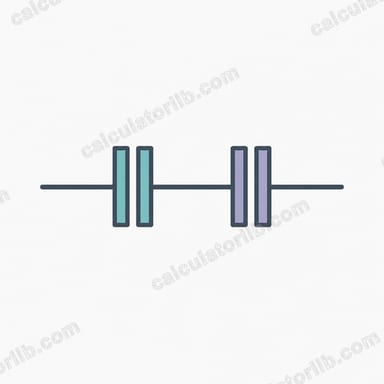
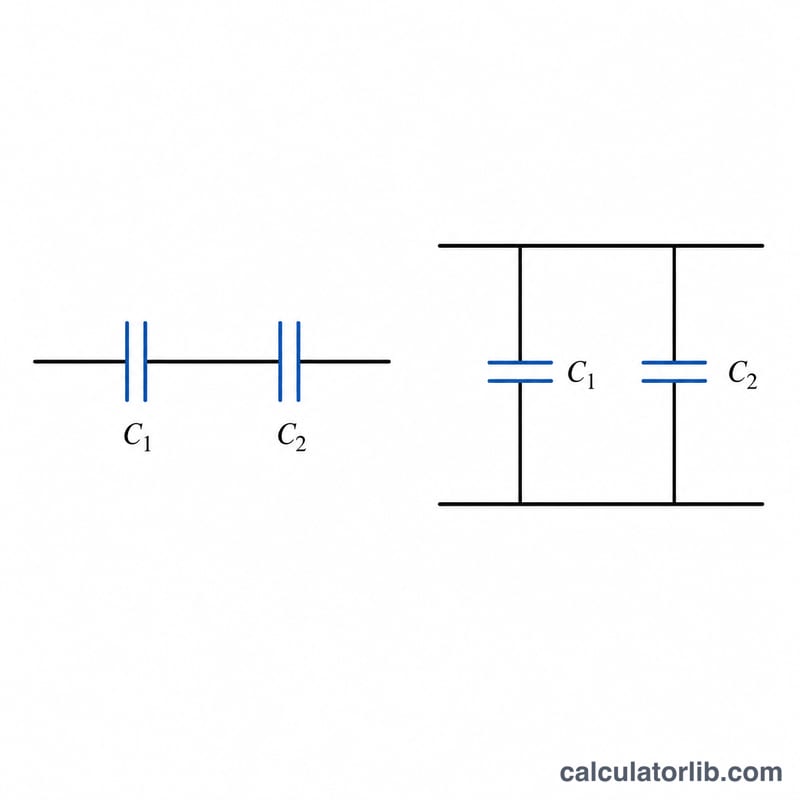
For two capacitors in series, charge must pass through both, so their reciprocals add: \(\frac{1}{C_s} = \frac{1}{C_1} + \frac{1}{C_2}\), which simplifies to
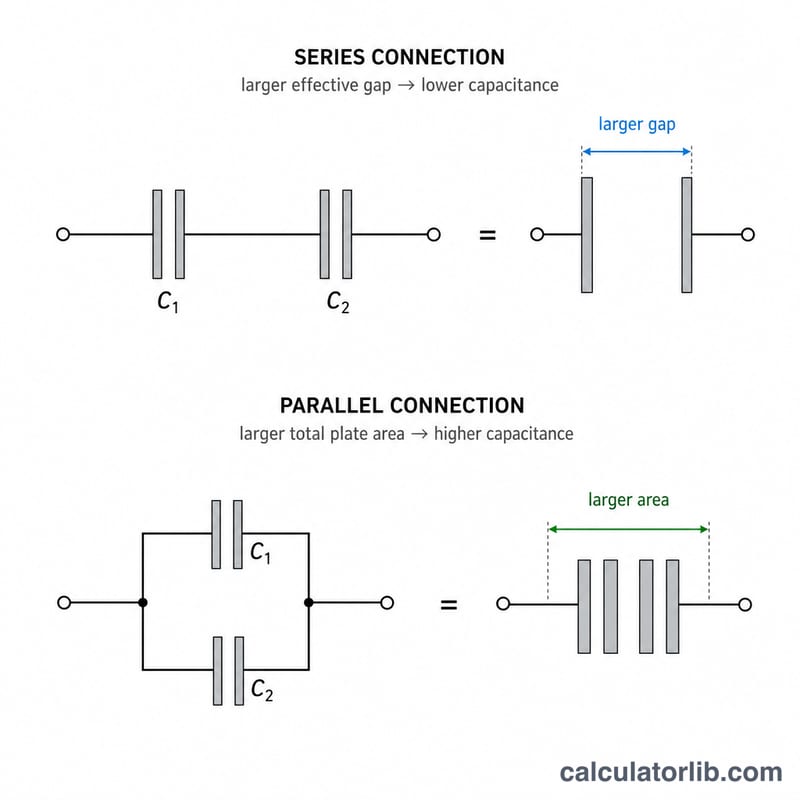
$$C_{series} = \frac{\text{C}_1 \cdot \text{C}_2}{\text{C}_1 + \text{C}_2}$$The result is always smaller than the smaller of the two capacitors. For two capacitors in parallel, the plate areas effectively add, so
$$C_{parallel} = \text{C}_1 + \text{C}_2$$always larger than either one. Because both inputs share the same unit, the unit factor cancels in the series ratio and factors out of the parallel sum, so the outputs are reported directly in the input unit.
Worked example
Take \(C_1 = 100\ \text{uF}\) and \(C_2 = 300\ \text{uF}\). Series:
$$C_s = \frac{100 \times 300}{100 + 300} = \frac{30000}{400} = 75\ \text{uF}$$Parallel:
$$C_p = 100 + 300 = 400\ \text{uF}$$Notice the series value (75 uF) is below the smaller capacitor (100 uF), while the parallel value (400 uF) exceeds both.
FAQ
Why is series capacitance smaller? Stacking capacitors in series increases the effective plate separation, which lowers capacitance - the reciprocal sum guarantees Cs is below the smallest capacitor.
What if one capacitor is zero? A zero (or open) capacitor in series blocks charge, so Cs = 0. In parallel, Cp simply equals the non-zero capacitor.
Do the units have to match? Yes - this calculator uses one unit for both inputs, and the outputs are given in that same unit.