
What is the RCL Series Impedance Calculator?
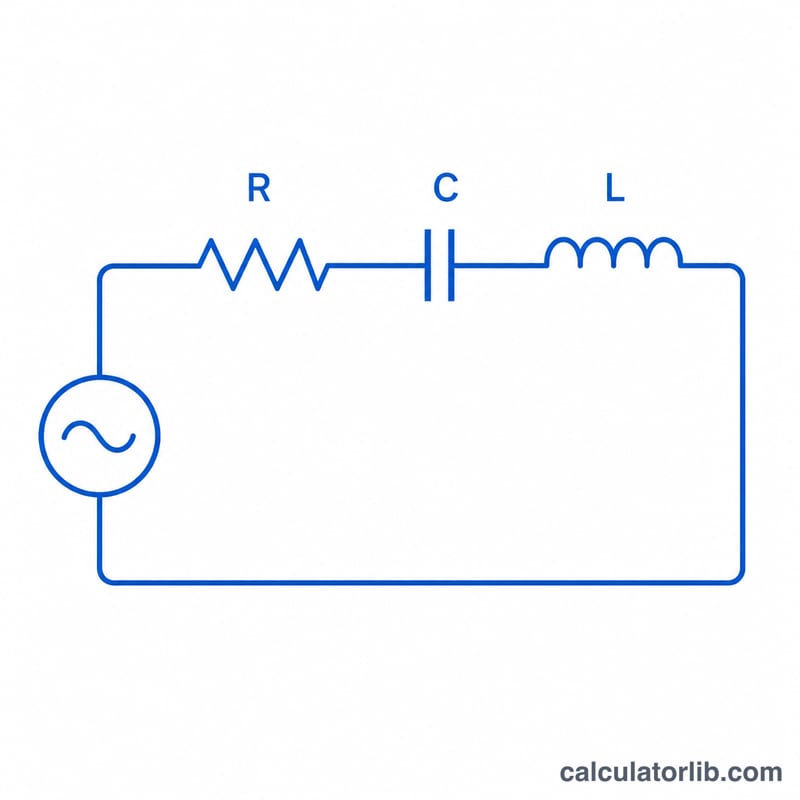
This tool computes the total impedance magnitude |Z| and the phase angle of a resistor (R), capacitor (C) and inductor (L) connected in series and driven by an alternating signal at a chosen frequency f. It applies universal AC circuit theory, so it works for any region or standard. Enter each component with its own unit (from giga-ohms down to micro-ohms, farads down to femtofarads, henries down to nanohenries, and gigahertz down to hertz) and the calculator converts everything to SI units automatically before computing.
How to use it
Type the resistance, capacitance, inductance and frequency values, then pick the matching unit for each from its dropdown. The result shows |Z| in ohms (the primary value) plus the same magnitude in kilo-ohms and milli-ohms, along with the phase angle in degrees. A positive phase means the circuit is net inductive (current lags voltage); a negative phase means it is net capacitive (current leads voltage).
The formula explained
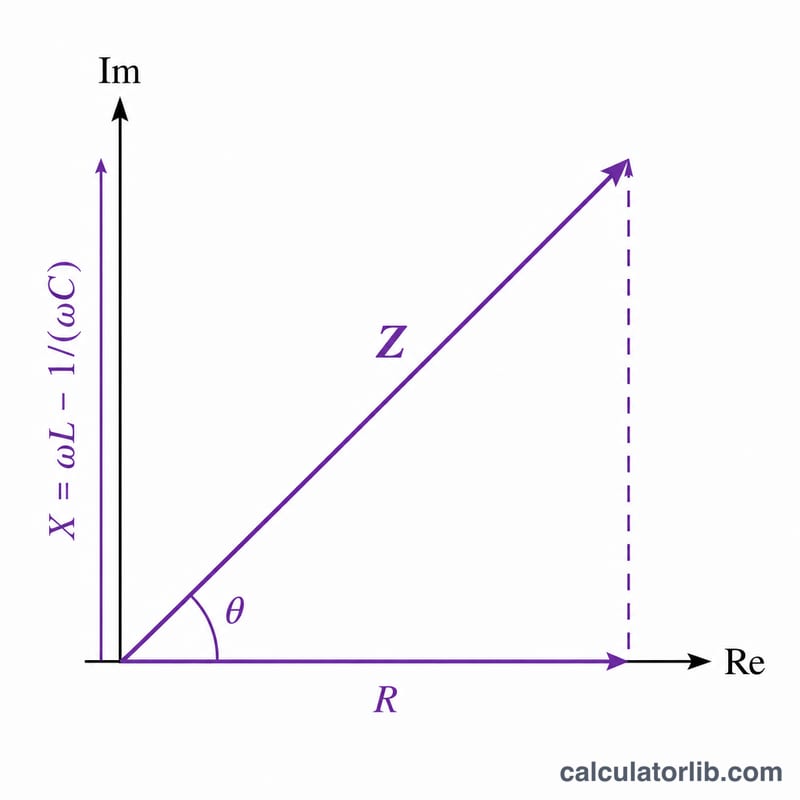
The angular frequency is \(\omega = 2\pi f\). The inductive reactance is \(X_L = \omega \cdot L\) and the capacitive reactance is \(X_C = 1/(\omega \cdot C)\). The net reactance is \(X = X_L - X_C\). Because the resistive and reactive parts are 90 degrees out of phase, they add as vectors:
$$|Z| = \sqrt{R^{2} + X^{2}}$$and the phase angle is \(\varphi = \operatorname{atan2}(X, R)\). At resonance \(X_L = X_C\), so \(X = 0\), \(|Z| = R\) and \(\varphi = 0\).
Worked example
With \(R = 10\,\Omega\), \(C = 500\,\mu\text{F}\), \(L = 2\,\text{mH}\) and \(f = 1\,\text{kHz}\): \(\omega = 6283.19\,\text{rad/s}\), \(X_L = 12.566\,\Omega\), \(X_C = 0.318\,\Omega\), so \(X = 12.248\,\Omega\). Then
$$|Z| = \sqrt{10^{2} + 12.248^{2}} = 15.81\,\Omega$$and \(\varphi = \operatorname{atan2}(12.248, 10) = 50.77\) degrees, meaning the current lags the voltage.
FAQ
What happens at DC (f = 0)? A capacitor blocks direct current, so \(X_C\) becomes infinite, \(|Z|\) tends to infinity and the phase tends to \(-90\) degrees.
Why three impedance rows? They are the same \(|Z|\) value shown in kilo-ohms, ohms and milli-ohms for convenience; the ohm value is the primary result.
Is the answer different for a parallel circuit? Yes. This calculator assumes a single series loop where the same current flows through R, C and L. Parallel networks use a different combining rule.