
What is the Tomoe-sen Win Probability Calculator?
Jurisdiction note (Japan / sumo rule): A "tomoe-sen" is the three-person playoff format used in Grand Sumo to settle a three-way tie for the championship. The probability model is universal — it works for any 3-player rotating playoff with these rules — but the custom and labels come from Japanese sumo. This tool computes how likely each of the three contestants is to win the whole playoff.
How the format works
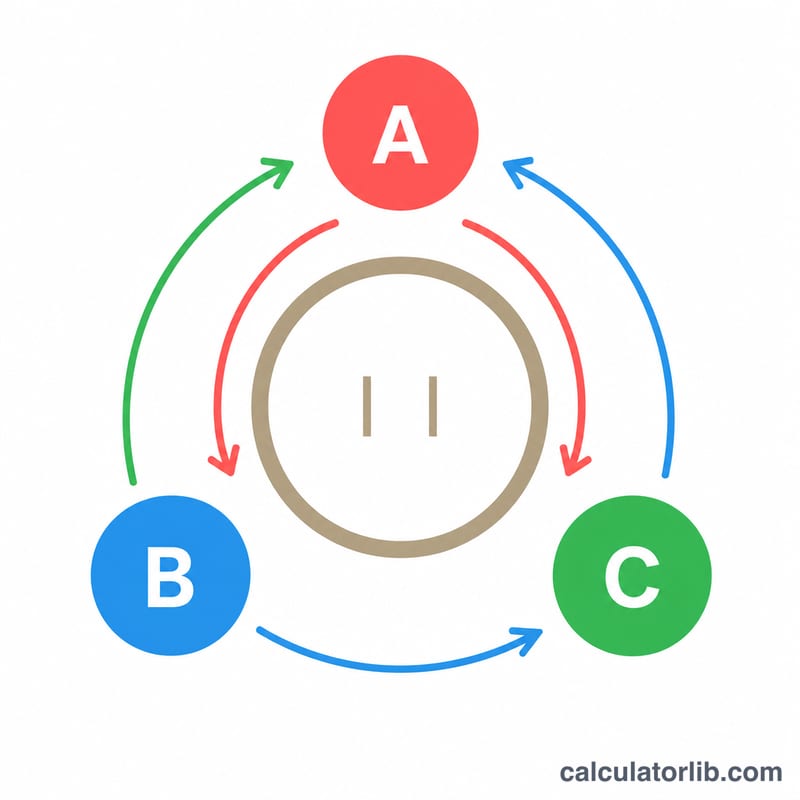
Three contestants compete. Player A and Player B fight the first bout while Player C waits "on deck." The loser of each bout steps aside, the winner stays and immediately faces the waiting contestant. A contestant wins the playoff by winning two consecutive bouts. Because the waiting player C must first win one bout before they can even begin a back-to-back pair, C is structurally disadvantaged, while the symmetric first-bout players A and B share a higher, equal probability.
How to use it
For the canonical fair sumo answer, leave all three bout win probabilities at 0.5. To explore an uneven matchup, enter each contestant's per-bout win probability (or percent). Internally these are treated as relative "strengths": in a bout between X and Y, \(P(X \text{ beats } Y) = \dfrac{s_X}{s_X + s_Y}\).
The formula
Set up a Markov chain over states (current streak holder, fresh incoming opponent). Absorbing states are a holder winning their second straight bout. Solving the recurrence in the fair 50/50 case gives the classic textbook result:
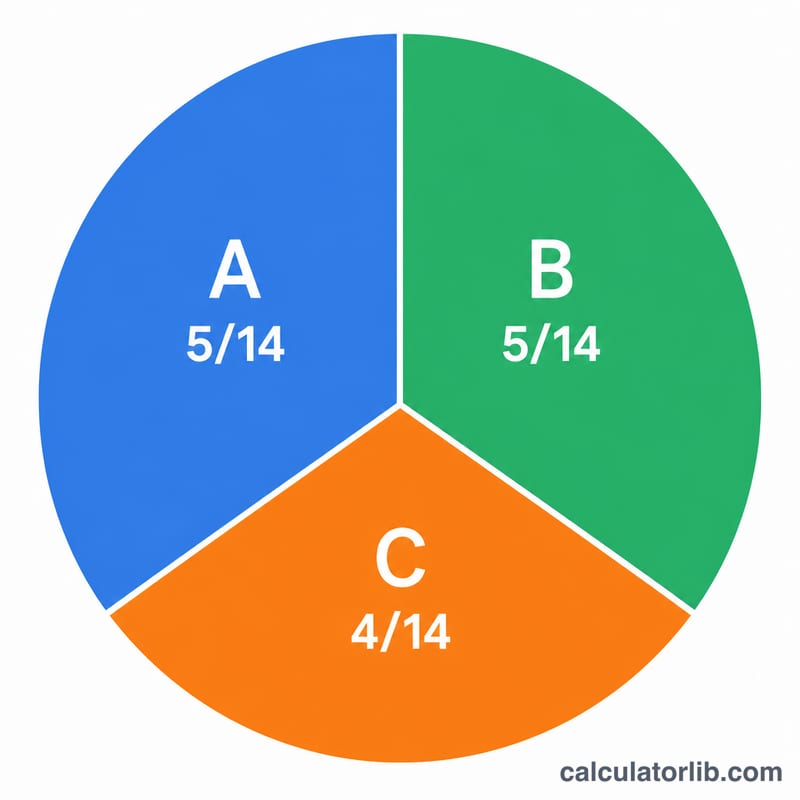
$$P(A) = P(B) = \frac{5}{14} \approx 35.71\%, \quad P(C) = \frac{4}{14} = \frac{2}{7} \approx 28.57\%.$$ They sum to exactly 1.
Worked example
All three bout probabilities = 0.5. Player A wins bout 1 \(\left(\frac{1}{2}\right)\), then immediately can take the title by winning again \(\left(\frac{1}{2}\right)\). Summing the infinite geometric series for every way A can later regain and complete a streak yields exactly \(\frac{5}{14}\). By symmetry B also gets \(\frac{5}{14}\), and C gets $$1 - 2 \times \frac{5}{14} = \frac{4}{14} \approx 28.57\%.$$
FAQ
Why is the waiting player disadvantaged? A and B can win the title with two straight wins starting immediately; C must first beat the bout-1 winner before even starting a consecutive pair.
Does the playoff always end? Yes — the chance of going forever without two consecutive wins approaches 0, so the three probabilities sum to exactly 1.
Are draws allowed? No. Sumo playoff bouts always produce a winner, so every bout resolves to win/loss.