
What this calculator does
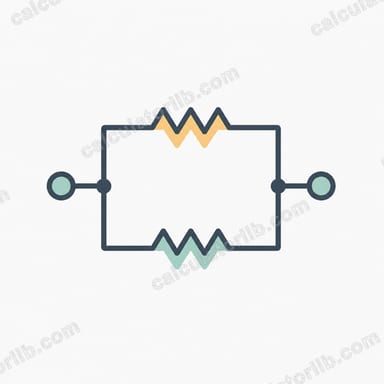
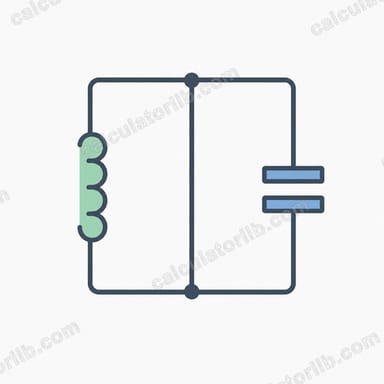
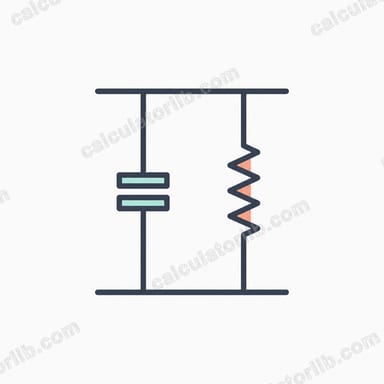
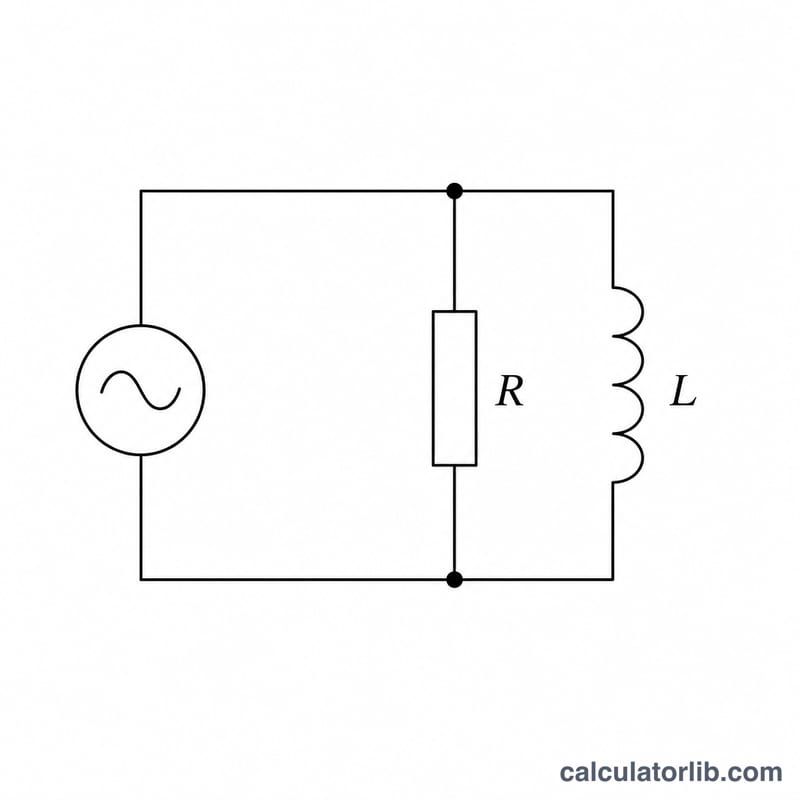
This tool computes the impedance magnitude |Z| and the phase angle of a circuit in which a resistor R and an inductor (coil) L are connected in parallel and driven by an AC source at frequency f. It is a universal physics tool that applies anywhere; no jurisdiction-specific assumptions are made.
How to use it
Enter the resistance R, the inductance L, and the source frequency f, each with its own unit prefix (for example kOhm, mH, kHz). The calculator converts every value to SI units (ohms, henries, hertz), computes the angular frequency, and returns the impedance magnitude in ohms and the phase angle in degrees.
The formula explained
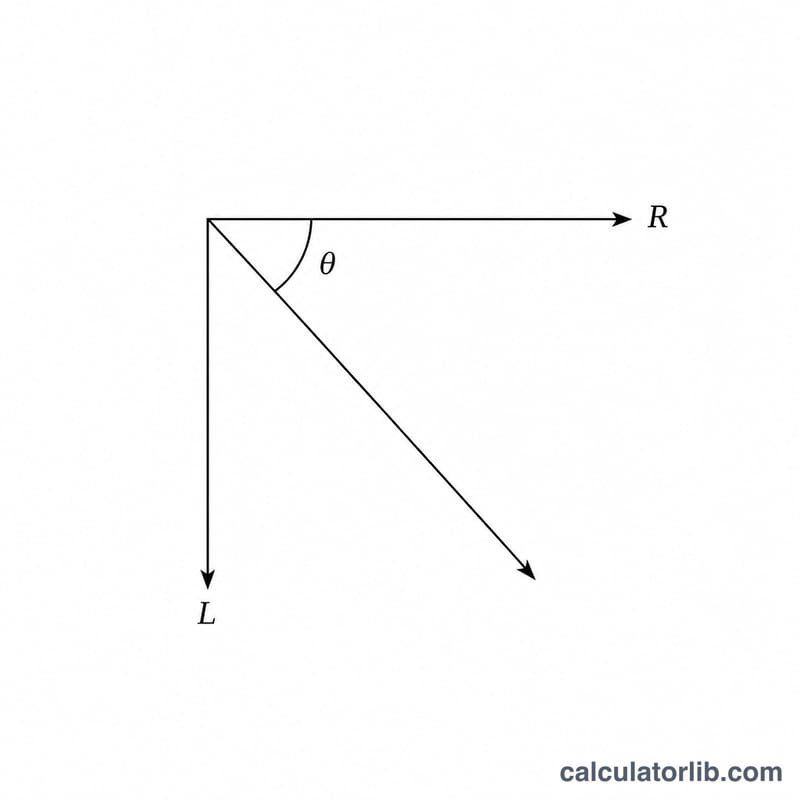
For a parallel RL circuit the admittances add: \(1/Z = 1/R + 1/(j\omega L)\), where \(\omega = 2\pi f\) is the angular frequency and \(\omega L\) is the inductive reactance. Taking the magnitude gives $$|Z| = \dfrac{1}{\sqrt{\left(\dfrac{1}{R}\right)^2 + \left(\dfrac{1}{\omega L}\right)^2}}.$$ The phase angle of the total impedance is $$\varphi = \arctan\!\left(\dfrac{R}{\omega L}\right),$$ converted to degrees by multiplying by \(180/\pi\). Because this is a parallel combination, \(|Z|\) can never exceed \(R\) alone.
Worked example
Take \(R = 100\ \text{Ohm}\), \(L = 10\ \text{mH} = 0.01\ \text{H}\), and \(f = 5\ \text{kHz} = 5000\ \text{Hz}\). Then $$\omega = 2\pi \cdot 5000 = 31415.93\ \text{rad/s}$$ and \(\omega L = 314.159\ \text{Ohm}\). So \(1/R = 0.01\) and \(1/(\omega L) = 0.0031831\). The sum of squares is \(1.10132\text{E-}4\), whose square root is \(0.0104944\), giving \(|Z| = 95.288\ \text{Ohm}\). The phase is $$\varphi = \arctan\!\left(\dfrac{100}{314.159}\right) = \arctan(0.31831) = 0.30876\ \text{rad} = 17.690^{\circ}.$$
FAQ
What happens at DC (f = 0)? An ideal coil acts as a short circuit, so \(\omega L = 0\), the impedance collapses to 0 Ohm and the phase is 90 degrees.
Why is |Z| smaller than R? In a parallel circuit the inductor provides an extra path for current, lowering the overall impedance below the resistor value.
Is the coil resistance included? No. This model treats the inductor as ideal (lossless). For a real coil with series resistance, the result is an approximation.