
What this calculator does
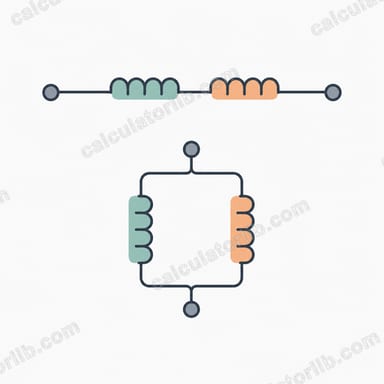
This tool computes the combined (equivalent) inductance of two coils when they are connected in series and in parallel. It is pure electrical engineering, so it applies identically everywhere. The calculation assumes the two coils are not magnetically coupled (coupling coefficient k = 0), meaning mutual inductance is ignored.
How to use it
Enter the two inductance values L1 and L2, pick the unit they share (H, mH, uH or nH), and read the series result Ls and the parallel result Lp. Each L value is converted internally to henries (SI) for the math, then converted back to your chosen unit for display. The table also shows both results in SI henries.
The formulas explained
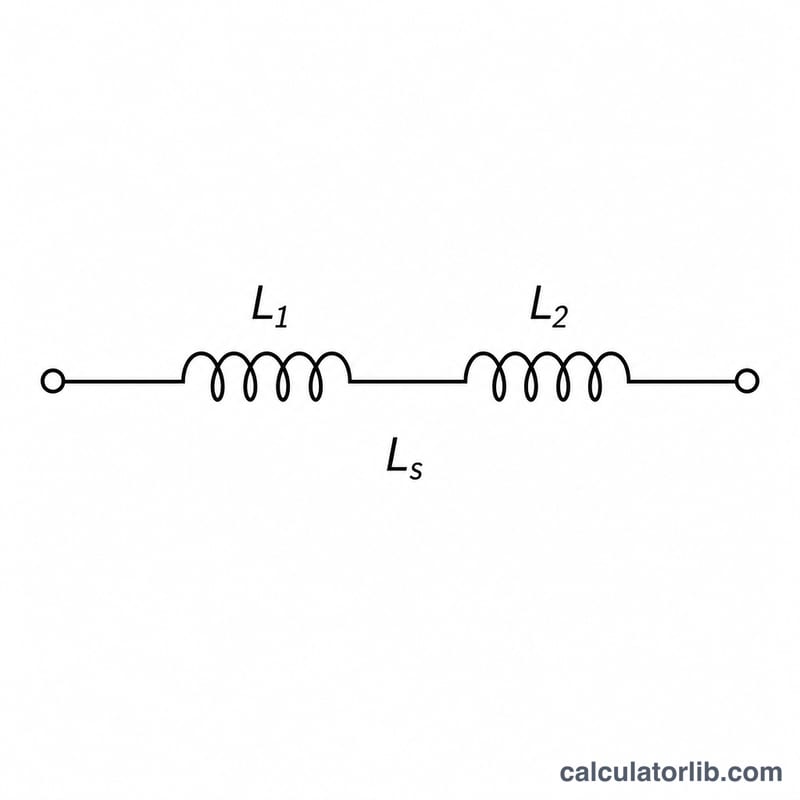
Inductors in series behave like resistors in series: the total is the sum, \(L_s = L_1 + L_2\). Inductors in parallel behave like resistors in parallel: \(L_p = (L_1 \times L_2) / (L_1 + L_2)\), equivalently \(1 / (1/L_1 + 1/L_2)\). The parallel result is always smaller than the smaller of the two inductors.
$$L_{\text{series}} = \text{L}_1 + \text{L}_2$$$$L_{\text{parallel}} = \frac{\text{L}_1 \cdot \text{L}_2}{\text{L}_1 + \text{L}_2}$$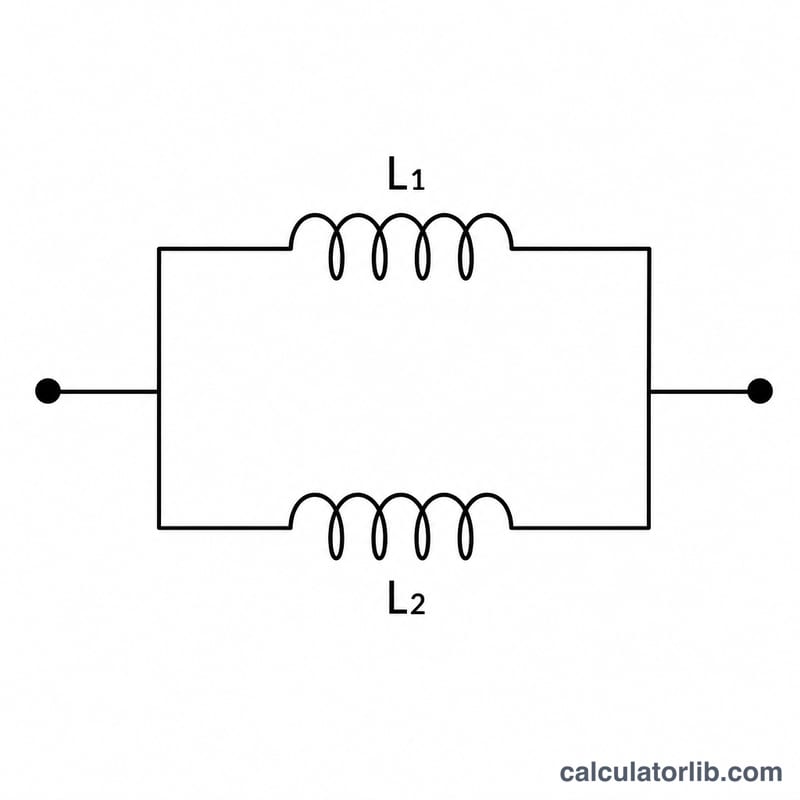
Worked example
Take L1 = 100 mH and L2 = 300 mH. In SI that is 0.100 H and 0.300 H. Series: $$L_s = 0.100 + 0.300 = 0.400 \text{ H} = \textbf{400 mH}.$$ Parallel: $$L_p = \frac{0.100 \times 0.300}{0.100 + 0.300} = \frac{0.03}{0.4} = 0.075 \text{ H} = \textbf{75 mH}.$$
FAQ
Does this include mutual inductance? No. It assumes k = 0. With coupling the formulas become \(L_s = L_1 + L_2 \pm 2M\) and a modified parallel expression.
What if one coil is 0 H? Series equals the other coil; parallel becomes 0, since an ideal 0 H inductor shorts the parallel branch.
Can I mix units? Both values use one shared unit. Convert one value first if your coils are specified in different units.