
What is an RL Series Circuit?
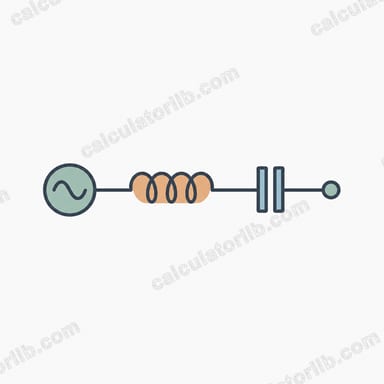
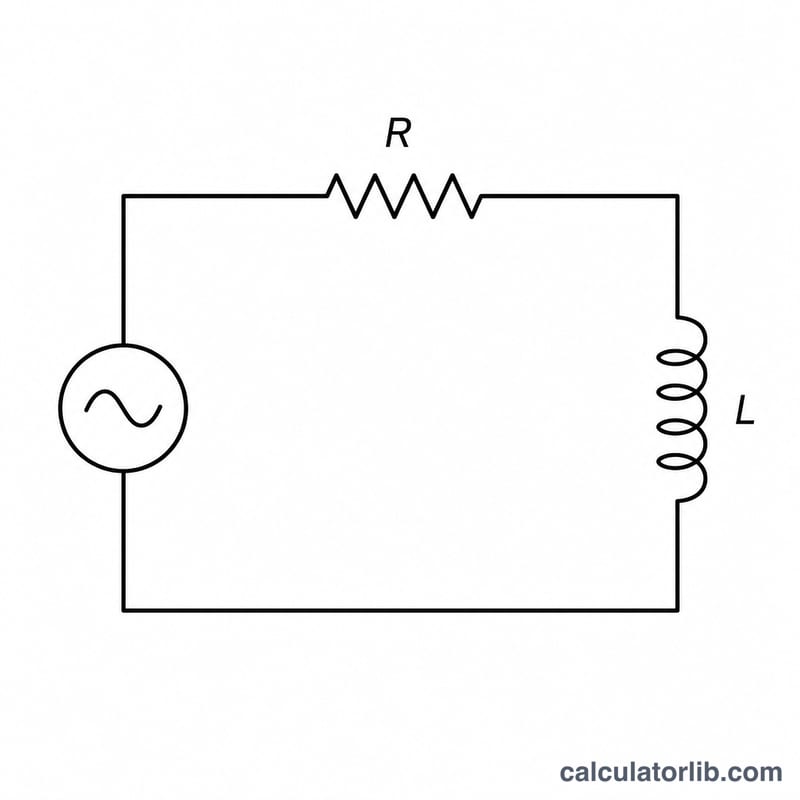
An RL series circuit is an electrical network in which a resistor (R) and an inductor (L) are connected end to end so the same current flows through both. When driven by a sinusoidal source at frequency f, the inductor opposes changes in current and introduces a frequency-dependent reactance. This calculator finds the total impedance magnitude |Z| and the phase angle between voltage and current.
How to Use It
Enter the resistance, inductance, and frequency, choosing a unit for each from its dropdown. All values are converted to SI base units (ohms, henries, hertz) before the math runs. Press calculate to see the impedance in ohms, the phase angle in degrees, the inductive reactance, and the angular frequency.
The Formula Explained
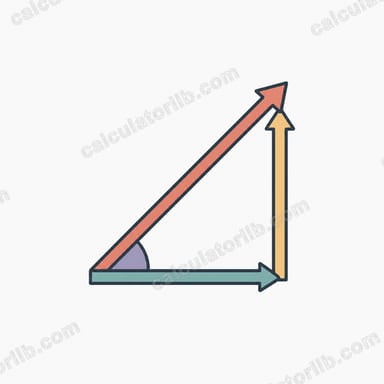
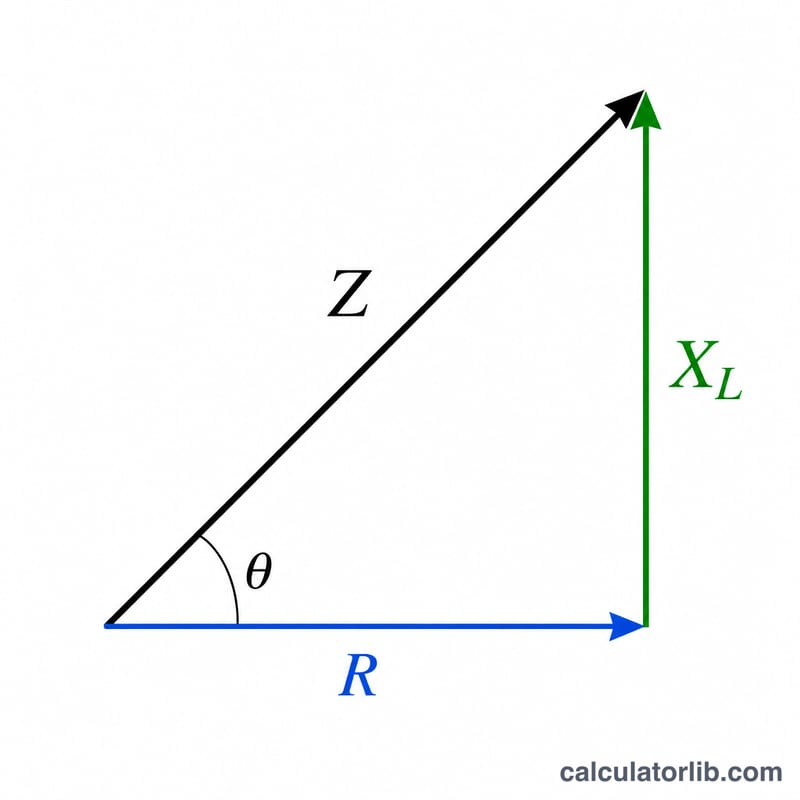
First the angular frequency is found: \(\omega = 2\pi f\). The inductive reactance is \(X_L = \omega L\). Because the resistor and inductor voltages are 90 degrees out of phase, the impedance is the vector sum:
$$|Z| = \sqrt{R^{2} + X_L^{2}}$$The phase angle, by which the source voltage leads the current, is
$$\varphi = \arctan\!\left(\frac{X_L}{R}\right)$$reported in degrees and lying between 0 and 90.
Worked Example
With \(R = 100\ \Omega\), \(L = 10\ \text{mH}\ (0.01\ \text{H})\), and \(f = 5\ \text{kHz}\ (5000\ \text{Hz})\):
$$\omega = 2\pi \times 5000 = 31415.93\ \text{rad/s}$$$$X_L = 31415.93 \times 0.01 = 314.159\ \Omega$$Then
$$|Z| = \sqrt{100^{2} + 314.159^{2}} = \sqrt{108696.04} = 329.691\ \Omega$$and
$$\varphi = \arctan(3.14159) = 72.343^{\circ}$$FAQ
What happens at DC (f = 0)? The reactance vanishes, so \(|Z| = R\) and the phase angle is \(0^{\circ}\).
What if resistance is zero (pure inductor)? Then \(|Z| = \omega L\) and the phase angle is exactly \(90^{\circ}\); the calculator handles this safely using a two-argument arctangent.
Does increasing frequency raise the impedance? Yes. Higher frequency increases \(X_L\), which increases \(|Z|\) and pushes the phase angle toward \(90^{\circ}\).