
What is impedance?
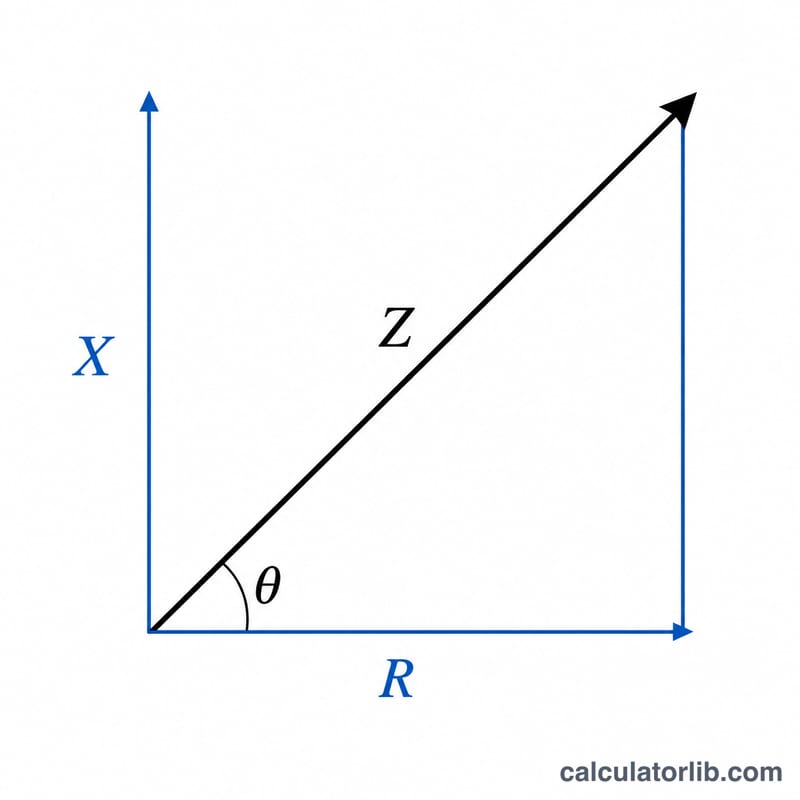
Impedance (Z) is the total opposition that a circuit presents to alternating current (AC). It combines the resistance (R), which dissipates energy, with the reactance (X), which stores and releases energy in inductors and capacitors. Because resistance and reactance act at right angles to each other in the complex plane, you cannot simply add them — instead you combine them as the hypotenuse of a right triangle.
How to use this calculator
Enter the resistance R in ohms and the net reactance X in ohms, then read off the impedance magnitude Z and the phase angle θ. The net reactance is the inductive reactance minus the capacitive reactance: \(X = X_{L} - X_{C}\). A positive X means the circuit is inductive; a negative X means it is capacitive. Either sign gives the same magnitude of Z because the term is squared, but the phase angle keeps the sign.
The formula explained
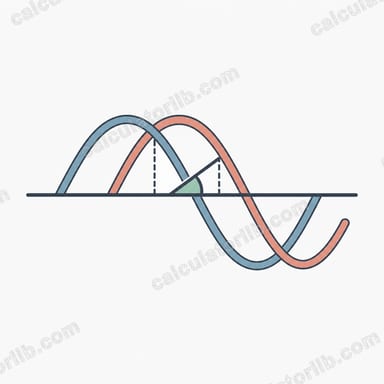
The impedance magnitude is given by $$Z = \sqrt{\text{R}^{2} + \text{X}^{2}}$$ The phase angle is $$\theta = \arctan\!\left(\frac{\text{X}}{\text{R}}\right) \times \frac{180}{\pi}$$ measured in degrees, telling you how far the current lags (inductive) or leads (capacitive) the voltage.
Worked example
Suppose R = 3 Ω and X = 4 Ω. Then $$Z = \sqrt{3^{2} + 4^{2}} = \sqrt{9 + 16} = \sqrt{25} = 5\ \Omega$$ The phase angle is \(\theta = \arctan(4 / 3) \approx 53.13°\), so the current lags the voltage by about 53 degrees.
FAQ
Can X be negative? Yes. A capacitive circuit has negative net reactance. The magnitude of Z is unaffected, but the phase angle becomes negative.
What if X = 0? Then the circuit is purely resistive and \(Z = R\), with a phase angle of 0°.
Is impedance the same as resistance? No. Resistance applies to DC and to the real part of AC opposition; impedance is the full AC opposition including reactive effects.