
What Is Acoustic Impedance?
Acoustic impedance (\(Z\)) describes how much a medium resists the passage of sound waves. It is a fundamental property in acoustics, ultrasound imaging, sonar, and audio engineering. The characteristic acoustic impedance of a medium is simply the product of its density and the speed of sound traveling through it. Its SI unit is the rayl (Pa·s/m), often expressed in MRayl (millions of rayls) for solids and liquids.
How to Use This Calculator
Enter the density of the medium (\(\rho\)) in kilograms per cubic meter and the speed of sound (\(c\)) through that medium in meters per second. The calculator multiplies the two values to return the acoustic impedance in rayls, plus a convenient MRayl figure. Typical inputs: water ≈ 1000 kg/m³ and 1480 m/s; air ≈ 1.21 kg/m³ and 343 m/s.
The Formula Explained
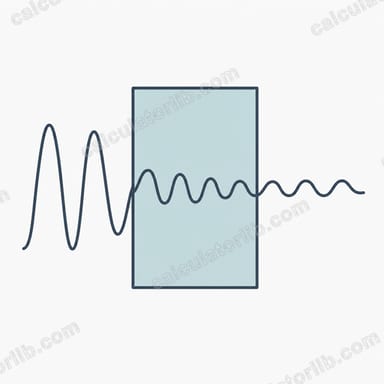
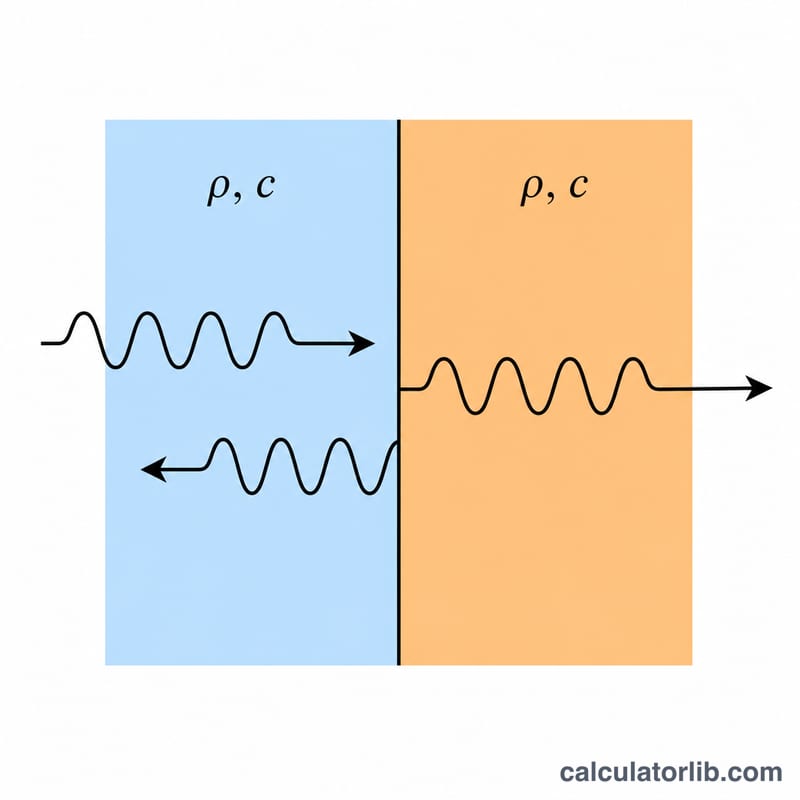
The relationship is $$Z = \rho \times c$$ Density (\(\rho\)) measures the mass packed into a volume, while the speed of sound (\(c\)) reflects how stiff and elastic the medium is. A denser, stiffer medium resists wave motion more, giving a higher impedance. When two media meet, the difference (mismatch) in their impedances determines how much sound is reflected versus transmitted — the principle behind ultrasound gel, which matches skin impedance to reduce reflection.

Worked Example
For water at 25 °C: \(\rho = 1000\ \text{kg/m}^3\) and \(c = 1480\ \text{m/s}\). Then $$Z = 1000 \times 1480 = 1{,}480{,}000\ \text{Pa}\cdot\text{s/m}$$ or 1.48 MRayl. This value closely matches the impedance of soft tissue, which is why ultrasound passes through the body so effectively.
FAQ
What unit is acoustic impedance measured in? The rayl (Pa·s/m). One MRayl equals one million rayls.
Why does impedance matter? The impedance mismatch between two media governs how much acoustic energy is reflected at their boundary — critical for imaging, coatings, and sound insulation.
What is the impedance of air? About 415 rayls (\(1.21\ \text{kg/m}^3 \times 343\ \text{m/s}\)), far lower than water or tissue, which is why a strong reflection occurs at air–tissue boundaries.