
What Is Speaker Impedance?
Speaker impedance is the electrical resistance (in ohms, Ω) that a speaker presents to an amplifier. When you connect multiple speakers to one amplifier channel, the way you wire them — in series or in parallel — changes the total impedance the amp "sees." Getting this right protects your amplifier and ensures efficient power transfer. This calculator works for any speakers and amplifiers worldwide; impedance math is universal.
How to Use This Calculator
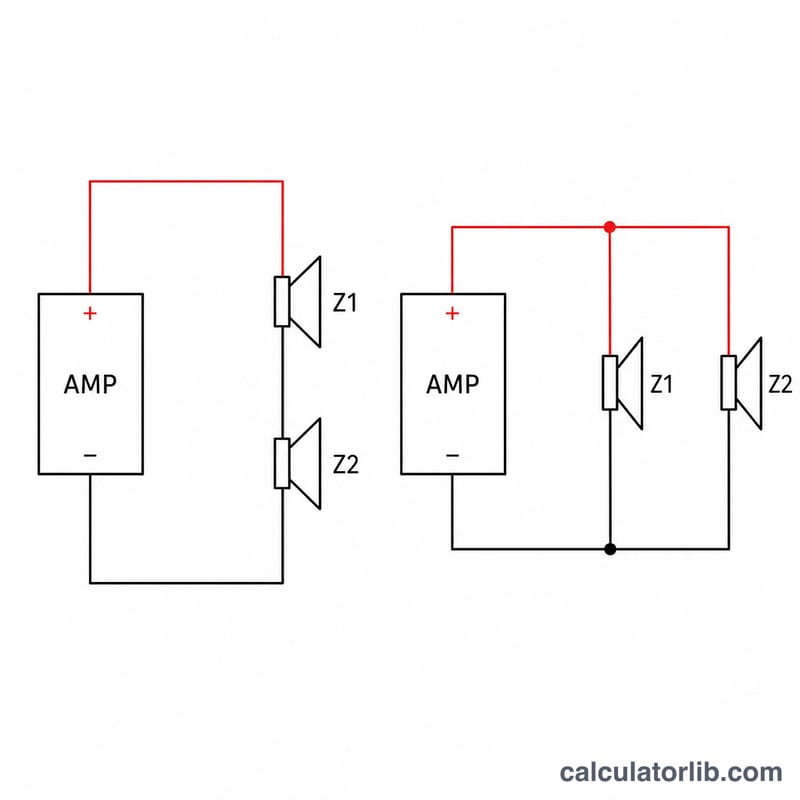
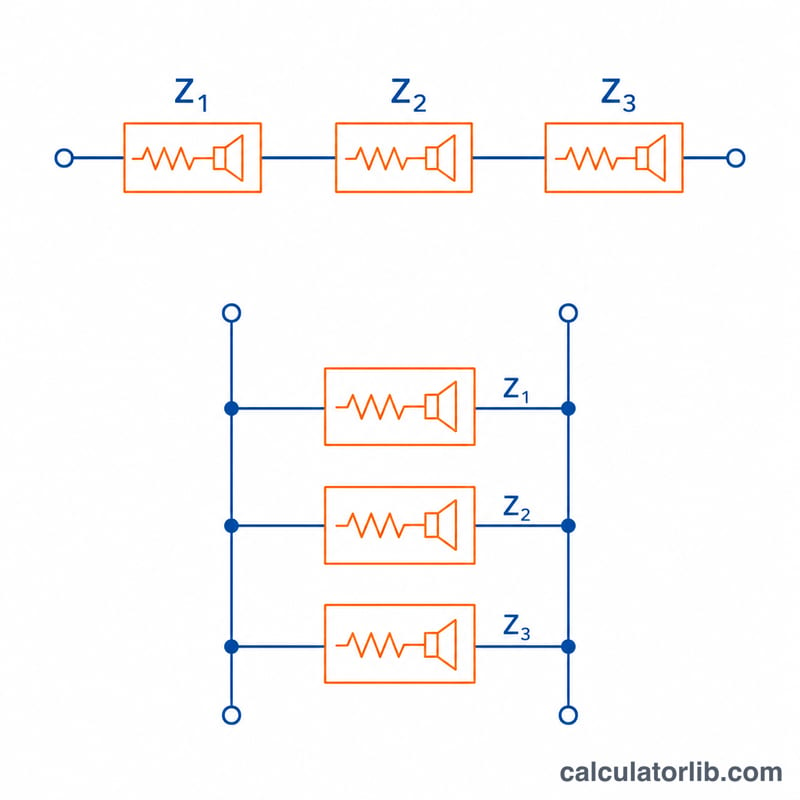
Choose whether your speakers are wired in series (one after another, positive of one to negative of the next) or parallel (all positives together, all negatives together). Then enter the impedance of each speaker in ohms — leave unused boxes blank or zero. The calculator returns the combined impedance load.
The Formula Explained
For series wiring, impedances simply add up: \(Z = Z_1 + Z_2 + \ldots\). Two 8 Ω speakers in series make a 16 Ω load. For parallel wiring, you sum the reciprocals and invert: \(\frac{1}{Z} = \frac{1}{Z_1} + \frac{1}{Z_2} + \ldots\). Two 8 Ω speakers in parallel make a 4 Ω load. Parallel wiring lowers impedance and draws more current; series raises it.
Worked Example
Suppose you have four 8 Ω speakers wired in parallel. Then $$\frac{1}{Z} = \frac{1}{8} + \frac{1}{8} + \frac{1}{8} + \frac{1}{8} = \frac{4}{8} = 0.5,$$ so \(Z = \frac{1}{0.5} = \) 2 Ω. Many amplifiers are rated to a 2 Ω minimum, so this is the practical floor for a 4-speaker parallel array of 8 Ω drivers.
FAQ
Can I mix series and parallel? Yes — series-parallel networks balance load and power. Calculate each branch separately, then combine. What load is safe for my amp? Never go below your amplifier's rated minimum impedance (often 2, 4, or 8 Ω); a lower load can overheat or damage it. Why does parallel reduce impedance? Adding parallel paths gives current more routes to flow, lowering total resistance — just like resistors in parallel.