
What Is the Weld Metal Weight Calculator?
This calculator estimates the amount of deposited weld metal needed for an equal-leg fillet weld. Knowing the weld metal weight helps you order the right quantity of filler wire or electrodes, estimate consumable cost, and plan welding time. The tool uses metric units (millimetres for the leg, metres for the length) and works for any material once you set its density.
How to Use It
Enter the fillet weld leg size in millimetres, the total weld length in metres, and the material density in grams per cubic centimetre (steel is about \(7.85\)). The calculator returns the deposited weld metal weight in kilograms, along with the cross-sectional area and volume.
The Formula Explained
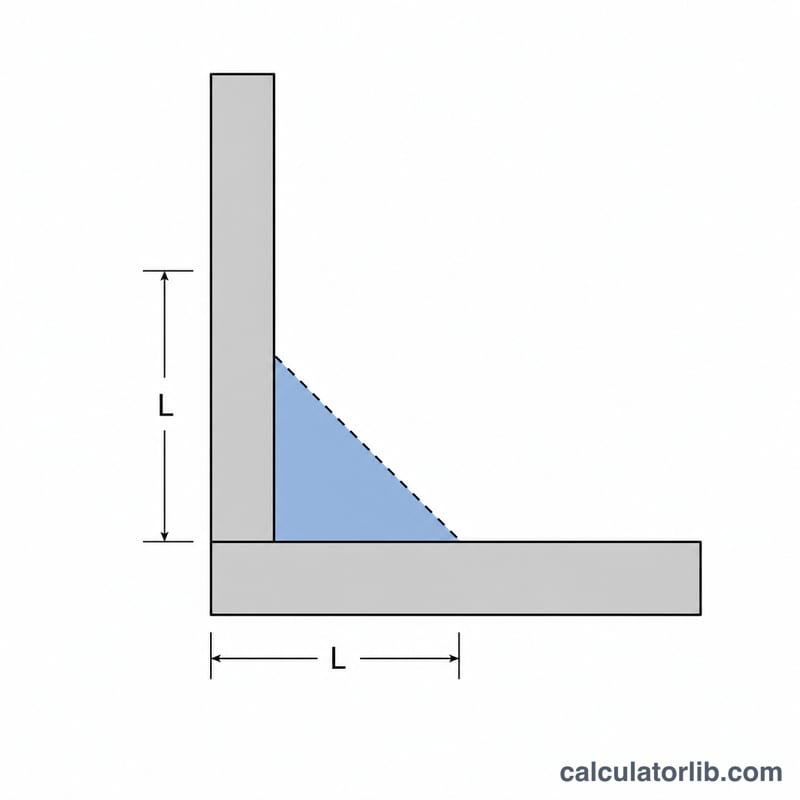
An equal-leg fillet weld has a triangular cross-section, so its area is half the leg squared. Multiplying by length gives volume, and multiplying by density gives weight:
$$A = \frac{L^2}{2}, \qquad W = A \times \ell \times \rho$$where \(A\) = cross-sectional area in mm², \(L\) = leg size in mm, \(\ell\) = weld length, and \(\rho\) = density. Unit conversions are handled internally so the result comes out in kilograms.
Worked Example
For a \(6\,\text{mm}\) fillet weld, \(2\,\text{m}\) long, in steel (\(7.85\,\text{g/cm}^3\)):
$$A = \frac{6^2}{2} = 18\,\text{mm}^2$$ $$V = 18\,\text{mm}^2 \times 2000\,\text{mm} = 36000\,\text{mm}^3 = 36\,\text{cm}^3$$ $$W = 36 \times 7.85 = 282.6\,\text{g} = 0.2826\,\text{kg}$$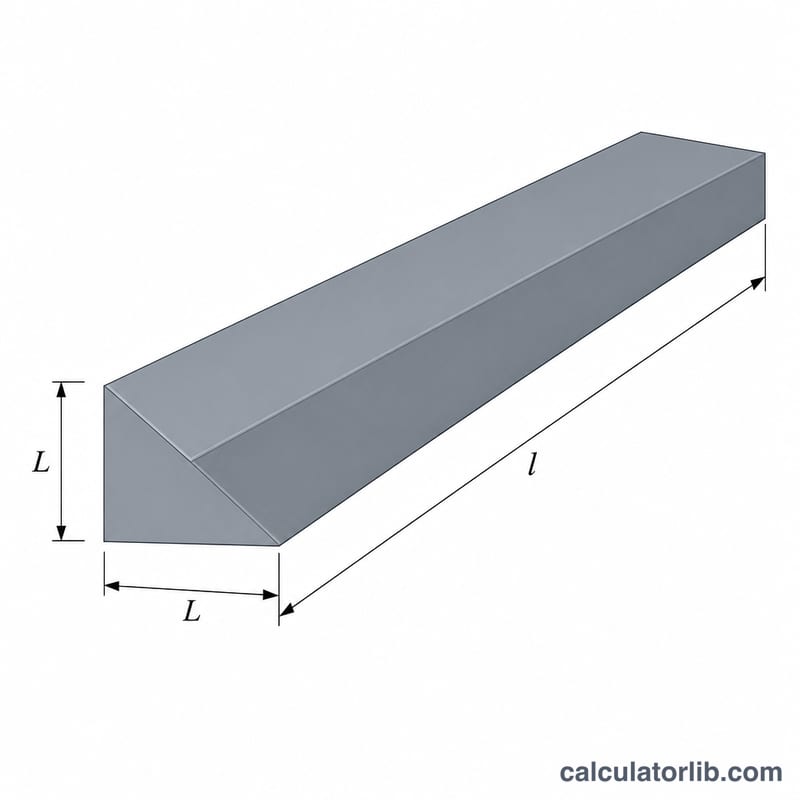
FAQ
Does this include reinforcement or convexity? No — it assumes a flat, theoretical triangular fillet. Real welds with convex faces deposit more, so add 10–25% for a safety margin.
What about filler efficiency and spatter? This is the deposited weight only. To find filler purchased, divide by the deposition efficiency of your process (e.g. 0.95 for solid MIG wire, ~0.65 for stick).
Can I use it for other metals? Yes. Change the density: aluminium ≈ 2.70, stainless ≈ 7.95, copper ≈ 8.96 g/cm³.