
What is the Log Weight Calculator?
The Log Weight Calculator estimates how much a log or piece of round timber weighs based on its diameter, length and the density of the wood. By modelling the log as a cylinder, it computes the timber's volume and multiplies by the wood density to give a practical weight estimate — handy for transport planning, firewood sales, forestry work and DIY projects.
How to use it
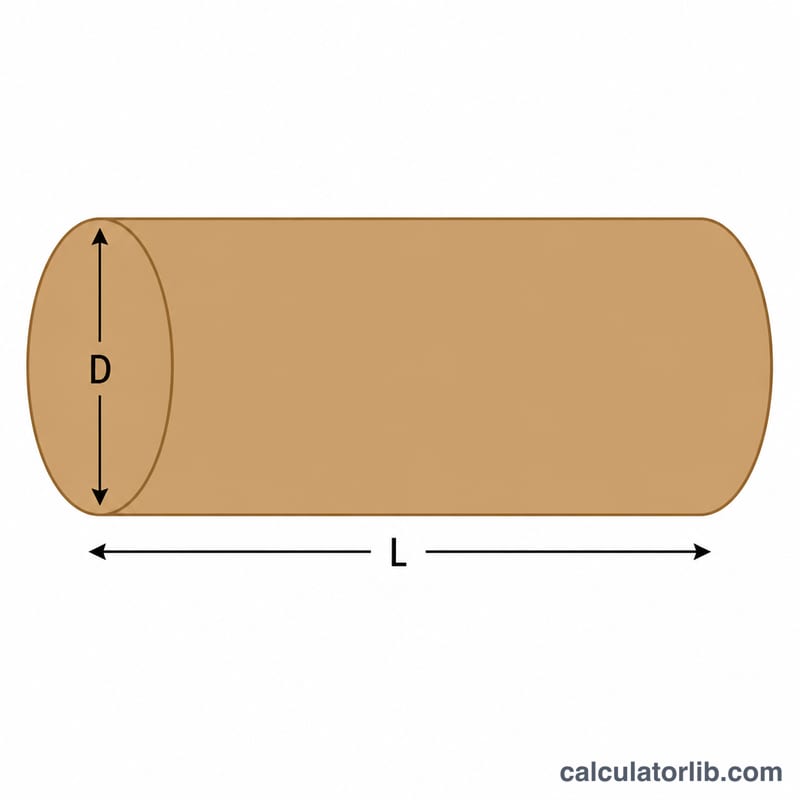
Enter the log's diameter in centimetres (measure across the middle), its length in metres, and the wood density in kilograms per cubic metre. Click calculate to see the estimated weight in kilograms along with the log's volume. Typical densities: pine ≈ 500, fir ≈ 450, oak ≈ 700, beech ≈ 720, and freshly cut "green" logs ≈ 900–1000 because of their moisture content.
The formula explained
A log is approximated as a cylinder. Its volume is \(V = \pi \times r^{2} \times L\), where \(r\) is the radius (half the diameter) and \(L\) is the length, both in metres. Weight is then \(W = V \times \rho\), where \(\rho\) is the density. The full formula is:
$$W = \pi \left(\frac{\text{Diameter (cm)}}{200}\right)^{2} \cdot \text{Length (m)} \cdot \text{Density (kg/m}^3\text{)}$$The calculator converts the diameter from centimetres to metres automatically.
Worked example
For a log 30 cm in diameter, 3 m long, with oak density 700 kg/m³: the radius is 0.15 m, so volume:
$$V = \pi \times 0.15^{2} \times 3 = 0.2121 \text{ m}^3$$Weight:
$$W = 0.2121 \times 700 \approx 148.4 \text{ kg}$$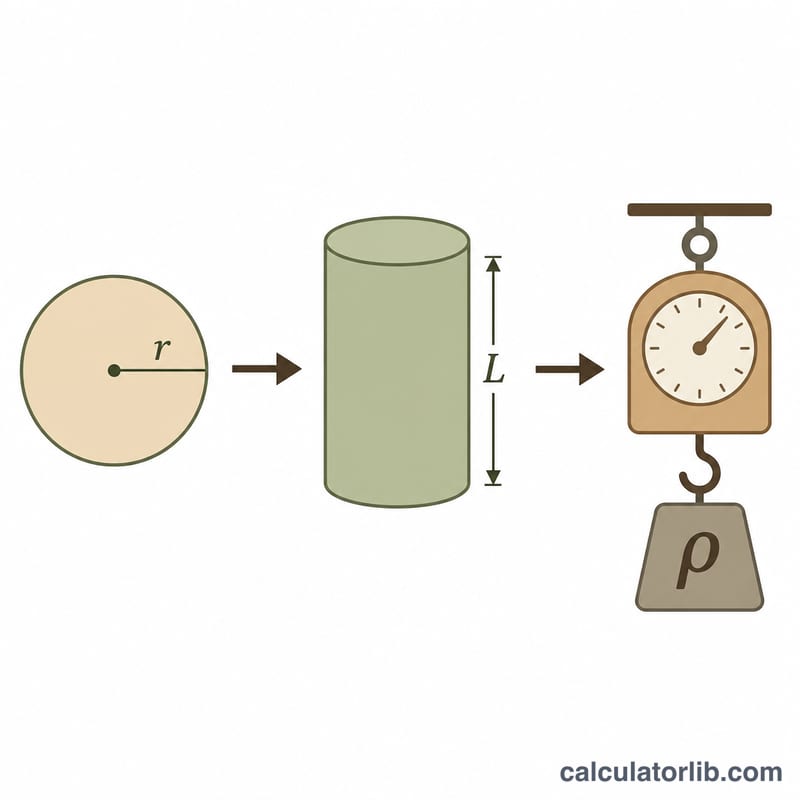
FAQ
Why does my result differ from the actual weight? Logs are not perfect cylinders — they taper, have bark and may be hollow — and moisture content varies a lot, so treat the figure as an estimate.
How do I find wood density? Use a species reference table; green (freshly felled) wood is much heavier than seasoned wood.
Can I use it for firewood? Yes — it's a good way to estimate the load weight for transport and pricing.