
What is the Steel Weight Calculator?
This tool estimates the mass of structural steel from its physical dimensions. Whether you are pricing material, planning a lift, or checking shipping weights, knowing the weight of a steel bar, plate or sheet helps you order and handle it safely. It works for round bars, square bars, rectangular flats and plates/sheets, and lets you set the quantity and material density.
How to use it
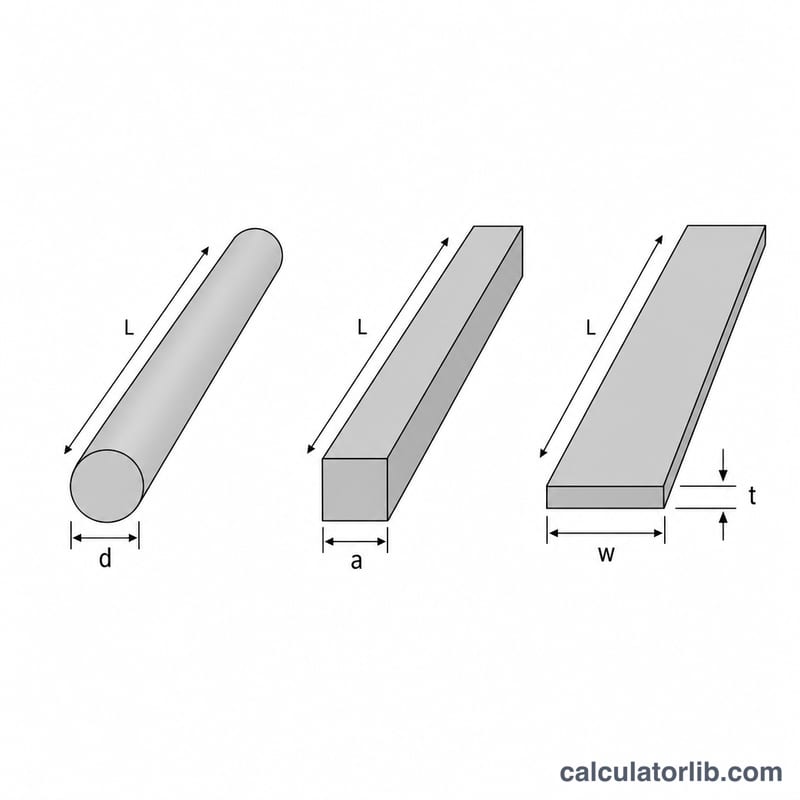
Pick the steel shape, then enter the relevant dimensions in millimetres and the length in metres. For a round bar, enter the diameter; for a square bar, the side width; for rectangular bars and plates, enter both width and thickness. Set the quantity to multiply across identical pieces. The default density of 7850 kg/m³ matches common carbon steel — change it for stainless (~8000) or other alloys.
The formula explained
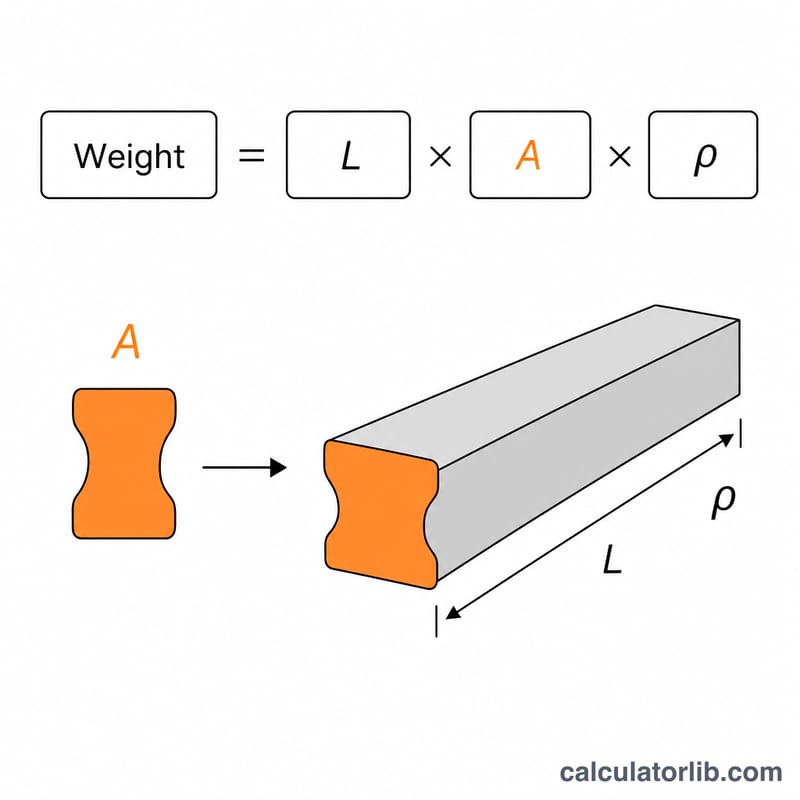
The core relationship is Weight = Volume × Density. Volume is the cross-sectional area multiplied by the length. For a round bar the area is \(\pi \cdot (d/2)^{2}\); for a square it is \(s^{2}\); for a rectangle or plate it is \(\text{width} \times \text{thickness}\). Because dimensions are entered in millimetres, each is divided by 1000 to convert to metres before computing the area in square metres and volume in cubic metres. Multiplying by density (kg/m³) yields kilograms.
Worked example
A round steel bar with a 20 mm diameter, 6 m long: radius = 0.01 m, area = $$\pi \times 0.01^{2} \approx 0.00031416 \ \text{m}^{2}.$$ Volume = $$0.00031416 \times 6 \approx 0.0018850 \ \text{m}^{3}.$$ Weight = $$0.0018850 \times 7850 \approx 14.80 \ \text{kg}$$ per bar.
FAQ
What density should I use? Carbon steel is about 7850 kg/m³, stainless steel roughly 7900–8000 kg/m³, and cast iron near 7200 kg/m³.
Does it work for tubes or beams? This version covers solid bars, plates and sheets. For hollow sections subtract the inner volume, or use a profile-specific calculator.
Why are my dimensions in mm but length in metres? Bar/plate cross-sections are typically specified in millimetres while stock length is quoted in metres — the calculator converts both automatically.