
What is the Stone Weight Calculator?
The Stone Weight Calculator estimates how heavy a rectangular block of stone is, based on its dimensions and the density of the stone. This is useful for builders, landscapers, masons and anyone planning transport, lifting equipment or foundation loads. By default it uses a density of about 2,500 kg/m³, which is typical for common natural stone such as granite, marble and limestone, but you can change the density for any material.
How to use it
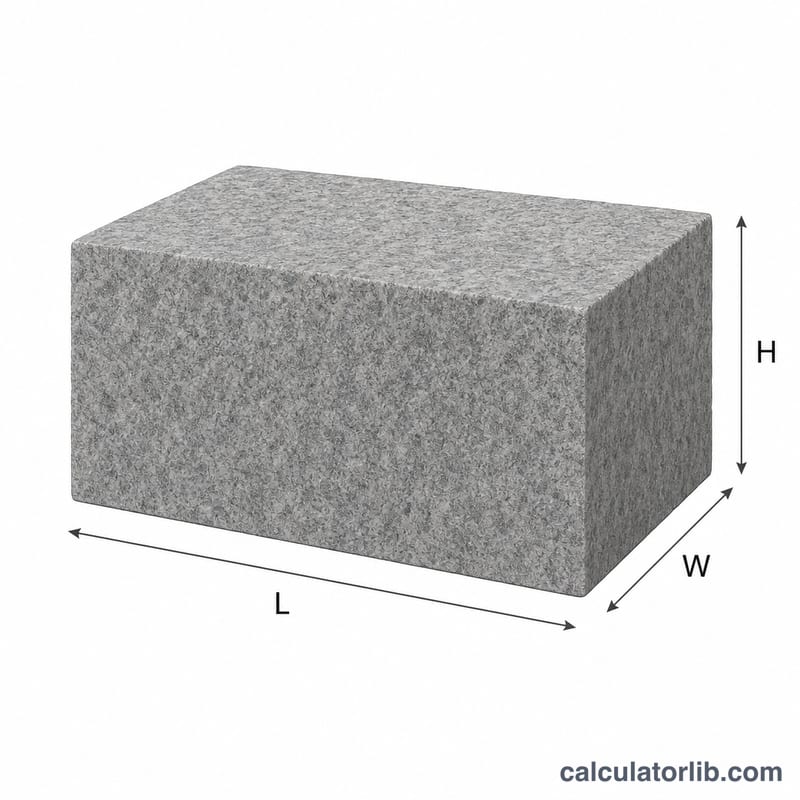
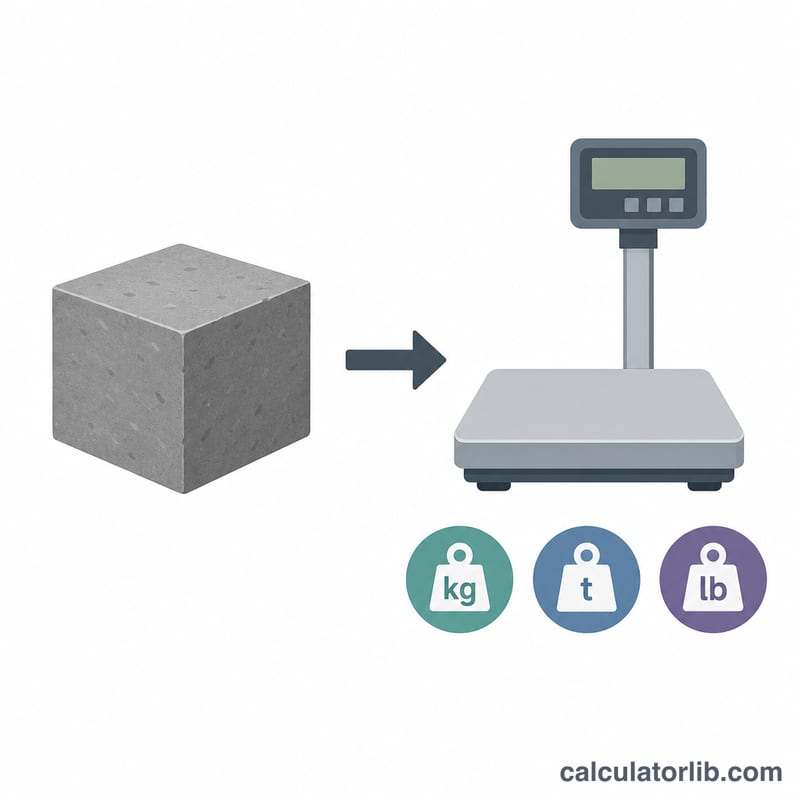
Enter the length, width and height of the stone block in metres, then enter the stone's density in kilograms per cubic metre. The calculator multiplies the three dimensions to get the volume, then multiplies by density to get the weight. Results are shown in kilograms, tonnes and pounds.
The formula explained
The core equation is $$\text{Weight} = \text{Length} \times \text{Width} \times \text{Height} \times \text{Density}$$. The first three terms produce the volume (\(V = L \times W \times H\)), measured in cubic metres. Multiplying volume by density (mass per unit volume) gives mass: a denser stone of the same size weighs more. To convert to tonnes divide kilograms by 1,000; to convert to pounds multiply kilograms by 2.20462.
Worked example
Suppose a granite block measures 2 m long, 1 m wide and 0.5 m high, with a density of 2,500 kg/m³. The volume is $$2 \times 1 \times 0.5 = 1 \text{ m}^3.$$ The weight is $$1 \times 2{,}500 = 2{,}500 \text{ kg},$$ which is 2.5 tonnes or about 5,511 pounds.
FAQ
What density should I use? Granite is roughly 2,700 kg/m³, marble about 2,600 kg/m³, limestone 2,300–2,700 kg/m³, and sandstone 2,200–2,500 kg/m³. The default 2,500 is a reasonable average for natural stone.
Does this work for irregular stones? The formula assumes a rectangular block. For irregular shapes, estimate an equivalent bounding volume or use water displacement to find the true volume, then multiply by density.
Why are my results different from a supplier? Quoted weights may include porosity, moisture or use a different density value. Always confirm the exact density of your specific material.