
What is the Concrete Block Calculator?
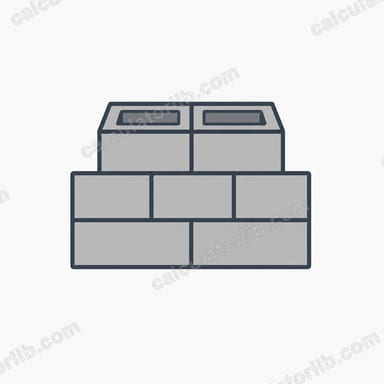
This tool estimates how many concrete masonry units (CMU blocks) you need to build a wall. Simply enter the wall dimensions and the size of a single block, and the calculator returns the total number of blocks required, including an optional waste allowance for cuts and breakage.
How to use it
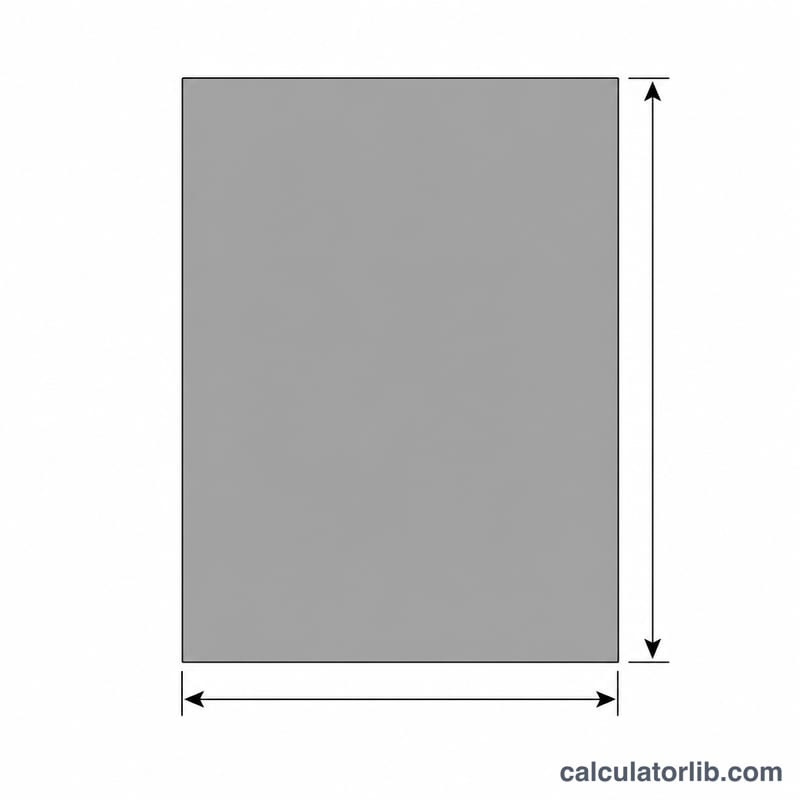
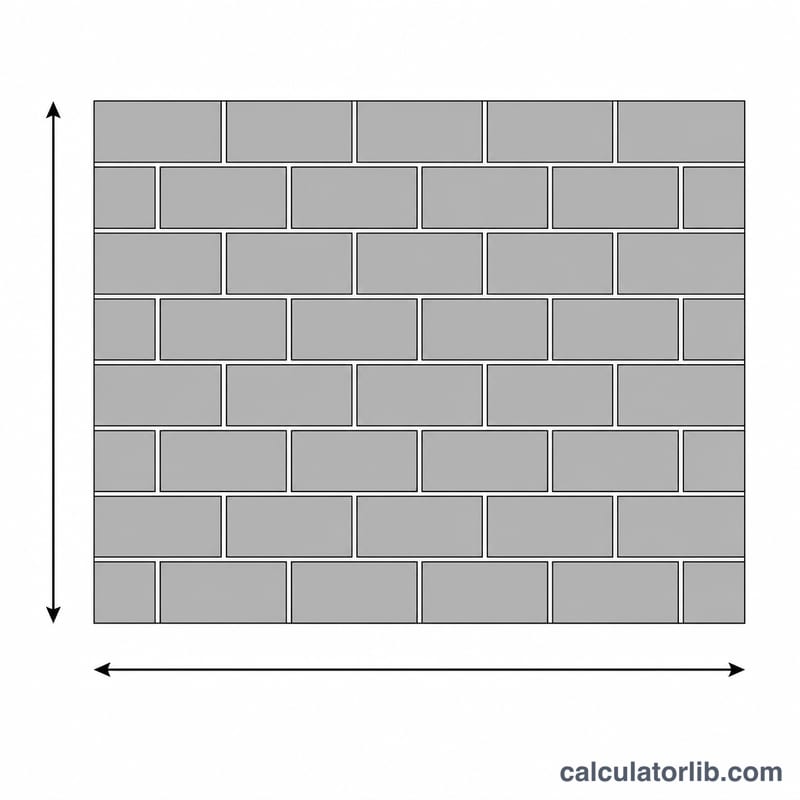
Enter the wall length and height in feet, then the length and height of one block in inches (a standard nominal block is 16 in × 8 in). Set a waste allowance — 5% to 10% is typical to cover broken or trimmed blocks. The result shows the rounded-up block count plus the wall area and per-block face area used in the math.
The formula explained
The wall area equals length × height. The face area of a single block, measured in inches, is converted to square feet by dividing by 144 (since 144 square inches = 1 square foot). Dividing wall area by block face area gives the raw block count. Multiplying by (1 + waste%) and rounding up yields the final order quantity.
$$\text{Blocks} = \left\lceil \frac{\text{Wall Length} \times \text{Wall Height}}{\dfrac{\text{Block Length} \times \text{Block Height}}{144}} \times \left(1 + \frac{\text{Waste \%}}{100}\right) \right\rceil$$
Worked example
For a 20 ft × 8 ft wall using 16 in × 8 in blocks: wall area = 160 sq ft; block face area = \((16 \times 8) \div 144 = 0.8889\) sq ft; raw blocks = \(160 \div 0.8889 = 180\). With a 5% waste allowance:
$$180 \times 1.05 = 189 \text{ blocks}$$
FAQ
Does this account for mortar joints? Use the nominal block size (which includes the standard 3/8 in joint), e.g. 16 × 8 in, rather than the actual unit size, for the most accurate count.
Should I subtract doors and windows? For a rough estimate you can ignore them; for a precise count, reduce the wall area by the opening areas before calculating.
How much waste should I add? 5–10% is common; add more for complex walls with many cuts.