
What is the Mortar Calculator?
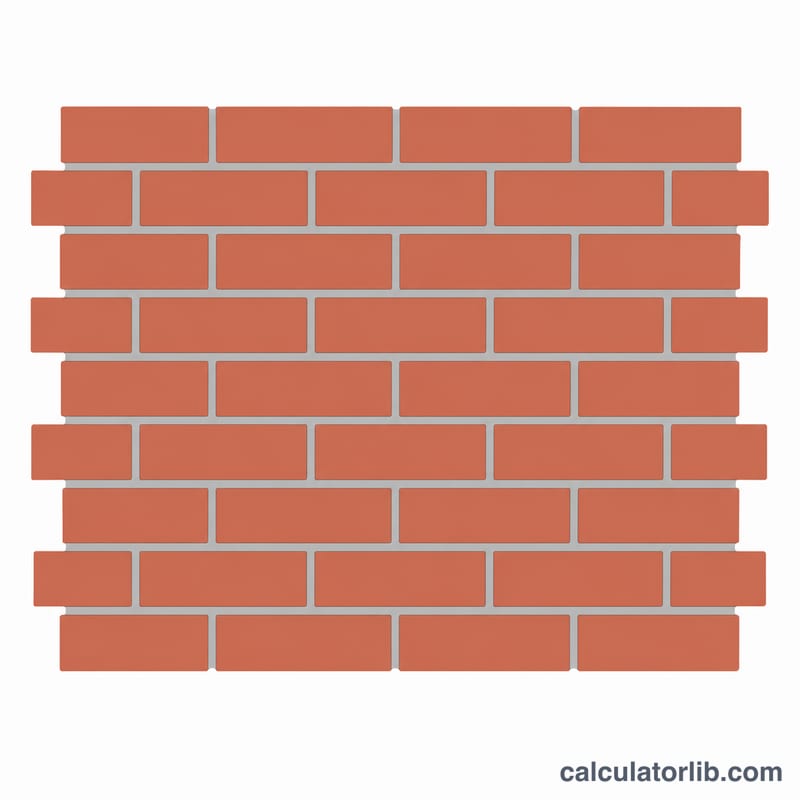
The Mortar Calculator estimates how much mortar a masonry job requires and converts that volume into the number of bags you should buy. It works for brick veneer, concrete block (CMU) walls, and similar projects where mortar is spread between units. Because mortar usage varies by unit size and joint thickness, the tool lets you set the mortar consumed per block so the estimate matches your real-world conditions.
How to use it
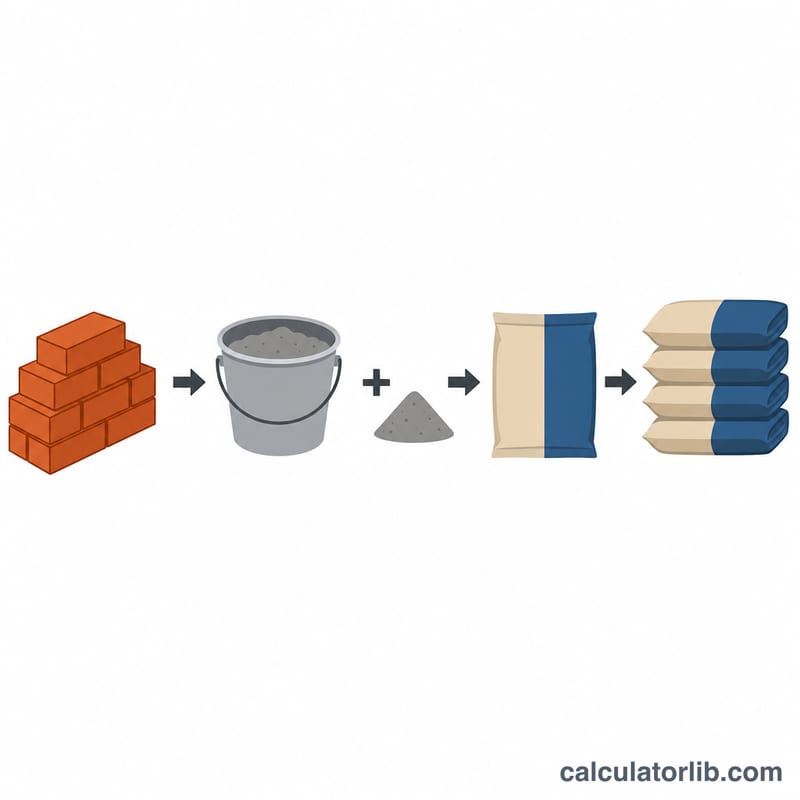
Enter the total number of blocks or bricks, the mortar required per unit (in cubic feet), the cubic-foot yield of one bag of mortar mix, and an optional waste allowance. The calculator multiplies blocks by mortar per block to get the base volume, adds your waste percentage, then divides by the bag yield and rounds up to whole bags.
The formula explained
The core relationship is mortar volume = number of blocks × mortar per block. After inflating for waste, $$\text{Bags} = \left\lceil \frac{V \times \left(1 + \frac{\text{Waste \%}}{100}\right)}{\text{Bag Yield (ft}^3\text{/bag)}} \right\rceil$$. A typical standard concrete block consumes roughly 0.10–0.15 cubic feet of mortar, and an 80 lb bag of mortar mix yields close to 1 cubic foot, though you should always confirm against the manufacturer's data sheet.
Worked example
Suppose you are laying 100 blocks, each needing 0.125 cu ft of mortar, with a bag yield of 1.0 cu ft and a 10% waste allowance. Base volume = \(100 \times 0.125 = 12.5\) cu ft. With waste: \(12.5 \times 1.10 = 13.75\) cu ft. Bags = \(\lceil 13.75 \div 1.0 \rceil = 14\) bags.
FAQ
How much mortar does one block use? Roughly 0.10 to 0.15 cubic feet for a standard 8×8×16 in. block, depending on joint thickness and waste.
Why round up the bag count? You cannot buy a fraction of a bag, and partially used mix sets quickly, so the result is always rounded up.
What waste allowance should I use? 5–15% is common to cover spillage, dropped mortar, and uneven joints; 10% is a safe default.