
What Is Air Changes per Hour (ACH)?
Air changes per hour (ACH) measures how many times the entire volume of air in a room is replaced with fresh or filtered air in one hour. It is a key metric in HVAC design, indoor air quality (IAQ), infection control, and clean-room engineering. A higher ACH means faster dilution of pollutants, odors, and airborne contaminants.
How to Use This Calculator
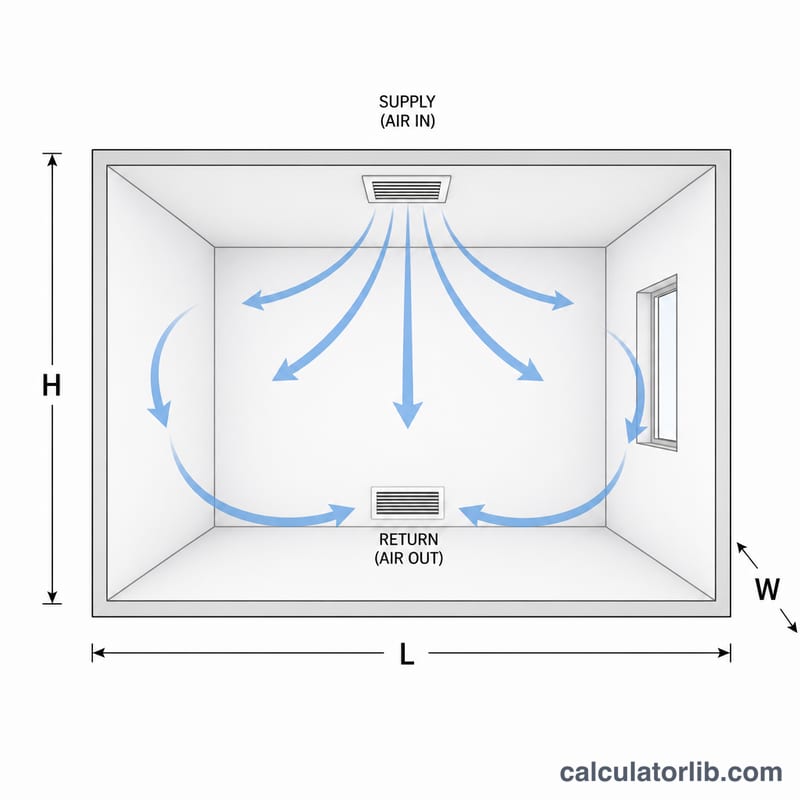
Enter the supply airflow in CFM (cubic feet per minute) delivered to the room, then enter the room's length, width, and ceiling height in feet. The calculator computes the room volume and returns the air changes per hour. Typical targets range from 4–6 ACH for offices, 6–12 ACH for kitchens, and 12+ ACH for labs or hospital isolation rooms.
The Formula Explained
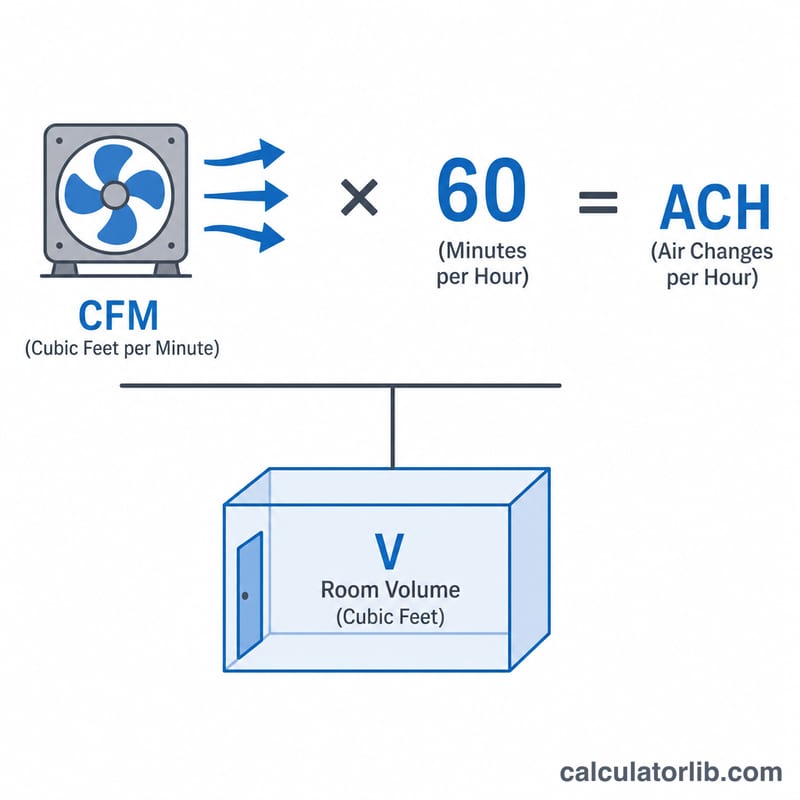
The equation is $$\text{ACH} = \dfrac{\text{CFM} \times 60}{\text{Room Volume (ft}^3)}$$ CFM is multiplied by 60 to convert cubic feet per minute into cubic feet per hour. Dividing by the room volume (\(L \times W \times H\)) tells you how many full room volumes flow through each hour.
Worked Example
Suppose a fan supplies 200 CFM into a room measuring 12 ft × 10 ft × 8 ft. The volume is $$V = 12 \times 10 \times 8 = 960 \text{ ft}^3.$$ Then $$\text{ACH} = \frac{200 \times 60}{960} = \frac{12{,}000}{960} = 12.5$$ air changes per hour.
Recommended ACH by Room Type
Air changes per hour (ACH) is the number of times the entire air volume of a room is replaced in one hour. Recommended ACH depends heavily on occupancy, contaminant load, and the governing standard. The values below are typical design targets drawn from widely referenced standards; always confirm against the current edition of the applicable code for your jurisdiction.
| Space type | Typical ACH range | Primary basis / standard |
|---|---|---|
| Residential living areas / bedrooms | 0.35 – 1 | ASHRAE 62.2 (minimum dwelling ventilation) |
| Bathrooms | 6 – 8 | ASHRAE 62.2 / local mechanical code |
| Residential kitchens | 7 – 8 (exhaust-driven) | ASHRAE 62.2 |
| Offices | 4 – 10 | ASHRAE 62.1 |
| Classrooms | 4 – 6 | ASHRAE 62.1 |
| Restaurants / dining | 8 – 12 | ASHRAE 62.1 |
| Commercial kitchens | 15 – 30 | ASHRAE 62.1 / IMC |
| Operating rooms | ≥ 20 (min. 4 outdoor) | ASHRAE 170 / FGI |
| Airborne infection isolation (AII) rooms | ≥ 12 (new), ≥ 6 (existing) | CDC / ASHRAE 170 |
| Laboratories (general) | 6 – 12 | ASHRAE 170 / NFPA 45 |
| Clean room ISO 8 | ~5 – 48 | ISO 14644-1 |
| Clean room ISO 7 | ~30 – 60 | ISO 14644-1 |
| Clean room ISO 6 | ~90 – 180 | ISO 14644-1 |
| Clean room ISO 5 | ~240 – 600 (often unidirectional) | ISO 14644-1 |
Note: ISO 14644-1 itself specifies particle-count limits rather than ACH; the air-change ranges shown are common industry design guidelines used to achieve those classes. Hospital values follow ASHRAE Standard 170 and CDC infection-control guidance.
ACH Across Common Scenarios
The table below applies the formula \(\text{ACH} = \dfrac{\text{CFM} \times 60}{\text{Volume (ft}^3)}\) to several realistic room and airflow combinations. Volume is length × width × height; CFM is the supplied airflow.
| Space | Dimensions (L×W×H ft) | Volume (ft³) | Airflow (CFM) | ACH |
|---|---|---|---|---|
| Small bedroom | 10 × 10 × 8 | 800 | 100 | 7.5 |
| Large living room | 20 × 15 × 9 | 2,700 | 200 | 4.44 |
| Office | 15 × 12 × 9 | 1,620 | 200 | 7.41 |
| Kitchen | 12 × 10 × 9 | 1,080 | 200 | 11.11 |
| Conference room | 24 × 16 × 9 | 3,456 | 400 | 6.94 |
| Open work area | 40 × 30 × 10 | 12,000 | 400 | 2 |
If you instead know the ACH you want and need to find the required airflow, reverse the calculation with the CFM Airflow Calculator: for the small bedroom, hitting 7.5 ACH in 800 ft³ requires 100 CFM.
FAQ
What is a good ACH for a home? Living spaces typically aim for 4–6 ACH, while bathrooms and kitchens benefit from higher rates.
How do I find the required CFM for a target ACH? Rearrange the formula: \(\text{CFM} = \dfrac{\text{ACH} \times V}{60}\).
Does this account for filtration efficiency? No—ACH measures total airflow turnover, not the fraction of particles removed. Pair it with filter ratings (e.g., MERV or HEPA) for full IAQ analysis.