
What Is the Air Conditioner BTU Calculator?
BTU (British Thermal Unit) measures the amount of heat an air conditioner can remove from a room each hour. Choosing the right BTU rating matters: an undersized unit will run constantly and never cool the space, while an oversized unit cycles on and off too quickly, wasting energy and leaving the air humid. This calculator gives you a quick, practical estimate of the cooling capacity your room needs.
How to Use It
Enter the floor area of the room in square feet, the number of people who regularly use it, and the room's sun exposure. The tool returns a recommended capacity in BTU per hour and the equivalent in refrigeration "tons" (1 ton = 12,000 BTU). Round up to the nearest standard unit size when shopping.
The Formula Explained
The widely used rule of thumb is 25 BTU per square foot of living space:
$$\text{BTU} = \text{Area}_{\text{sqft}} \times 25$$We then refine that base figure: each occupant beyond the first two adds 600 BTU, because people generate body heat. A very sunny room gets a 10% boost, a heavily shaded one a 10% reduction, and a kitchen adds a flat 4,000 BTU to account for the stove and appliances.
$$\text{BTU}_{\text{final}} = (\text{BTU} + 600(n-2)) \times f_{\text{sun}}$$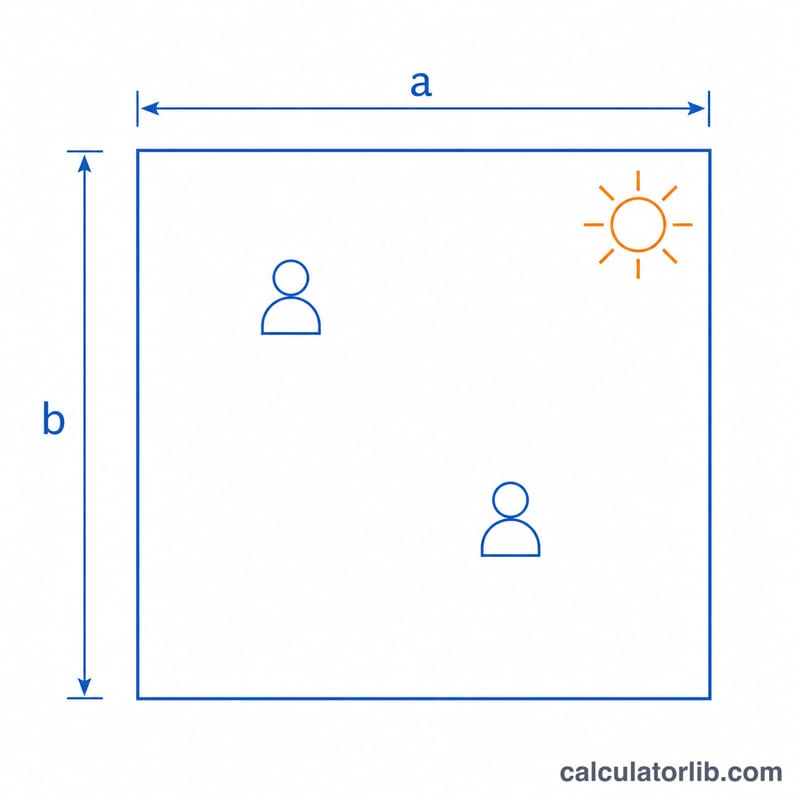
Worked Example
Consider a 300 sq ft sunny living room with 2 occupants. Base load = \(300 \times 25 = 7{,}500\) BTU. There are no extra occupants beyond two, so no occupant add-on. Because the room is very sunny, multiply by 1.10:
$$7{,}500 \times 1.10 = 8{,}250 \text{ BTU}$$which is about 0.69 tons. A 9,000 BTU window unit would comfortably cover it.
Adjustment Factors
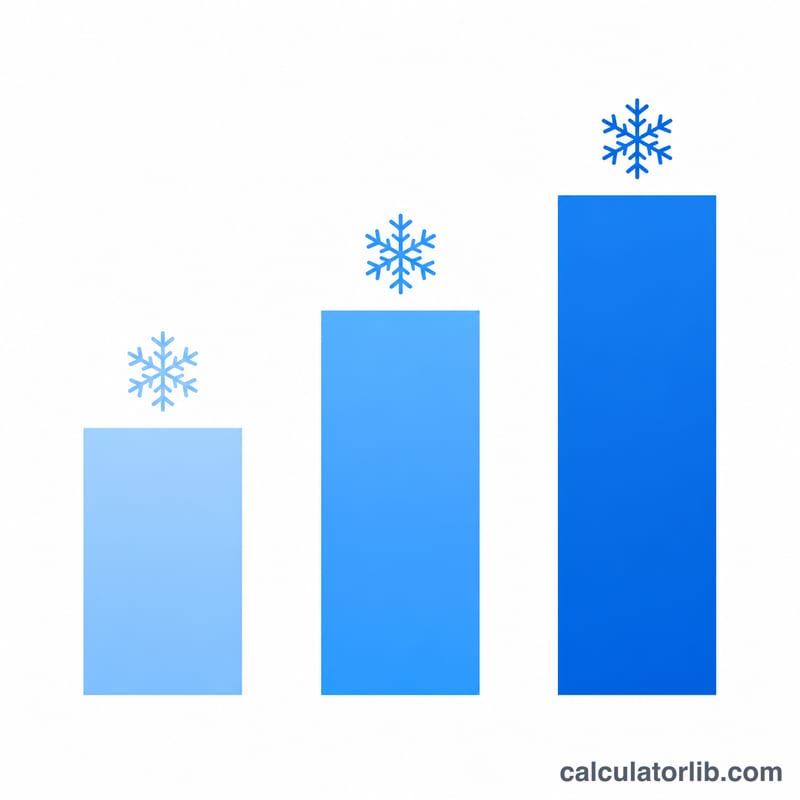
Apply these corrections to the baseline capacity after you read it from the room-size table. Multipliers stack, and the flat additions are summed onto the result.
| Condition | Adjustment | Notes |
|---|---|---|
| Very sunny room | +10% (×1.10) | Rooms with large south/west-facing windows or heavy afternoon sun |
| Heavily shaded room | −10% (×0.90) | North-facing or shaded by trees/adjacent buildings |
| Each occupant beyond 2 | +600 BTU per person | People add sensible and latent heat load |
| Kitchen | +4,000 BTU (flat) | Accounts for heat from cooking appliances |
| High ceilings (over 8 ft) | +10% to +20% | More air volume to cool; scale with ceiling height |
For example, a baseline of 6,000 BTU in a very sunny room with 4 occupants becomes \(6000 \times 1.10 + 600 \times (4-2) = 6600 + 1200 = 7800\) BTU.
FAQ
How many BTUs do I need per square foot? The standard estimate is 20–25 BTU per square foot; this tool uses 25 for a safe margin.
What is a "ton" of cooling? One ton equals 12,000 BTU per hour, originally the cooling power of a ton of melting ice over 24 hours.
Should I size up if my ceilings are high? Yes. The standard formula assumes 8 ft ceilings; for taller rooms add roughly 10–20% more capacity.