What This Calculator Does
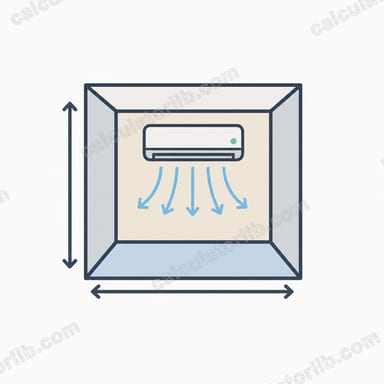
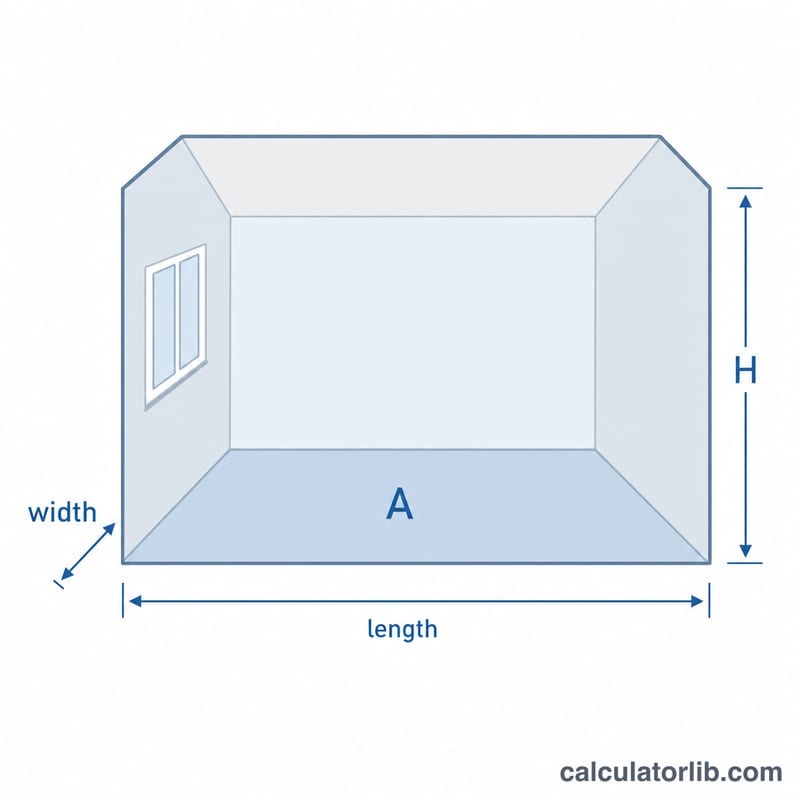
Estimate the cooling capacity (in BTU/hr and tons) needed for an air conditioner to cool a room comfortably. The calculation starts from the room's square footage and adjusts for ceiling height, insulation, sun exposure, occupants, room type, and climate.
The BTU Sizing Method
This calculator uses the simplified Manual-J–style sizing rule favoured by HVAC contractors for residential rooms:
$$\text{BTU} = A \times 20 \text{ BTU/sq ft}$$ (base, assuming 8-ft ceiling)
Then multiplied by adjustment factors:
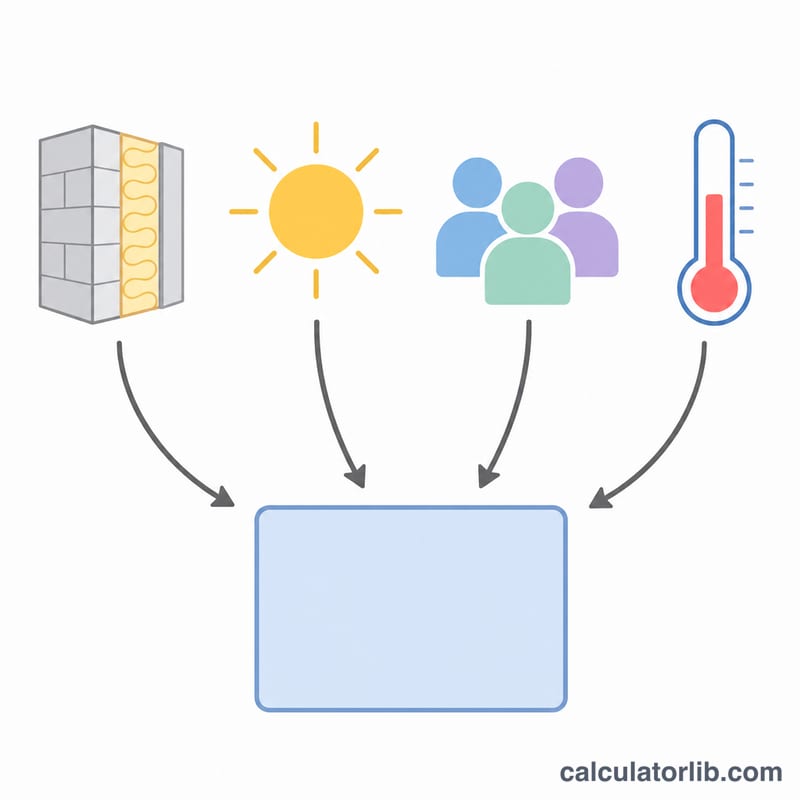
- Ceiling height: ratio above 8 ft (e.g., 10-ft ceiling \(\times 1.25\))
- Insulation: good \(\times 0.85\) / average \(\times 1.0\) / poor \(\times 1.2\)
- Sun exposure: shaded \(\times 0.9\) / average \(\times 1.0\) / sunny \(\times 1.1\)
- Climate: cold \(\times 0.85\) / temperate \(\times 1.0\) / hot \(\times 1.15\)
- Kitchen: + 4,000 BTU (heat from cooking)
- Each extra occupant beyond 2: + 600 BTU
Picking the Right AC Unit
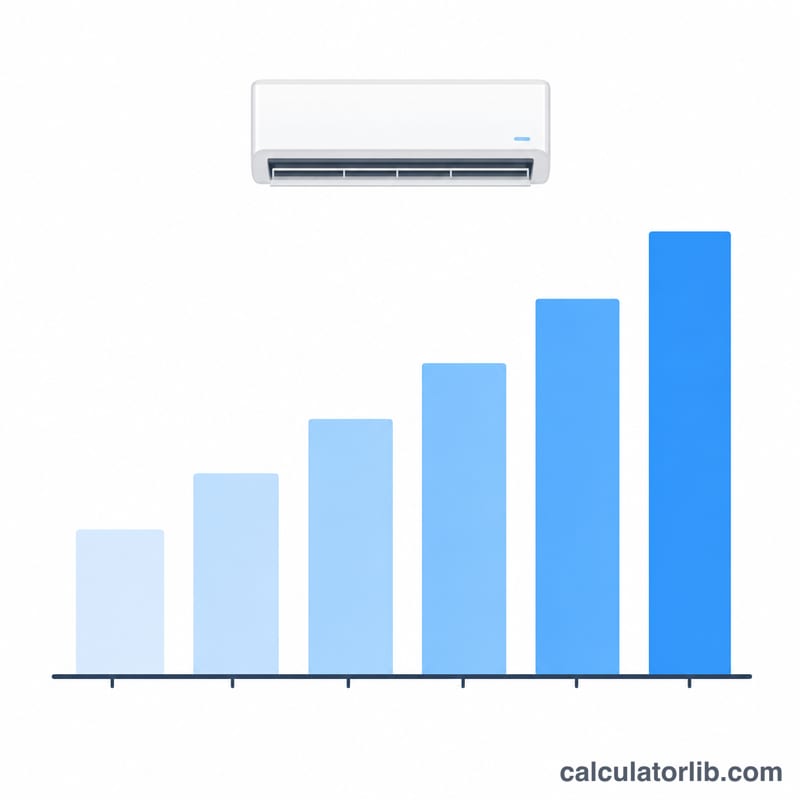
Air conditioners are sold in standard sizes. After computing the required BTU, round UP to the next available unit:
| BTU/hr | Tons | Typical Room |
|---|---|---|
| 5,000 | 0.42 | 100–150 sq ft |
| 6,000 | 0.50 | 150–250 sq ft |
| 8,000 | 0.67 | 300–350 sq ft |
| 10,000 | 0.83 | 400–450 sq ft |
| 12,000 | 1.00 | 450–550 sq ft |
| 18,000 | 1.50 | 700–1,000 sq ft |
| 24,000 | 2.00 | 1,400–1,500 sq ft |
| 30,000 | 2.50 | 1,500–2,000 sq ft |
One ton of cooling = 12,000 BTU/hr — the unit central-AC contractors quote. The conversion is $$\text{Tons} = \frac{\text{BTU}}{12{,}000}$$
Why Right-Sizing Matters
- Undersized AC runs continuously, never reaches set temperature, wastes energy, and has a short lifespan.
- Oversized AC short-cycles (kicks on/off too quickly), leaves humidity high (room feels clammy), wears out the compressor faster, and costs more upfront.
- Aim within \(\pm 10\%\) of calculated BTU. If between two unit sizes, pick the smaller one — modern AC runs efficiently near full load.
Heating BTU vs Cooling BTU
This calculator estimates cooling BTU. For heating, the same Manual-J approach applies but the climate factor matters more (cold winters need 30–40 BTU/sq ft, mild winters 20–25). For furnaces or heat pumps in cold climates, expect 30–40 BTU/sq ft; in mild climates, 20–25 is typical.
Caveats
- This is a rule-of-thumb estimate — for new construction or major renovation, hire an HVAC pro to do a full Manual-J load calc that accounts for window orientation, wall R-values, infiltration, and duct losses.
- Excludes humidity removal capacity. In humid climates (Houston, Saigon), look for an AC with a high SHR (sensible heat ratio) — undersized "humidity-cool" units leave rooms muggy.
- Excludes solar gain through specific windows. A 50 sq ft west-facing window in summer can add 5,000 BTU/hr — major impact this calc only loosely captures.
Key Terms Explained
- BTU/hr (British Thermal Unit per hour)
- A rate of heat transfer. One BTU is the energy needed to raise one pound of water by 1°F; air-conditioner capacity is rated as the BTUs of heat the unit can remove per hour. Higher BTU/hr means more cooling power.
- Ton of cooling
- A traditional capacity unit equal to 12,000 BTU/hr — historically the cooling produced by melting one ton of ice over 24 hours. A "1.5-ton" unit is 18,000 BTU/hr.
- Manual J
- The industry-standard residential load-calculation method published by ACCA. It accounts in detail for walls, windows, infiltration, orientation and local design temperatures. Quick rule-of-thumb estimates like this calculator approximate, but do not replace, a full Manual J.
- Cooling load
- The total amount of heat (in BTU/hr) that must be removed from a space to hold it at the desired temperature. It combines heat from the sun, walls, occupants, lights and appliances.
- Short-cycling
- When an oversized unit cools the air quickly, switches off, then restarts soon after. Frequent on/off cycles waste energy, wear out the compressor and leave humidity behind because the unit never runs long enough to dehumidify.
- Oversizing / Undersizing
- Oversizing (too many BTUs) causes short-cycling and poor humidity control; undersizing (too few BTUs) leaves the room warm and forces the unit to run continuously. Sizing within roughly 10–20% above the calculated load is the practical target.
- Set temperature
- The thermostat setpoint you want the room to maintain. A lower setpoint relative to outdoor temperature increases the cooling load the unit must satisfy.