What This Calculator Does
Enter any date and instantly get the day of the week (Monday through Sunday). Useful for planning anniversaries, scheduling future appointments, retrieving the weekday of a historical event, or simply checking what day of the week a particular date will fall on.
How It Works
The calculator uses the proleptic Gregorian calendar — the modern calendar projected backward through history regardless of when each region adopted it. Internally, it computes the day-of-week using Java's LocalDate.getDayOfWeek(), which is bug-free and correct for any year ±10⁶.
Manual algorithms like Zeller's Congruence and the Doomsday Algorithm produce the same result, with formulas that take year, month, and day as input and return a number 0–6 mapping to weekday.
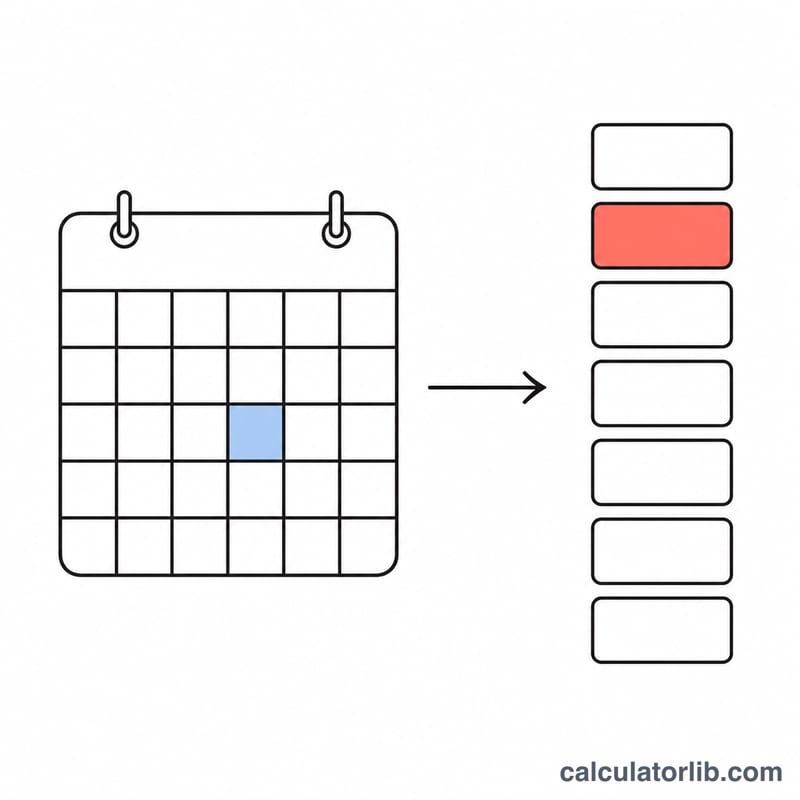
Zeller's Congruence (For the Curious)
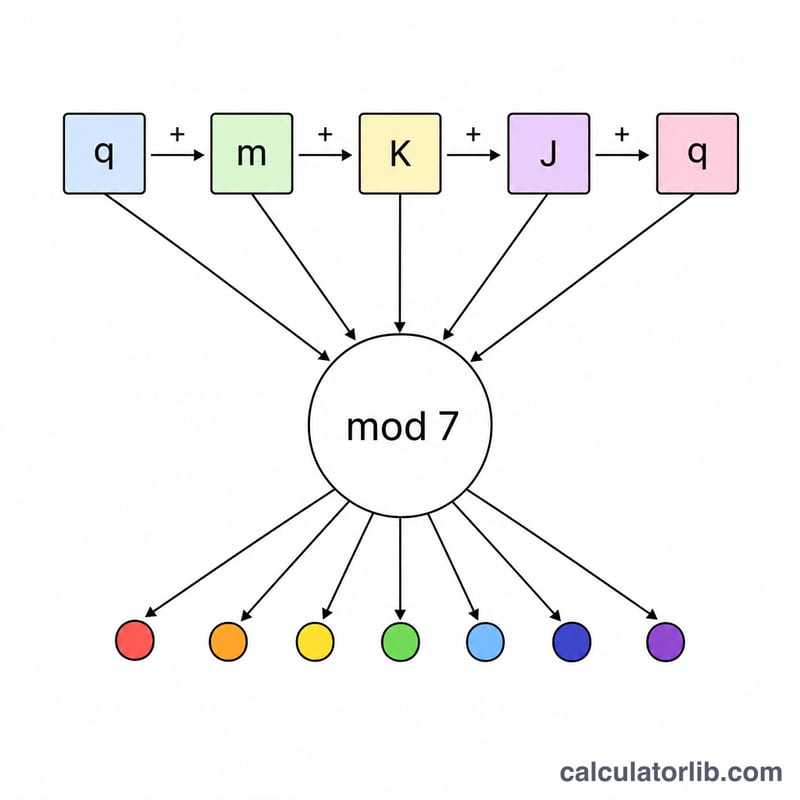
$$h = \left( q + \left\lfloor \frac{13(m+1)}{5} \right\rfloor + K + \left\lfloor \frac{K}{4} \right\rfloor + \left\lfloor \frac{J}{4} \right\rfloor - 2J \right) \bmod 7$$
where:
- \(q\) = day of month
- \(m\) = month (3 = March … 14 = February of previous year; January and February are treated as months 13 and 14 of the previous year)
- \(K = \text{year} \bmod 100\)
- \(J = \left\lfloor \text{year} / 100 \right\rfloor\)
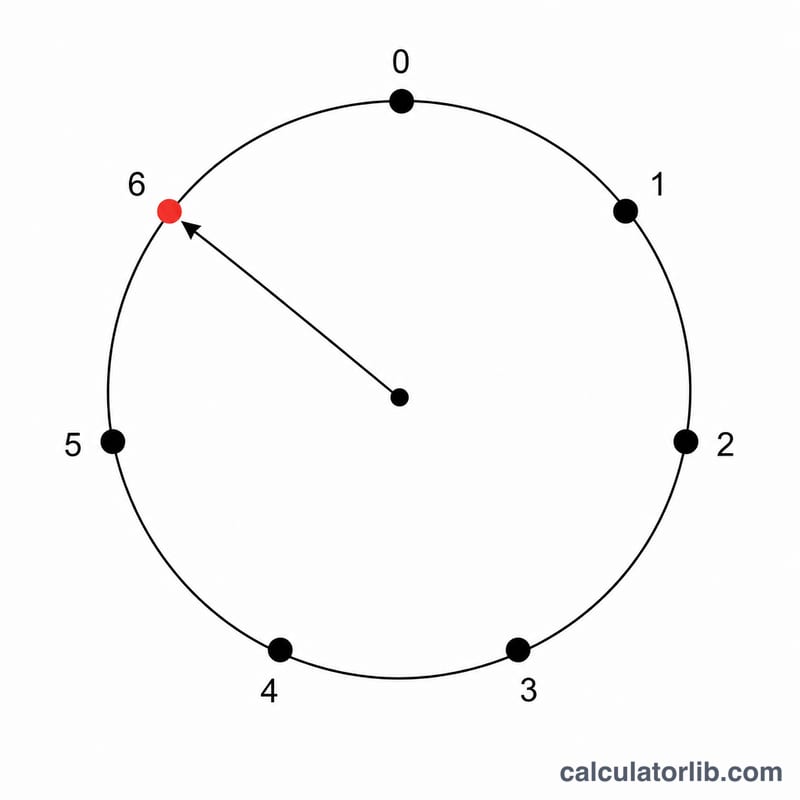
- \(h\) = 0 (Saturday), 1 (Sunday), 2 (Monday)…
Doomsday Algorithm (Easier Mental Math)
John Conway's algorithm for computing day-of-week mentally. Each year has a "Doomsday" — a known weekday that 4/4, 6/6, 8/8, 10/10, 12/12 always fall on, plus 9/5 (5/9 in some notations), 7/11, 11/7. Knowing the Doomsday for a year lets you walk forward/backward to any date.
Doomsday for the 2000s = Tuesday. So 4/4/2024 was a Thursday (… wait, let me verify by the calculator).
Calendar Notes
- Gregorian calendar. Adopted in 1582 by Catholic countries (skipping Oct 5–14 to align with the seasons). Britain and colonies didn't switch until 1752 (skipping Sep 3–13). This calculator uses Gregorian for all dates regardless.
- Leap years. Year is leap if divisible by 4, EXCEPT centuries (divisible by 100) which need to also be divisible by 400. So 2000 was leap, 1900 was not.
- Year 0. Doesn't exist in the Anno Domini system — 1 BC immediately precedes 1 AD. The calculator's underlying library uses ISO-8601 numbering where year 0 = 1 BC.
Common Uses
- Birthday checks: "What day was I born on?" — useful for trivia or celestial-alignment fans.
- Planning anniversaries: "What day will our 25th anniversary fall on in 2049?"
- Historical research: Match journal entries to actual weekdays of events.
- Scheduling: Verify a future date isn't a weekend before booking.