
What is the Solar Elevation Angle?
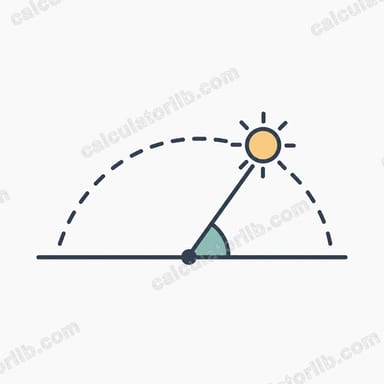
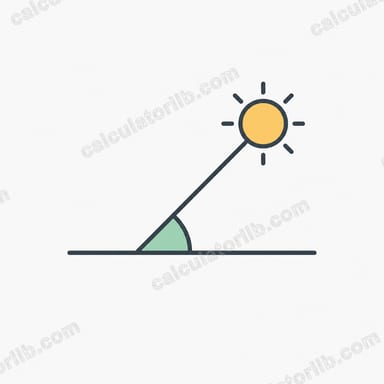
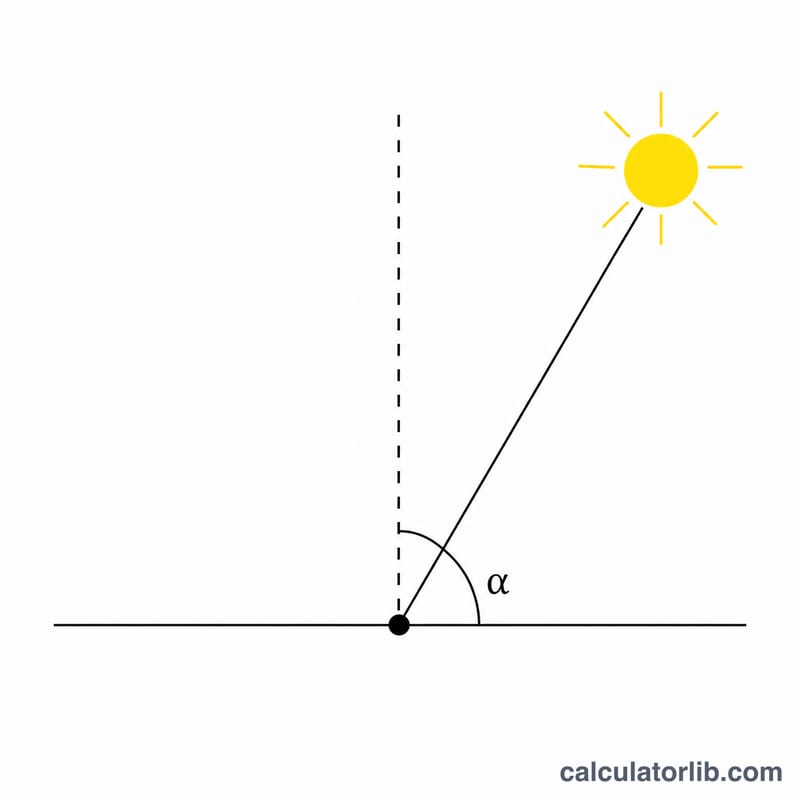
The solar elevation angle (also called the solar altitude angle, \(\alpha\)) is the angle between the Sun and the local horizon. It is 0° at sunrise and sunset, reaches its maximum at solar noon, and is negative when the Sun is below the horizon. Knowing the Sun's elevation is essential for solar panel placement, shadow analysis, daylighting design, and astronomy. This calculator is universal — it works for any location on Earth.
How to Use the Calculator
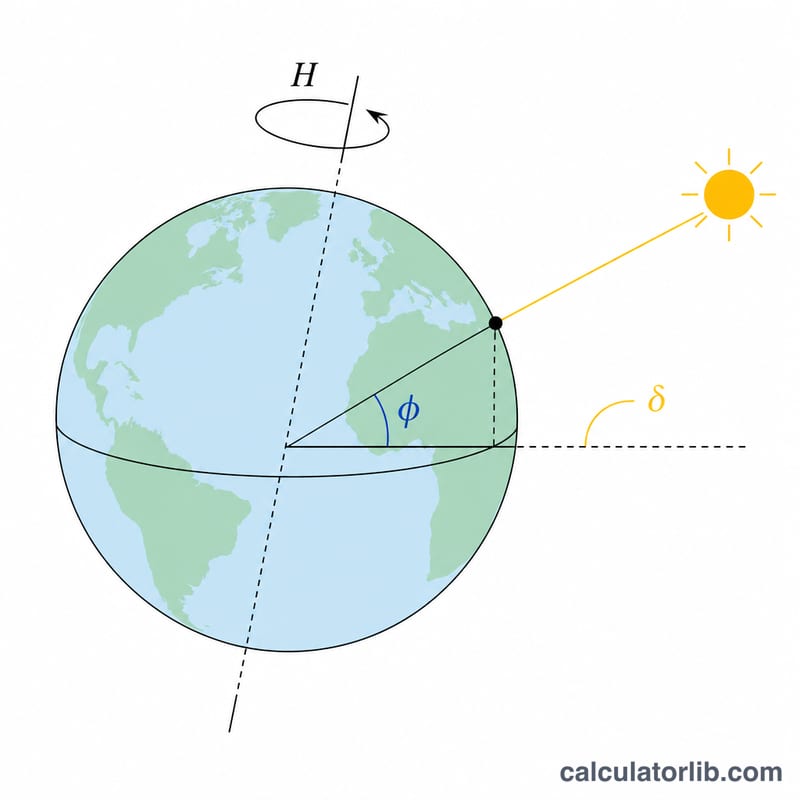
Enter three values: your latitude (positive for the Northern Hemisphere, negative for the Southern), the solar declination \(\delta\) for the date (ranges from −23.45° to +23.45° over the year, and is 0° at the equinoxes), and the hour angle \(H\) (0° at solar noon, +15° per hour after noon, −15° per hour before noon). The tool returns the elevation angle, the complementary zenith angle, and the raw sine value.
The Formula Explained
The position is found with:
$$\alpha = \arcsin\!\left( \sin\phi \sin\delta + \cos\phi \cos\delta \cos H \right)$$
where \(\phi\) is latitude, \(\delta\) is solar declination, and \(H\) is the hour angle. All angles are converted to radians internally. Taking the inverse sine gives the elevation \(\alpha\), and the zenith angle is simply \(90° - \alpha\).
Worked Example
At latitude \(\phi = 40°\), declination \(\delta = 20°\), and solar noon (\(H = 0°\)): $$\sin(\alpha) = \sin 40° \cdot \sin 20° + \cos 40° \cdot \cos 20° \cdot 1 = 0.6428 \cdot 0.3420 + 0.7660 \cdot 0.9397 = 0.2199 + 0.7198 = 0.9397$$ So \(\alpha = \arcsin(0.9397) \approx 70°\), and the zenith angle is about 20°.
FAQ
What is the hour angle? It measures the Sun's position relative to solar noon, increasing 15° for each hour. Morning hours are negative, afternoon hours positive.
How do I get the solar declination? A common approximation is \(\delta = 23.45° \cdot \sin\!\left( \frac{360 \cdot (284 + N)}{365} \right)\), where \(N\) is the day of the year.
Why is my elevation negative? A negative result means the Sun is below the horizon — it is nighttime or twilight at that hour angle.