
What Is the Solar Panel Tilt Angle Calculator?
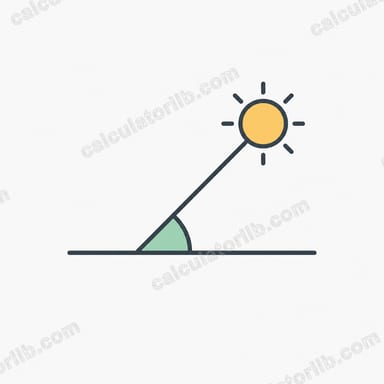
The tilt angle is the vertical angle between your solar panels and the horizontal ground. Getting it right is one of the cheapest ways to squeeze more energy out of a photovoltaic system. This calculator uses your location's latitude to estimate the optimal fixed tilt for year-round output, plus recommended seasonal adjustments for summer and winter.

How to Use It
Enter the absolute value of your latitude (between 0° and 90°). You can look it up by searching your city on any map service. The calculator returns three angles: a year-round angle equal to your latitude, a summer angle (latitude minus 15°), and a winter angle (latitude plus 15°). All angles are measured from the horizontal — 0° is flat, 90° is vertical.
The Formula Explained
The sun's average height in the sky over a year is closely tied to your latitude, so a fixed panel tilted to match your latitude captures sunlight near-perpendicularly on average. In summer the sun rides higher, so reducing the tilt by about 15° points panels more skyward. In winter the sun sits low, so adding about 15° aims them lower toward the horizon. The result is clamped to the valid 0°–90° range.
$$\begin{gathered} \theta_{\text{annual}} = \left|\,\text{Latitude}\,\right| \\[1.5em] \text{where}\quad \left\{ \begin{aligned} \theta_{\text{summer}} &= \left|\,\text{Latitude}\,\right| - 15^{\circ} \\ \theta_{\text{winter}} &= \left|\,\text{Latitude}\,\right| + 15^{\circ} \end{aligned} \right. \end{gathered}$$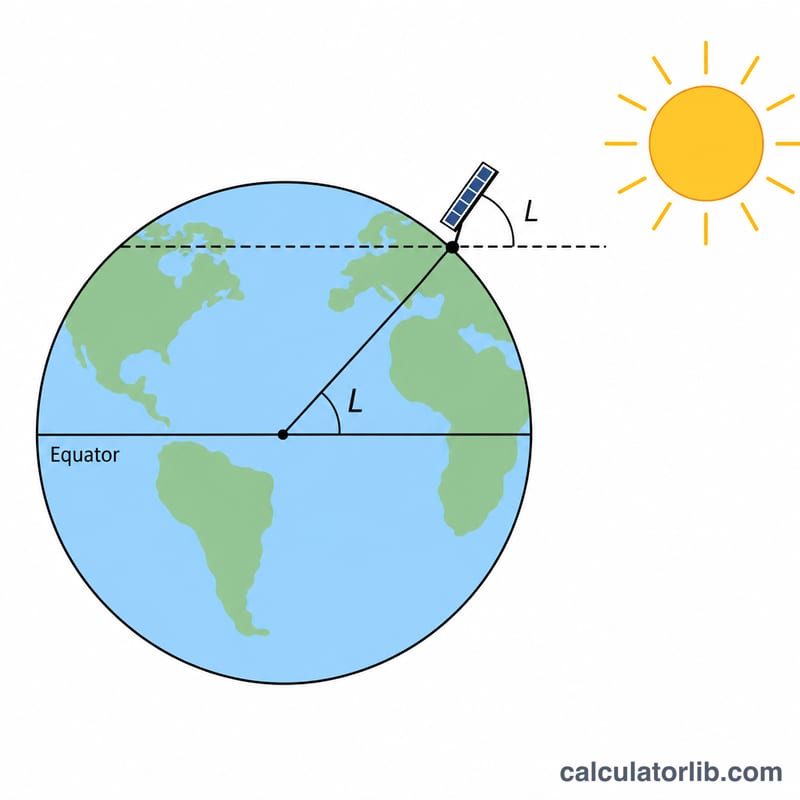
Worked Example
For a site at latitude 40°: the year-round tilt is 40°, the summer tilt is \(40 - 15 = 25^{\circ}\), and the winter tilt is \(40 + 15 = 55^{\circ}\). A two-season adjustment between 25° and 55° can boost annual output by a few percent compared with a single fixed angle.
FAQ
Does hemisphere matter? Use the absolute latitude value for the tilt. Only the panel's facing direction changes — south in the Northern Hemisphere, north in the Southern Hemisphere.
How often should I adjust the tilt? Twice a year (spring and autumn) captures most of the seasonal benefit. Monthly tuning adds only marginal gains.
Is latitude the perfect angle? It's an excellent rule of thumb. Local climate, shading, and snow can shift the ideal by a few degrees, but latitude-based tilt is reliable for most installations.