What it does
This calculator estimates how large a solar photovoltaic (PV) system you need to cover your electricity use. Enter your average daily energy consumption, the peak sun hours for your location, a performance ratio that accounts for real-world losses, and the wattage of the panels you plan to install. It returns the required system size in kilowatts (kW) and how many panels that works out to.
How to use it
1. Daily Energy Use — your average daily consumption in kWh (divide a monthly bill by ~30). 2. Peak Sun Hours — the equivalent hours of full-strength sun per day for your area, typically 3–6. 3. Performance Ratio — a factor (commonly 0.75–0.85) for inverter losses, heat, wiring and soiling. 4. Panel Wattage — the rated output of a single panel, e.g. 400 W.
The formula explained
System kW = Daily kWh ÷ (Peak Sun Hours × Performance Ratio). Multiplying peak sun hours by the performance ratio gives the effective generation per kW installed each day, so dividing your demand by it gives the kW you must install. Panel count = ceil(System kW × 1000 ÷ Panel Watt), rounded up so capacity is never short.
$$ \text{Size}_{kW} = \frac{\text{Daily Use (kWh)}}{\text{Sun Hours} \times \text{Perf. Ratio}} $$$$ N = \left\lceil \frac{1000 \cdot \text{Size}_{kW}}{\text{Panel (W)}} \right\rceil $$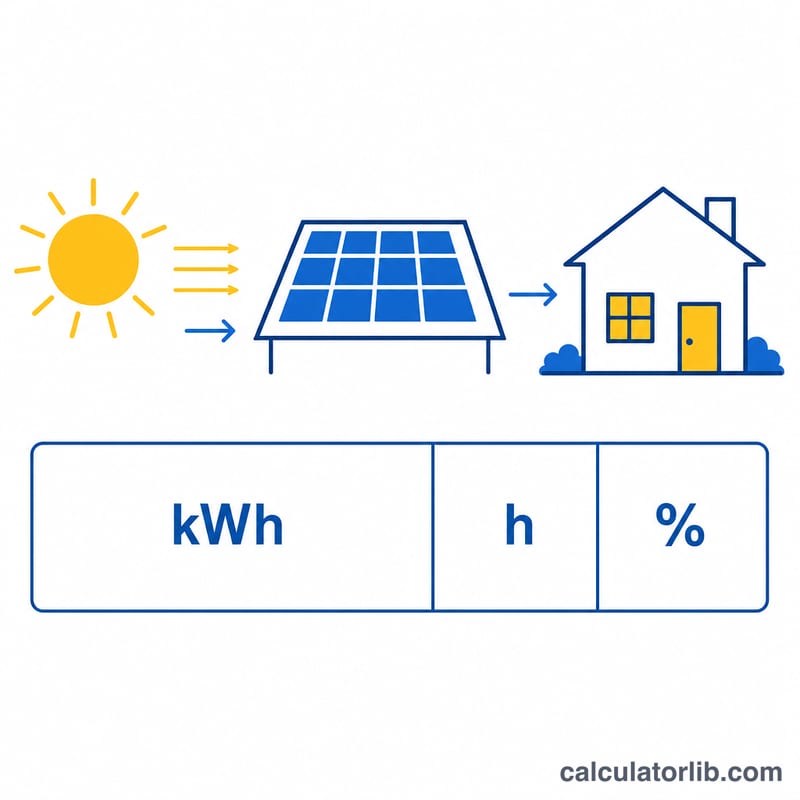
Worked example
Suppose you use 30 kWh per day, your location gets 5 peak sun hours, the performance ratio is 0.8, and you use 400 W panels. System size = \(30 \div (5 \times 0.8) = 30 \div 4 = 7.5\) kW. Panels = \(\lceil 7.5 \times 1000 \div 400 \rceil = \lceil 18.75 \rceil = 19\) panels, giving an installed capacity of \(19 \times 400 = 7{,}600\) W = 7.6 kW.
Typical Peak Sun Hours by Region
Peak sun hours are the equivalent number of hours per day at 1 kW/m² irradiance, which is numerically the same as daily insolation in kWh/m²/day. The values below are approximate annual averages for representative regions. Seasonal and site-specific values vary considerably: winter can be a third or less of summer, and tilt, orientation, local cloud and shading all matter.
| Region / climate | Approx. annual average peak sun hours (kWh/m²/day) |
|---|---|
| Northern Europe / UK | ~2.5–3 |
| Germany | ~3–3.5 |
| Southern Europe (Spain, Italy, Greece) | ~4.5–5.5 |
| US Pacific Northwest | ~3–3.5 |
| US Northeast | ~4–4.5 |
| US Southeast / Florida | ~4.5–5.5 |
| US Southwest (e.g. Arizona) | ~6–7 |
| Australia (varies by city; sunniest in the interior and north) | ~4.5–6.5 |
| India (varies by state) | ~4.5–6 |
| Middle East | ~5.5–7 |
For exact figures for your address, use a dedicated tool such as NREL PVWatts (US-focused, with worldwide data) or the Global Solar Atlas (worldwide). Enter the resulting value into the calculator's Sun Hours field.
System Size Under Different Scenarios
Each row uses \(\text{Size}_{kW} = \dfrac{\text{Daily kWh}}{\text{Sun Hours} \times PR}\) and \(N = \lceil 1000 \cdot \text{Size}_{kW} / 400 \rceil\), assuming 400 W panels.
| Daily use (kWh) | Sun hours | PR | System size (kW) | Panels (400 W) |
|---|---|---|---|---|
| 10 | 4 | 0.80 | 3.125 (10 ÷ 3.2) | 8 (7.81 rounded up) |
| 20 | 4.5 | 0.80 | 5.56 (20 ÷ 3.6) | 14 (13.89 rounded up) |
| 30 | 3 | 0.75 | 13.33 (30 ÷ 2.25) | 34 (33.33 rounded up) |
| 30 | 6 | 0.85 | 5.88 (30 ÷ 5.1) | 15 (14.71 rounded up) |
The same 30 kWh/day load needs more than twice the system in a low-sun, lower-PR location (13.33 kW) as in a high-sun, high-PR one (5.88 kW). Panel counts are always rounded up so the system is not undersized for the target.
Typical Performance Ratio and Panel Wattage Ranges
Performance ratio (PR)
Performance ratio is the fraction of the theoretical output that is actually delivered to your load after losses. Real-world systems typically fall in the range 0.70–0.90, with 0.75–0.85 a common planning assumption. Typical loss sources (approximate):
| Loss source | Approx. loss |
|---|---|
| Inverter conversion | ~2–4% |
| Temperature (hot panels produce less) | ~5–10% |
| Wiring / DC and AC resistance | ~1–3% |
| Soiling (dust, dirt, pollen, snow) | ~2–5% |
| Shading and module mismatch | Highly site-dependent |
These losses compound multiplicatively, which is why they commonly add up to a PR around 0.75–0.85 rather than 1.0.
Panel wattage
Modern residential panels are typically rated at roughly 350–450 W each. Commercial and utility-scale modules can reach about 550 W or more. Higher-wattage panels reduce the panel count but are physically larger, so the total array size in kW is what matters most for energy production.
Household daily use (context only)
Daily electricity use varies widely by country, home size, heating and cooling type and occupancy. It can range from under 5 kWh/day in small, efficient homes to 30 kWh/day or more in large homes with electric heating, cooling or EV charging. Check your own utility bills for your actual figure. The result is a general estimate, not a design or installation specification.
FAQ
Where do I find peak sun hours? National solar maps or PV tools list average daily insolation (kWh/m²/day), which equals peak sun hours.
What performance ratio should I use? 0.80 is a good default for a modern, well-installed system; use lower for hot climates or shading.
Does this size a battery? No — it sizes generation only. Battery storage is sized separately from your nighttime load and desired backup time.