
What Is the Solar Power Calculator?
This calculator estimates the size of a solar photovoltaic (PV) system you need and how much energy it will generate. It is a universal tool — it works anywhere, as long as you know your local peak sun hours. Enter your daily electricity consumption, the average peak sun hours for your location, and a performance ratio that accounts for real-world losses (inverter, wiring, temperature, dust, shading).
How to Use It
Provide three numbers: \(U\) = daily energy usage in kWh, \(H\) = peak sun hours per day, and \(PR\) = performance ratio (typically \(0.75\)–\(0.85\)). The calculator returns the recommended array size in kW and the expected daily, monthly, and yearly energy production.
The Formula
The required system size is the daily demand divided by the productive sun hours and the performance ratio:
$$P_{kW} = \frac{U}{H \times PR}$$where \(P_{kW}\) = system size in kilowatts, \(U\) = daily usage (kWh), \(H\) = peak sun hours, and \(PR\) = performance ratio. Daily generation from that array is:
$$E_{day} = P_{kW} \times H \times PR$$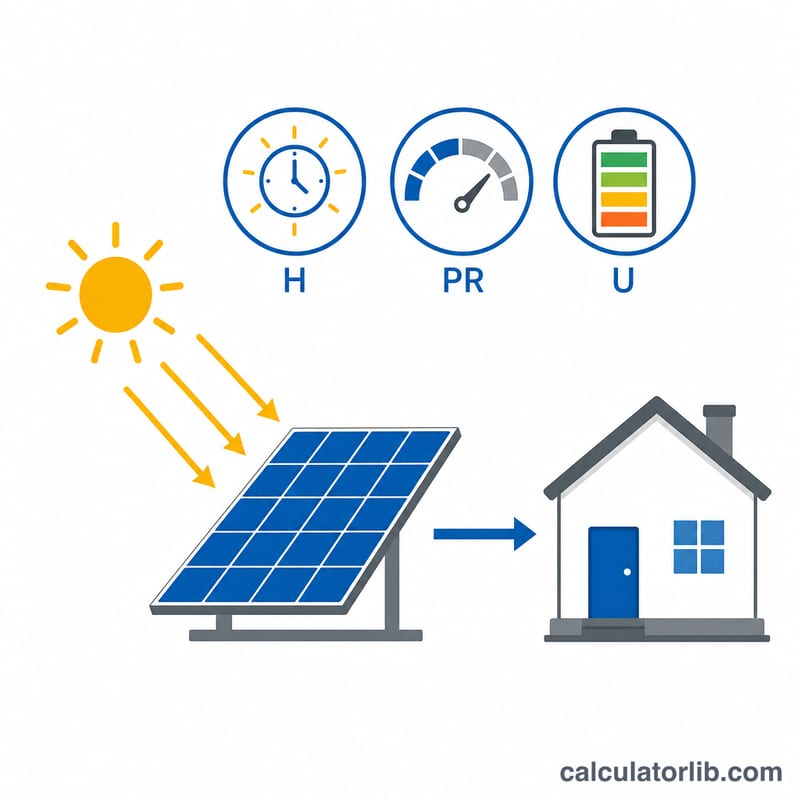
Worked Example
Suppose you use \(30\) kWh per day, your region averages \(5\) peak sun hours, and \(PR = 0.8\). The required system size is:
$$P_{kW} = \frac{30}{5 \times 0.8} = \frac{30}{4} = 7.5\,\text{kW}$$That system produces \(E_{day} = 7.5 \times 5 \times 0.8 = 30\) kWh per day, about \(913\) kWh per month and \(10{,}950\) kWh per year.
FAQ
What are peak sun hours? The number of hours per day when sunlight intensity averages \(1000\,\text{W/m}^2\). It is not the same as daylight hours and varies by location and season.
What performance ratio should I use? A well-designed rooftop system typically achieves \(0.75\)–\(0.85\). Use a lower value for hot climates or shaded roofs.
Does this size the battery? No — this estimates panel array size and generation. Battery sizing depends on your desired backup duration and depth of discharge.