
What is the Motor Power Calculator?
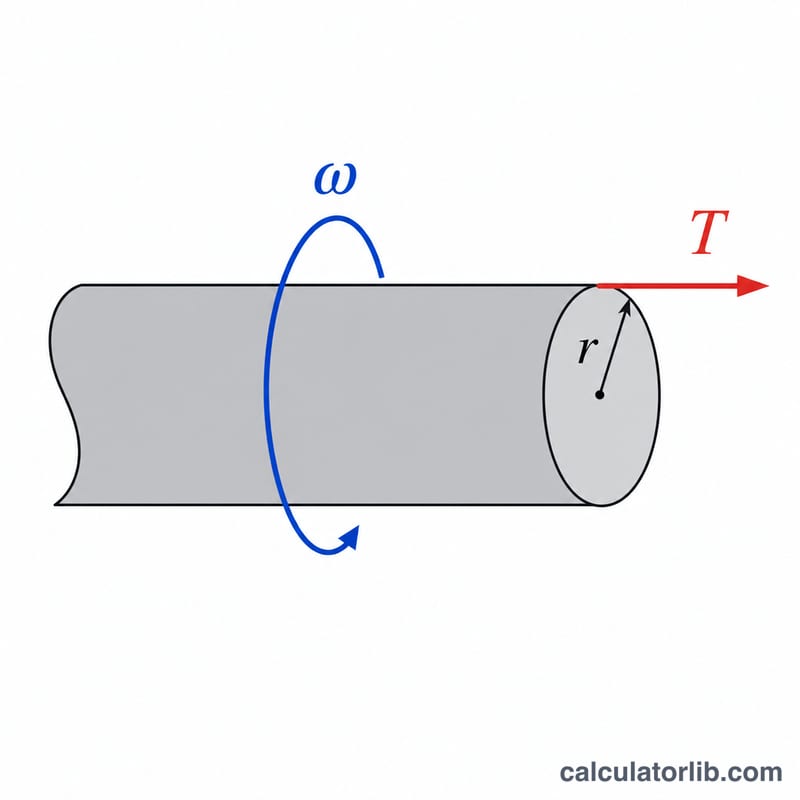
This calculator finds the mechanical (shaft) power produced by a rotating motor or engine from its torque and rotational speed. Power is the rate at which the motor does work, and it depends directly on how hard it twists the shaft (torque) and how fast that shaft spins (angular speed). The tool reports the result in watts, kilowatts and horsepower so you can compare against datasheet ratings in any unit.
How to use it
Enter the torque in newton-metres (N\(\cdot\)m) and the rotational speed in revolutions per minute (RPM). The calculator converts RPM to angular velocity, multiplies by torque, and displays the power output. This works for electric motors, gearmotors, turbines and engines alike.
The formula explained
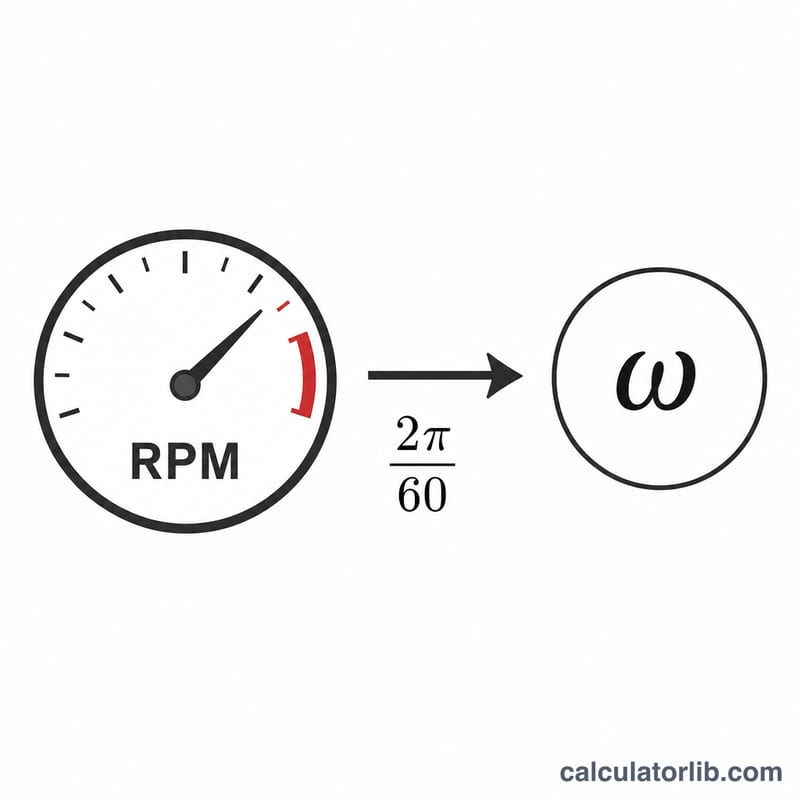
Mechanical power is $$P = T \times \omega$$ where T is torque in N\(\cdot\)m and \(\omega\) is angular speed in radians per second. Because speed is usually given in RPM, we convert it with $$\omega = \frac{2\pi \cdot \text{RPM}}{60}$$ (one revolution is \(2\pi\) radians and there are 60 seconds per minute). Combining these gives $$P = T \times \frac{2\pi \cdot \text{RPM}}{60}$$ with P in watts. To get kilowatts divide by 1,000; for horsepower divide watts by 745.7.
Worked example
A motor delivers 10 N\(\cdot\)m at 1,500 RPM. Angular speed $$\omega = \frac{2\pi \times 1500}{60} = 157.08 \text{ rad/s}$$ Power $$P = 10 \times 157.08 = 1{,}570.8 \text{ W} \approx 1.57 \text{ kW} \approx 2.11 \text{ hp}$$
FAQ
Does this give input or output power? It gives the mechanical output power at the shaft. To find the electrical input power, divide by the motor's efficiency.
What if I have speed in rad/s already? Then power is simply torque \(\times\) angular speed; you can back-calculate RPM as \(\omega \times 60 / 2\pi\).
Why 745.7 watts per horsepower? That is the definition of one mechanical (imperial) horsepower, 550 ft\(\cdot\)lbf/s, expressed in SI units.