
What this calculator does
The Energy Cost Per Hour Calculator tells you exactly how much it costs to run an electrical appliance for one hour, then scales that figure to a day, a month, and a year. All you need is the device's power rating in watts and the price you pay for electricity per kilowatt-hour (kWh). It works with any currency or country — just enter the rate your utility charges.
How to use it
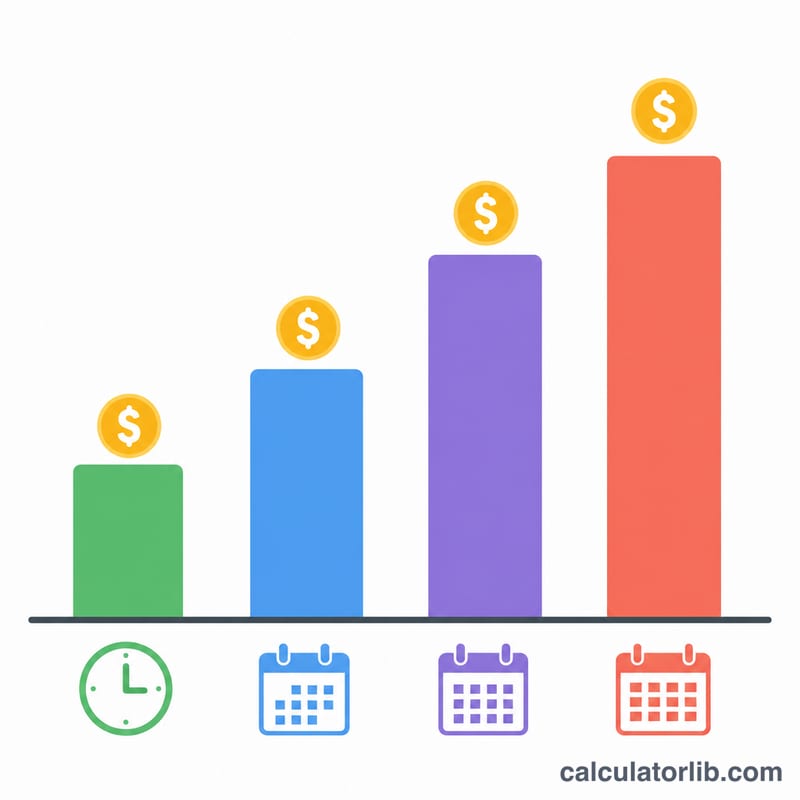
Enter three values: the appliance power in watts (check the label, nameplate, or a plug-in power meter), your electricity rate in $/kWh (found on your utility bill), and the hours per day you expect the device to run. The calculator instantly returns the cost per hour plus projected daily, monthly (30-day) and yearly (365-day) costs.
The formula explained
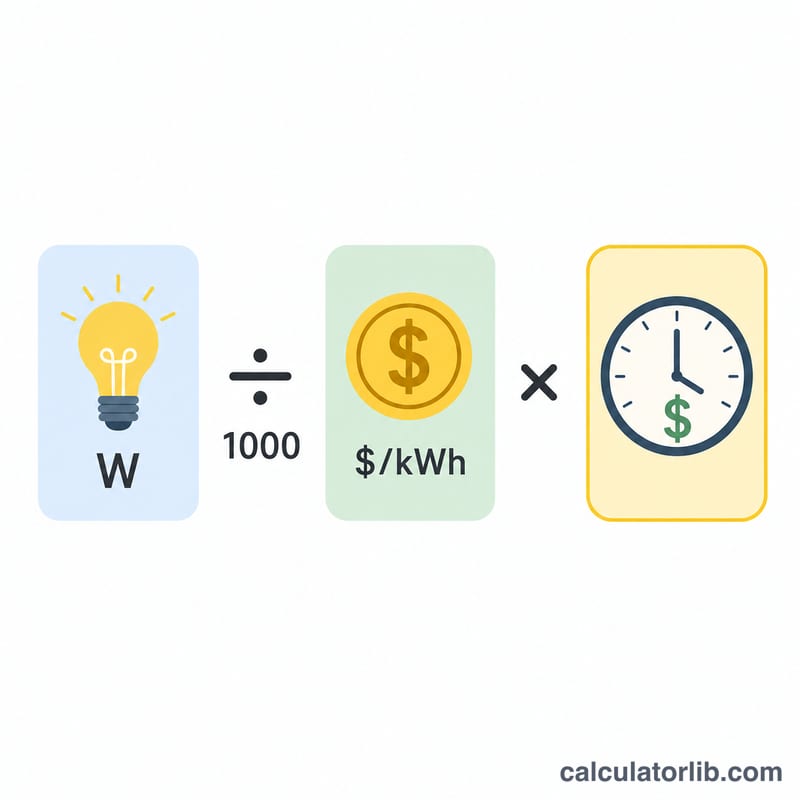
Electricity is billed per kilowatt-hour. A watt is one-thousandth of a kilowatt, so first divide the wattage by 1,000 to get kilowatts. A device running at that power for one hour consumes that many kWh. Multiply by your rate to get the cost: $$\text{Cost/hr} = \frac{\text{Watts}}{1000} \times \text{rate}$$ Daily cost is hourly cost times hours used; monthly and yearly costs simply scale the daily figure by 30 and 365.
Worked example
Suppose a 1,500 W space heater runs at a rate of $0.20/kWh for 5 hours a day. Power in kilowatts is \(1500 \div 1000 = 1.5\) kW. Cost per hour = \(1.5 \times 0.20 = \$0.30\). Cost per day = \(0.30 \times 5 = \$1.50\). Over a 30-day month that's $45, and over a full year (365 days) about $547.50.
FAQ
Where do I find an appliance's wattage? Check the rating label on the back or bottom of the device, the power supply, or the user manual. A cheap plug-in energy monitor measures actual draw.
What if my device shows amps, not watts? Multiply amps by your voltage (e.g. 120 V or 230 V) to estimate watts before entering the value.
Why is my real bill different? Real usage varies — appliances cycle on and off, rates can include tiers, taxes and standing charges. This gives a clean estimate based on continuous operation at the rated power.