
What Is the Watt-Hours Calculator?
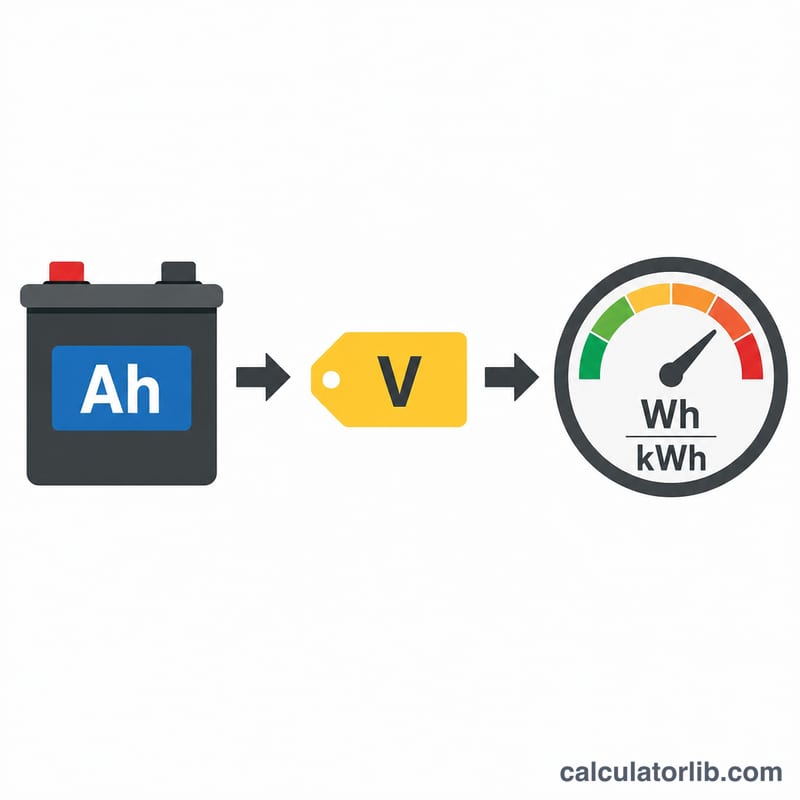
This calculator converts a battery's capacity rating in amp-hours (Ah) and its nominal voltage (V) into stored energy expressed in watt-hours (Wh) and kilowatt-hours (kWh). Battery capacity is often advertised in amp-hours, but to compare batteries of different voltages or to estimate how long a device will run, you need to know the actual energy content — and that is measured in watt-hours.
How to Use It
Enter the battery capacity in amp-hours and the nominal voltage of the pack. Press calculate to see the energy in watt-hours, plus the equivalent in kilowatt-hours. For example, a 100 Ah deep-cycle battery at 12 V stores 1,200 Wh (1.2 kWh) of energy.
The Formula Explained
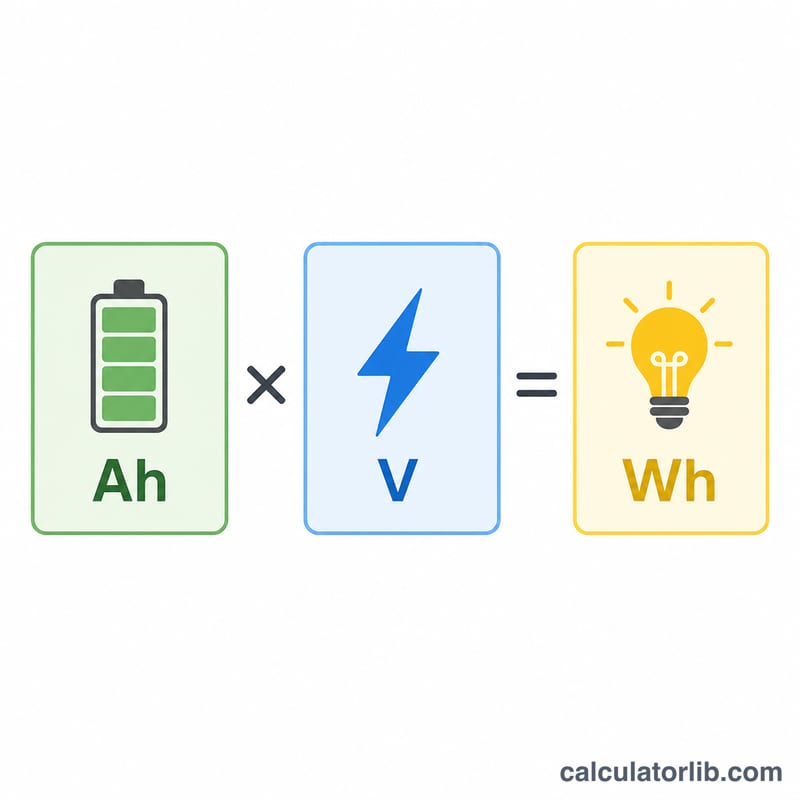
The relationship is simple: $$\text{Wh} = \text{Ah} \times \text{V}$$ Amp-hours measure electric charge over time (current × hours), and multiplying charge by voltage gives energy. To convert to kilowatt-hours, divide the result by 1,000. Always use the battery's nominal voltage (e.g. 12 V for a lead-acid bank, 3.7 V for a single Li-ion cell) for an accurate figure.
Worked Example
Suppose you have a 200 Ah battery bank wired at 24 V. The energy is $$200 \times 24 = 4{,}800 \text{ Wh}$$ which equals 4.8 kWh. This tells you the bank could theoretically power a 480 W load for 10 hours (ignoring inverter losses and depth-of-discharge limits).
FAQ
What is the difference between Ah and Wh? Amp-hours measure charge and depend on voltage; watt-hours measure true energy, so they let you compare batteries of different voltages fairly.
Which voltage should I enter? Use the nominal pack voltage, not the maximum charge voltage. A 12 V battery's nominal voltage is 12 V even though it may charge to 14.4 V.
Does this account for usable capacity? No — it gives total rated energy. Real usable energy is lower due to depth-of-discharge limits and inverter efficiency.